

Retirement Planning Calculator  |  Features

Accounts & Assets

Every account, home and loan, together in one living plan

Your plan is only as good as what it knows about your money. In Ready Aim Retire you enter each 401(k), IRA, brokerage and savings account by name, along with your home, your loans, your pensions and the rest of what you own. Each one then grows, pays out and is taxed by its own rules, year by year, so you can see your net worth today and answer the question almost every planner asks: "Will my money last?"

There is no bank linking. You type in your balances, and you choose where your plans are kept: on our servers, encrypted, or only in your own browser.
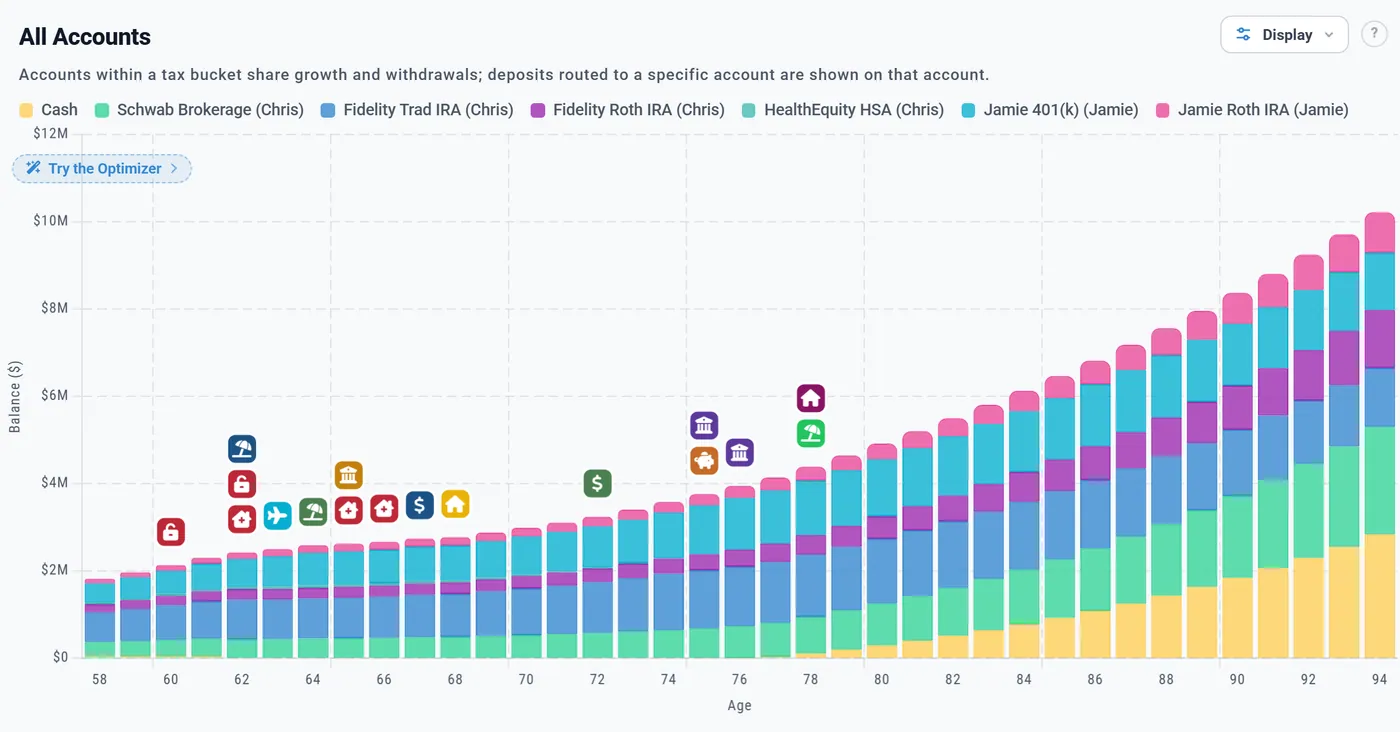
The All Accounts chart: one stacked band per account by name (Schwab Brokerage, Fidelity Trad IRA, Fidelity Roth IRA, HealthEquity HSA, Jamie 401(k) and Jamie Roth IRA) plus cash, growing from about $1.8 million at age 58 to about $10 million at 94

The All Accounts chart for Chris and Jamie, a made-up couple we use in our examples: every account, by name, from today to the end of the plan.

Start Planning

Every Account, By Name

Each account, by its own rules

Add each account you have, pick its type and enter today's balance. The type decides how withdrawals are taxed, when required minimum distributions start, and whether an early withdrawal is penalized.

Each account can also have its own settings:

  • Its own growth: your plan's mix, a custom stock and bond mix, a fixed rate or no growth
  • Cost basis on a taxable account, so gains are taxed on what you really paid
  • Availability: lock it until an age, or never draw from it at all
  • Past Roth contributions, which can come out before 59½ without the penalty
  • Rule of 55, for a 401(k) or 403(b) you leave at 55 or later
  • Its place in line: choose which account in each tax bucket pays first

Then watch each one grow and drain on the All Accounts chart. Planning in Canada or the UK? The account types follow your country: RRSP, RRIF, TFSA and FHSA, or SIPP, ISA and GIA.
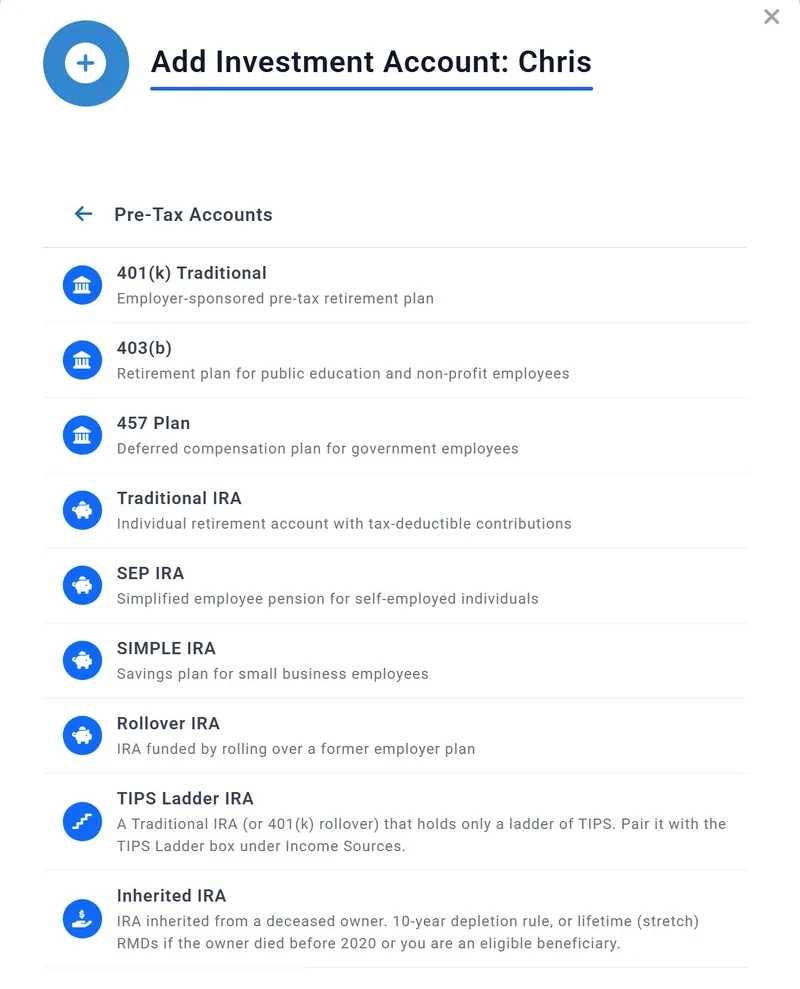
Add Investment Account: the Pre-Tax Accounts list with 401(k) Traditional, 403(b), 457 Plan, Traditional IRA, SEP IRA, SIMPLE IRA, Rollover IRA, TIPS Ladder IRA and Inherited IRA, each with a line describing it

Pick the kind of account, then the type.
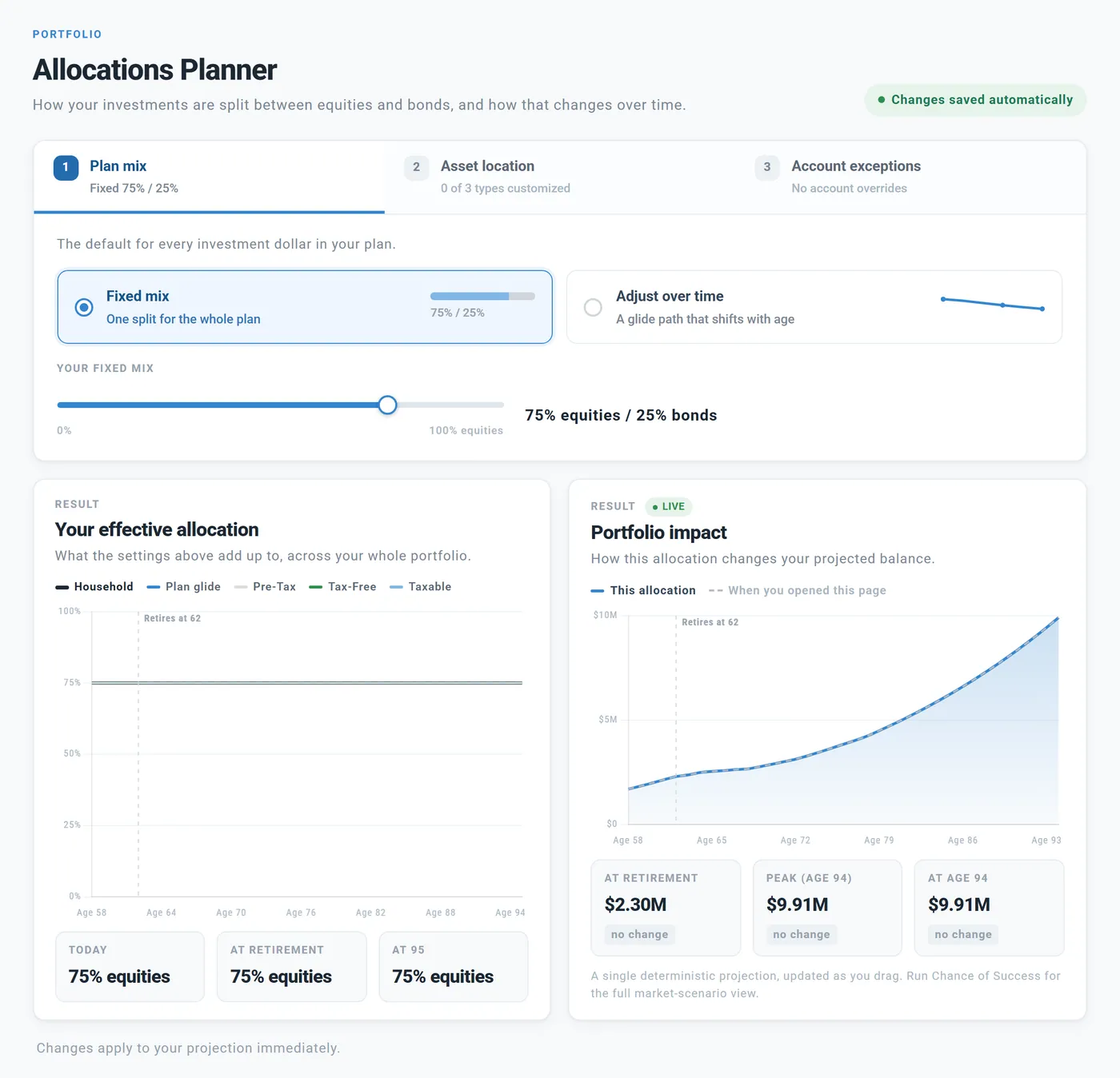
The Allocations Planner: three steps, Plan mix, Asset location and Account exceptions; a fixed mix of 75% stocks and 25% bonds; and two result cards, your effective allocation by age and the portfolio impact against where the plan stood when the page was opened

The Allocations Planner on Chris and Jamie's plan.

Your Investment Mix

One mix, a glide path, or one per account type

The Allocations Planner puts your whole investment mix on one page, in three steps:

  • Plan mix: one split of stocks and bonds, or a glide path that shifts as you age
  • Asset location: a different mix for your pre-tax, Roth and taxable accounts, such as bonds in your IRA and stocks in your Roth
  • Account exceptions: a stable value fund or a single stock that grows its own way

A Portfolio impact card shows what each change does to your projection as you make it. The plan never quietly rebalances one account against another: accounts set differently simply grow apart. Your mix, glide path and asset location count in your Chance of Success too, along with the fees your funds and any adviser charge.

Real Estate

Your home, your rentals, and their loans

Add your home with its value, its growth and its property tax. It counts in your net worth, and it never pays for retirement unless you plan to sell it or borrow against it.

  • A mortgage you are part-way through: type the payoff month from your statement and the years left fill in
  • Rentals that pay their own way: rent, less property tax, insurance, upkeep and the mortgage, counted as income
  • A planned sale, with selling costs, your cost basis and, in the US, up to $250,000 of gain excluded on your main home ($500,000 for a couple)
  • A refinance, with a new rate and term, cash out and closing costs
  • A HELOC, drawn as a lump sum or month by month
  • A reverse mortgage from 62, as a lump sum or monthly payouts
  • A home you plan to buy later, paid for from cash

For a home you live in, the mortgage payment and property tax come out of your spending, where you put them. Link a budget, and saving a financed home offers to add the payment as a row that follows the loan and stops when it is paid off.
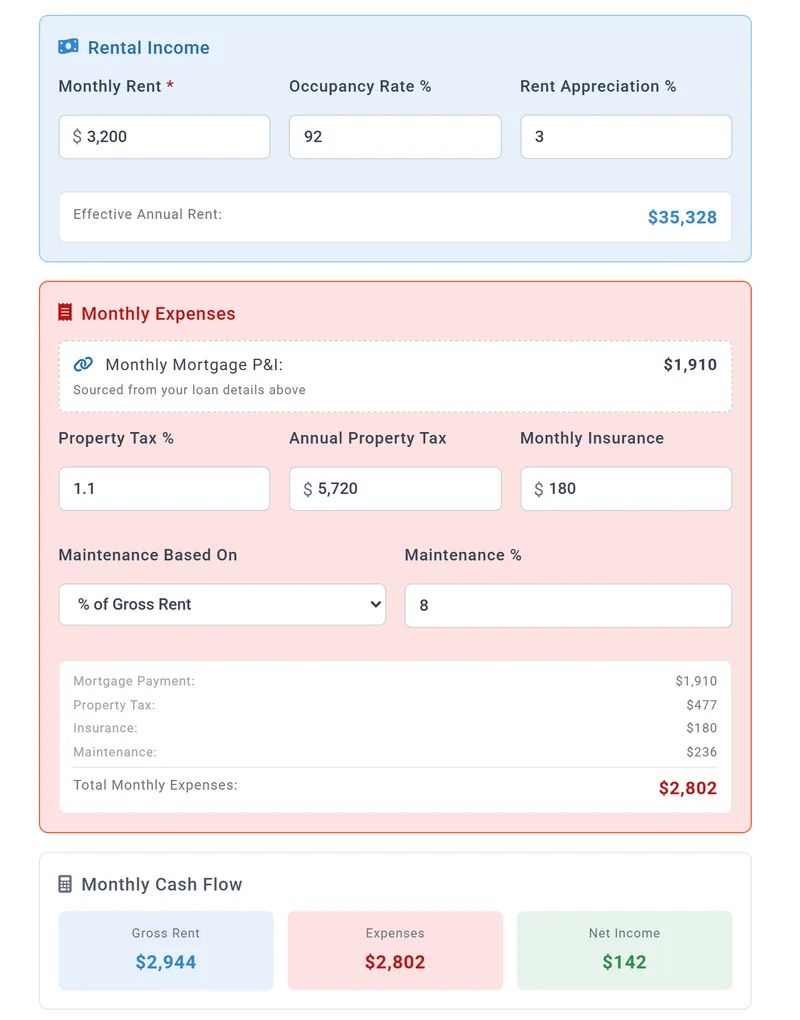
A rental's figures: $3,200 monthly rent at 92% occupancy; monthly expenses of $1,910 mortgage, $477 property tax, $180 insurance and $236 maintenance; and a monthly cash flow of $2,944 gross rent, $2,802 expenses and $142 net income

Chris and Jamie's rental: rent less every cost, $142 a month.
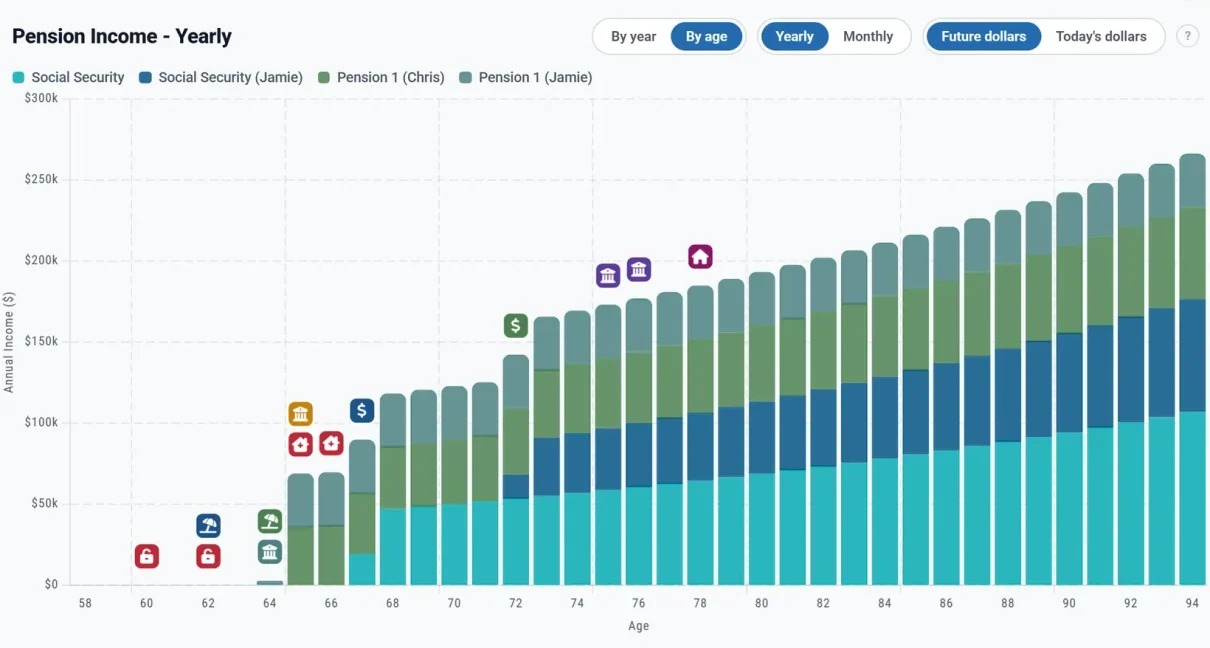
Pension Income, yearly by age: Pension 1 (Jamie) from 64, Pension 1 (Chris) from 65, then Social Security for Chris and for Jamie, rising to about $265,000 a year at 94

Chris and Jamie's pensions and Social Security, year by year, on the Pensions chart.

Pensions & Annuities

Income you can count on, set up your way

A couple in the US can enter four pensions and two annuities, each with its own start, length and raise.

  • A pension that starts at an age, when you retire, when your spouse retires, or at a milestone
  • Paid for life, until an age (such as a bridge to 62 or 65), or for a set number of years
  • A raise each year, as a percent or as a set number of dollars
  • A survivor share for your spouse, and your state's tax rules for a government pension
  • Annuities you already receive, plan to buy, or own and are still growing, including one held in an IRA

Buy an annuity in your plan and the premium comes out of the accounts you choose, at the age you choose. If the money is short, the plan buys a smaller annuity and tells you, rather than spending money you don't have.

Inherited IRAs, by the rules that apply

Add an IRA or Roth IRA you inherited, with the original owner's details. The planner works out which rule applies and takes the withdrawals it requires, every year.

  • The 10-year rule, with or without yearly minimums
  • Withdrawals over your life expectancy, for a spouse or another eligible beneficiary
  • A spouse can treat it as their own
  • Spread the withdrawals evenly, or take only the minimums until the deadline

There is no 10% early-withdrawal penalty at any age, and the account's row shows its deadline.

A TIPS ladder for income you know in advance

Already hold a ladder of Treasury Inflation-Protected Securities in an IRA? Give it its own TIPS Ladder IRA, and the plan pays it out year by year, raised with inflation. (US plans)

  • The same income each year between two ages, or a different amount for each year
  • Import your ladder's Funded years file from tipsladder.com, or a simple spreadsheet
  • The file is read in your browser and never uploaded
  • Its payments count toward your required minimum distributions, and what is left stays yours
  • A TIPS Ladder chart shows each year's payment and the ladder's value

Cash, debts, other assets and life insurance

  • Checking, savings, CDs and money market accounts, with a minimum balance your plan keeps as an emergency reserve
  • Car loans, student loans and credit cards, paid down on schedule, with the payments in your spending or budget
  • A car, a boat, a business or collectibles, each with its own yearly change in value

Life insurance is a real policy: who is insured, the death benefit, when coverage ends and the premium. The plan pays the premium, and if the insured person's Plan End age comes before the end of the plan, the death benefit is paid to the household, tax-free.

Your net worth, today and over time

The Net Worth Summary adds up everything you own, less everything you owe.

  • Investments, cash, real estate and other assets, less your loans
  • A progress point recorded each day you change your accounts, charted on the Progress tab
  • Points for past dates, to see how far you have come
  • Accounts shared by every plan, so a balance you change once changes everywhere

How net worth tracking works

No bank linking, by design

We'll never ask you to link your bank or brokerage accounts. You enter the balances you're comfortable with, and the planner does the rest.

  • Your plans are kept on our servers, encrypted, unless you choose otherwise
  • Privacy Mode keeps your plans, budgets and accounts only in your own browser
  • While it is on, our servers refuse to store plan data
  • Download a backup whenever you like
  • Privacy Mode works on a Preview account and on Planner+

Start with what you have today

Your accounts and assets are the foundation of your financial life.

Ready Aim Retire helps you build a complete picture, so you can ask the important questions with confidence:

  • How much can I safely spend each year?
  • What happens if markets underperform?
  • What happens when my mortgage is paid off?
  • What if we sell the house and downsize?
  • Will my money last as long as I do?

Preview Free to get started

  • Change the example accounts' balances, and delete the ones you don't have
  • Add and edit your home and rentals
  • Your plan's stock and bond mix, including a glide path
  • The pension and annuity boxes: when they start, how long they pay and how they rise
  • Privacy Mode, to keep your plans in your own browser

Planner+ Planner+ adds

  • Adding your own accounts: 401(k)s, IRAs, brokerage, cash, debts and other assets
  • Each account's own settings, such as its growth, and asset location by account type
  • Inherited IRAs, TIPS ladders and life insurance policies
  • Your own pension and annuity amounts
  • The All Accounts chart, and the order accounts are drawn in
Want every detail? Read the full guide, Your accounts, home and loans, in our help center. Read the guide

What we mean by "assets"

In Ready Aim Retire, assets are everything you own that belongs in your plan: retirement and investment accounts, cash, your home and rentals, other property, and the cash value of a permanent life insurance policy. Your investments, HSA, inherited accounts and cash can pay for retirement; homes and other assets count in your net worth unless you plan to sell them or borrow against your home. Ready Aim Retire is an educational tool, not tax, legal or investment advice.
Explore & Learn

Take aim at your retirement
with Ready Aim Retire

Sign up today and start building the financial plan you deserve. It's free to get started!

Get Started