
RETIREMENT PLANNING CALCULATOR  |  FEATURES

Retirement Budget Planner

Turn your lifestyle into a spending plan that lasts

Retirement success isn't just about how much you've saved. It's about how you live. The Ready Aim Retire Budget tab lets you list your retirement spending line by line, with costs that start and stop at the ages they really do. Link it to your plan, and every row sets your spending, year by year.

The real question is not "How much do I have?" but "How much can I safely spend?"
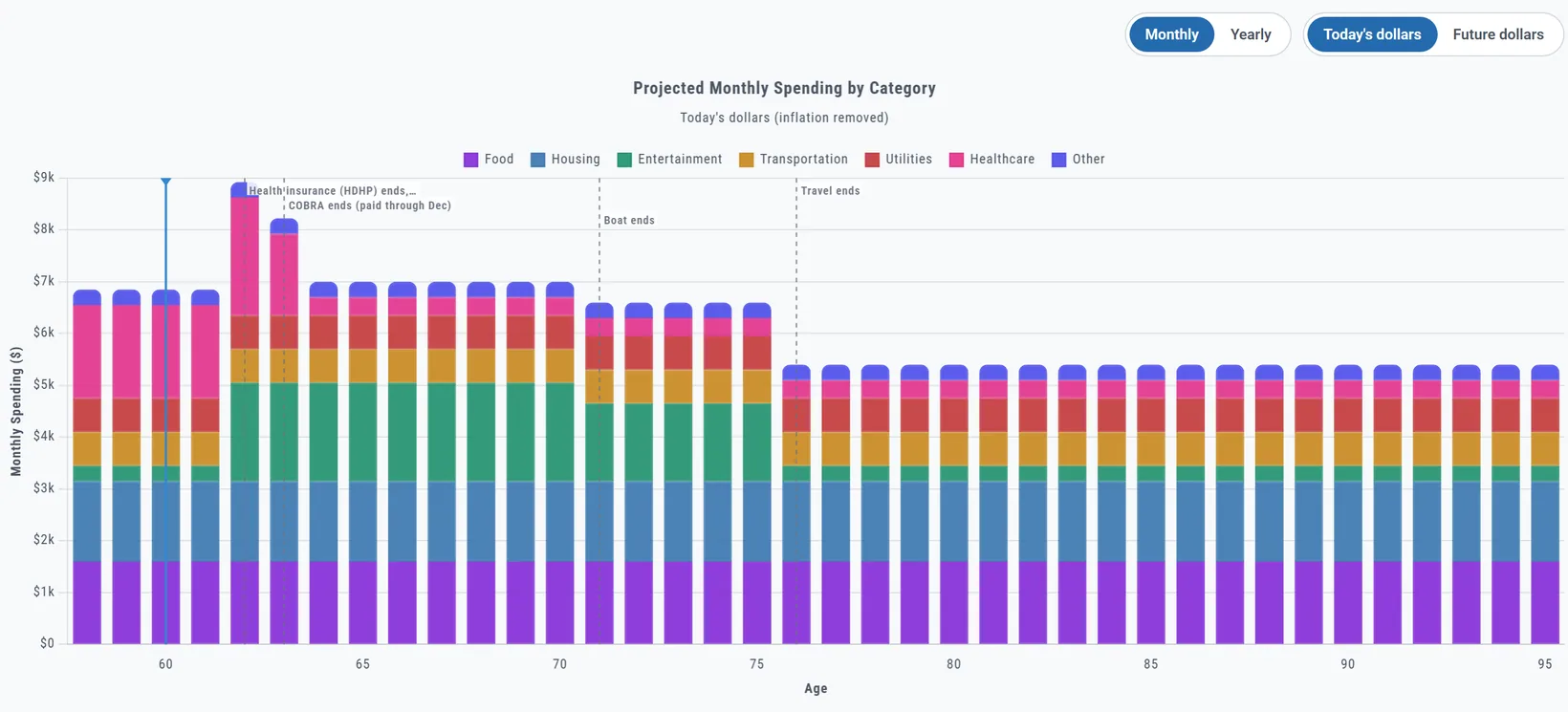
Projected Monthly Spending by Category in today's dollars: stacked bars for food, housing, entertainment, transportation, utilities, healthcare and other at each age from 58 to 95, with markers where health insurance and COBRA end, where the boat ends at 71 and where travel ends at 76

The budget of Chris and Jamie, a made-up couple we use in our examples, by category at every age, in today's dollars.

Build Your Budget

The Budget Tab

Build your budget line by line

Start from scratch, or from one of six sample budgets: a simple budget, and five lifestyles from Essential Minimalist to Affluent Experience Seeker.

Quick Actions add rows fast:

  • Subscriptions, from streaming to apps
  • Large costs that come back every few years, like a new roof, spread into a monthly amount
  • Common expenses, including care late in life
  • Categories of your own, each with its own icon

Every row is a Need, a Want or a Splurge. The snapshot at the top shows the split, and how much of your spending is flexible if your plan needs room. Changes save as you go, and you can keep more than one budget, such as one for after you downsize.

Sample Budgets: Simple budget, Essential Minimalist at about $45K a year, Lean & Active at about $60K, Comfortable Lifestyle at about $75K, Active Family / Upscale Professional at about $90K and Affluent Experience Seeker at about $150K, each with a picture and a short description

Six sample budgets to start from.

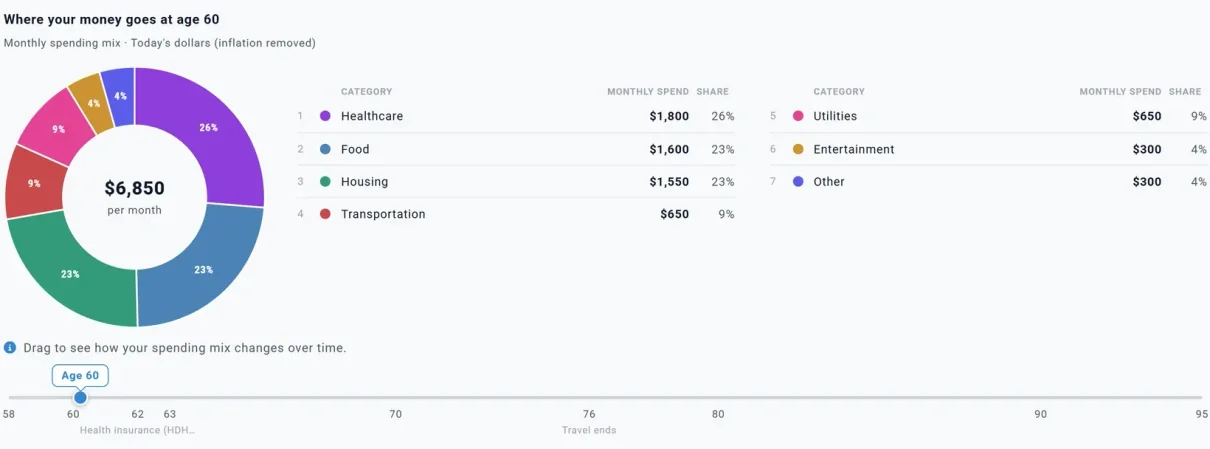
Where your money goes at age 60: a ring with $6,850 a month in the middle and a ranked list, healthcare $1,800 (26%), food $1,600, housing $1,550, transportation $650, utilities $650, entertainment $300 and other $300, above an age slider

Where Chris and Jamie's money goes at 60. Drag the slider to see any age.

Spending Over Time

Costs that start and stop when they really do

Spending rarely stays flat in retirement. Give each row its own start and end age, and your budget changes with you.

  • Start at retirement, stop the month before it, or pick an age and a month
  • Run for a set time, such as 18 months of COBRA
  • Start on a milestone you name, like downsizing at 70, or on your spouse's age
  • Its own inflation rate, or 0% for a payment that never rises

Graphs draws your budget by category for every age and marks the biggest changes. The Forecast lists what you'll spend each year, with a Changes column that names what starts and stops, like "Travel starts" or "Boat ends".

The Spending Smile

Spending that changes with age

Research by David Blanchett (Morningstar, 2013) found that many retirees spend less, after inflation, through the middle of retirement, then more again late in life as health and care costs grow. On a chart, the curve dips and rises: a smile.

Switch on the Spending Smile and shape your own:

  • Start from a preset, from a gentle 5% dip to 25%, or Early Travel
  • Drag any point, or type an exact value for an age
  • Save your curve as a preset for every plan
  • Explore it in the Learning Library's Spending Smile guide, worked out on your own plan

With the 15% preset, Chris and Jamie spend about $269,000 less over their retirement and have about $316,000 more at the end of their plan, in today's dollars. It only holds if you would really spend that way, so the guide suggests starting gentle. Using a linked budget instead? Its rows already set each year's spending, so the Smile steps aside.
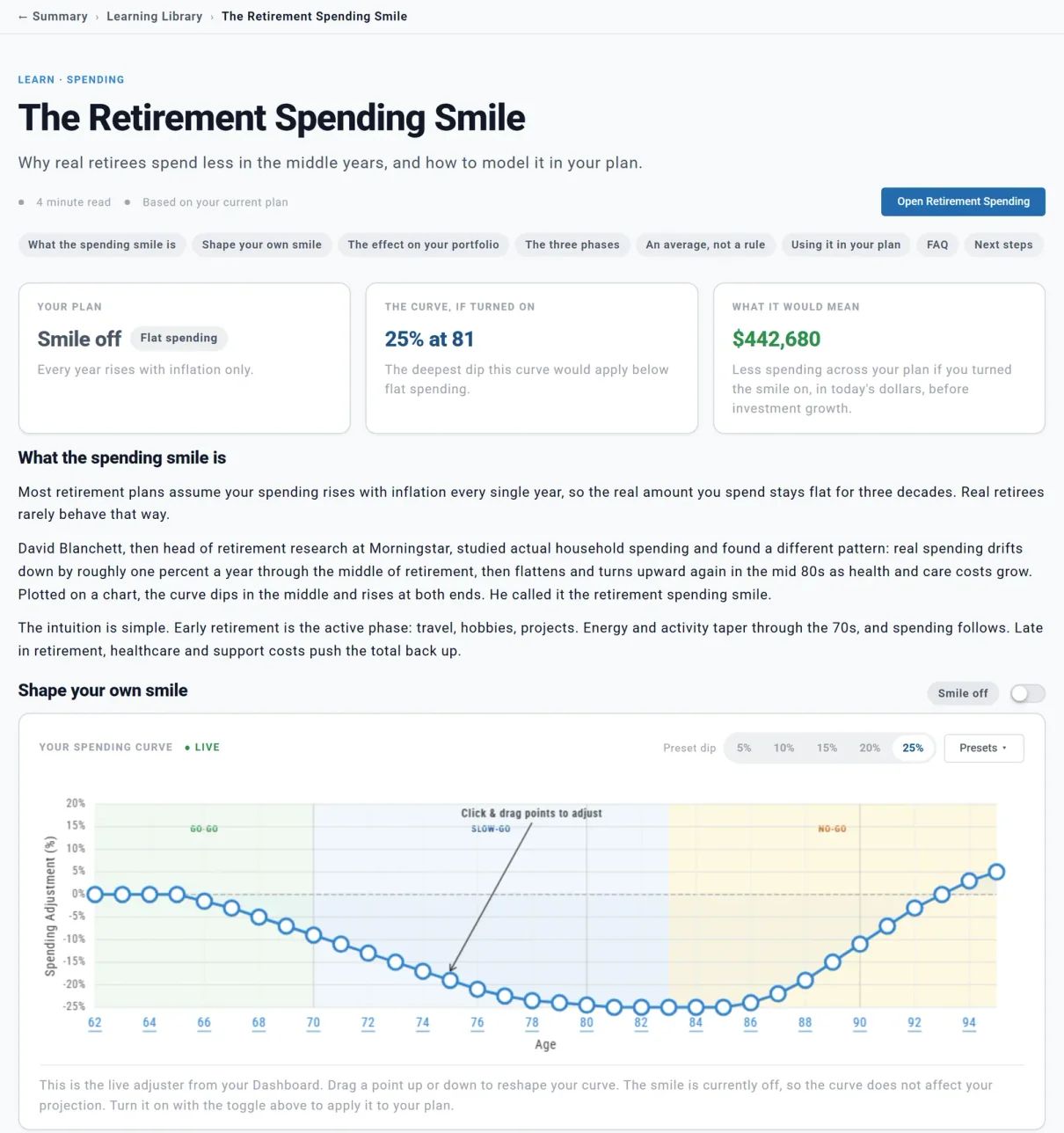
The Retirement Spending Smile guide in the Learning Library: three cards about the plan, the deepest dip of 25% at 81 and $442,680 less spending, then the live curve to drag, from 0% at 62 down to minus 25% in the early 80s and back above 0% by 92, over go-go, slow-go and no-go bands

The Spending Smile guide, worked out on Chris and Jamie's plan, with a curve you can drag.
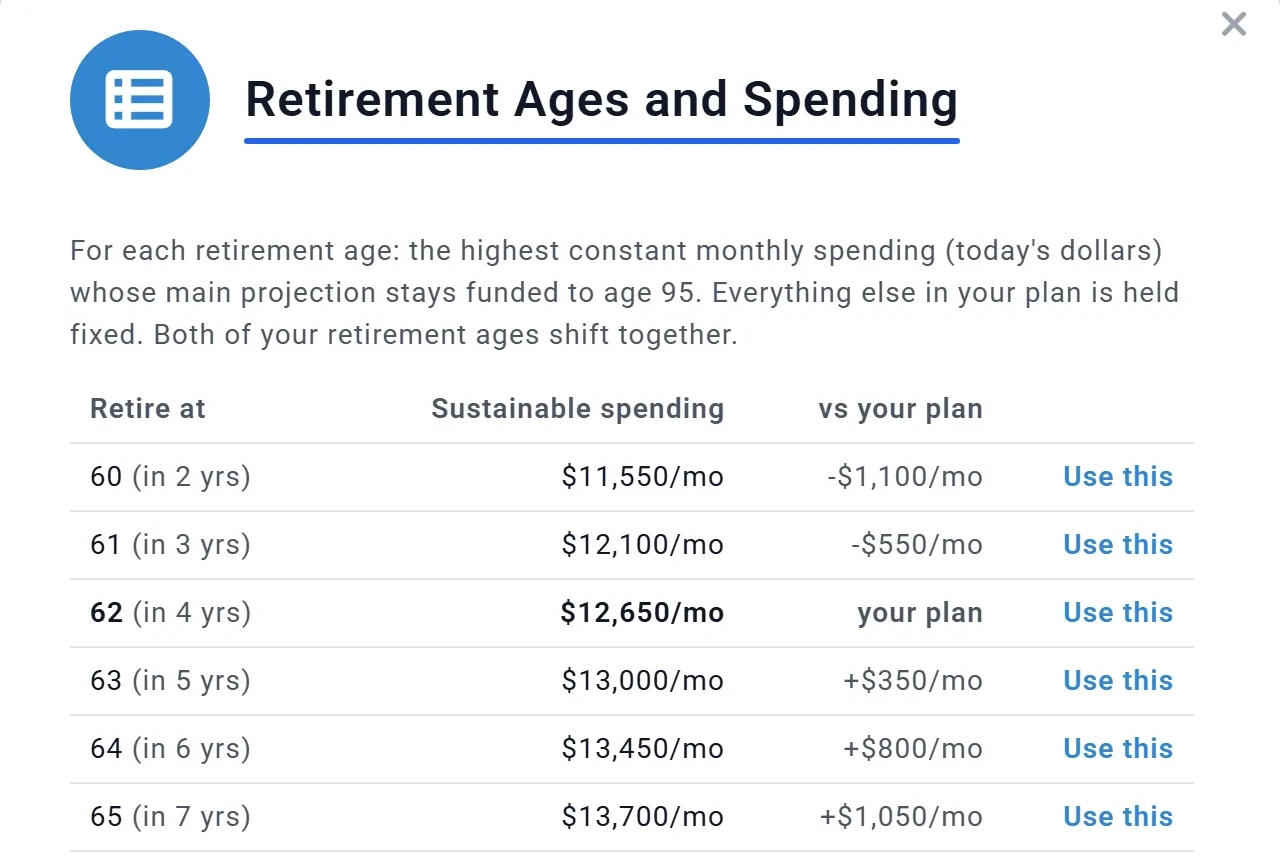
Retirement Ages and Spending: for retirement at 60 to 65, the highest constant monthly spending in today's dollars that keeps the main projection funded to age 95, from $11,550 a month at 60 to $13,700 at 65, compared with the plan's own age of 62, each row with a Use this link

Chris and Jamie's retirement ages, each with the most their plan could spend.

What Can We Spend?

The most your plan can spend, at each retirement age

Not sure what to aim for? Under your monthly spending, Compare retirement ages and spending amounts lists your retirement age and the ages around it, from two years sooner to three years later. Each row shows the most you could spend every month, in today's dollars, without your projection running out.

  • For a couple, both retirement ages move together
  • Use this sets the age and the spending in one click
  • Then check your Chance of Success: the amount keeps no cushion for bad markets

It works on a single monthly amount. Once a budget is linked, your rows set the spending instead.

Build a real retirement budget

Retirement spending is different from working-year spending. Some costs disappear. Others show up for the first time.

With Ready Aim Retire, you can plan for:

  • Everyday living expenses
  • Housing, with a mortgage payment that follows your loan
  • Healthcare and insurance
  • Travel, hobbies and lifestyle goals
  • Big costs that come back every few years
  • Care late in life
See how spending affects the big picture

Link your budget to your plan, and each change you make runs your plan again.

Once it's linked:

  • Each row sets your spending at the ages it covers
  • Switch off Wants or Splurge to see if your plan works on needs alone
  • The Spending chart shows what your plan spends each year
  • Your Chance of Success tests it against real market history
Name your one-off expenses

Some costs happen once, or every few years. The Extra Withdrawals box holds up to six, each with a name you choose.

  • A name like "Trip to Japan" on your charts and in Charts & Data
  • A single payment in the month you pick
  • Repeating costs: a new car every 7 years is one entry
  • Paid from your savings, or from one account you name
Plan for the big moments

Life doesn't always follow the script.

  • Budget rows that start on a milestone, and move when the milestone does
  • A milestone that adds an expense to your plan, such as care for your spouse from 85
  • A row that starts when a condition you set comes true
  • College costs for up to three students, paid from your 529 plans first
Healthcare, counted once

In US plans, the planner charges Medicare premiums for you from 65, and the Health Care box can price marketplace insurance before then. Your budget's Healthcare category holds the rest.

  • Out-of-pocket costs, dental and prescriptions
  • Mark a row HSA Eligible and your HSA can pay it, tax-free, from retirement
  • Long-term care, ready-made for the last years of your plan

How health care is planned

Spend with confidence

A clear retirement budget turns uncertainty into confidence.

You'll know:

  • What you can spend, and why
  • How long your money is projected to last
  • Where you have flexibility
  • When adjustments may be needed

Preview Free to get started

  • The Budget tab in full: build budgets and use every view and Quick Action
  • Your budgets, saved to your account
  • Sample budgets, Graphs and the age-by-age Forecast
  • The Spending Smile, with its presets and your own curve

Planner+ Planner+ adds

  • Linking a budget to your plan, so its rows set your spending
  • Budget rows that start when a condition milestone happens
  • Milestones that add an expense to your plan
  • The Budget and Spending charts on the Dashboard
Want every detail? Read the full guide, The Budget tab, in our help center. Read the guide

Why budgeting matters in retirement

In retirement, spending is the plan. By connecting your lifestyle choices directly to your financial projections, Ready Aim Retire helps you enjoy today while protecting tomorrow. Your real spending, prices and markets will differ from any projection, and Ready Aim Retire is an educational tool, not financial advice.
Explore & Learn

Take aim at your retirement
with Ready Aim Retire

Sign up today and start building the financial plan you deserve. It's free to get started!

Get Started