

We're 54 With $2.6 Million Saved. Can We Retire Now?

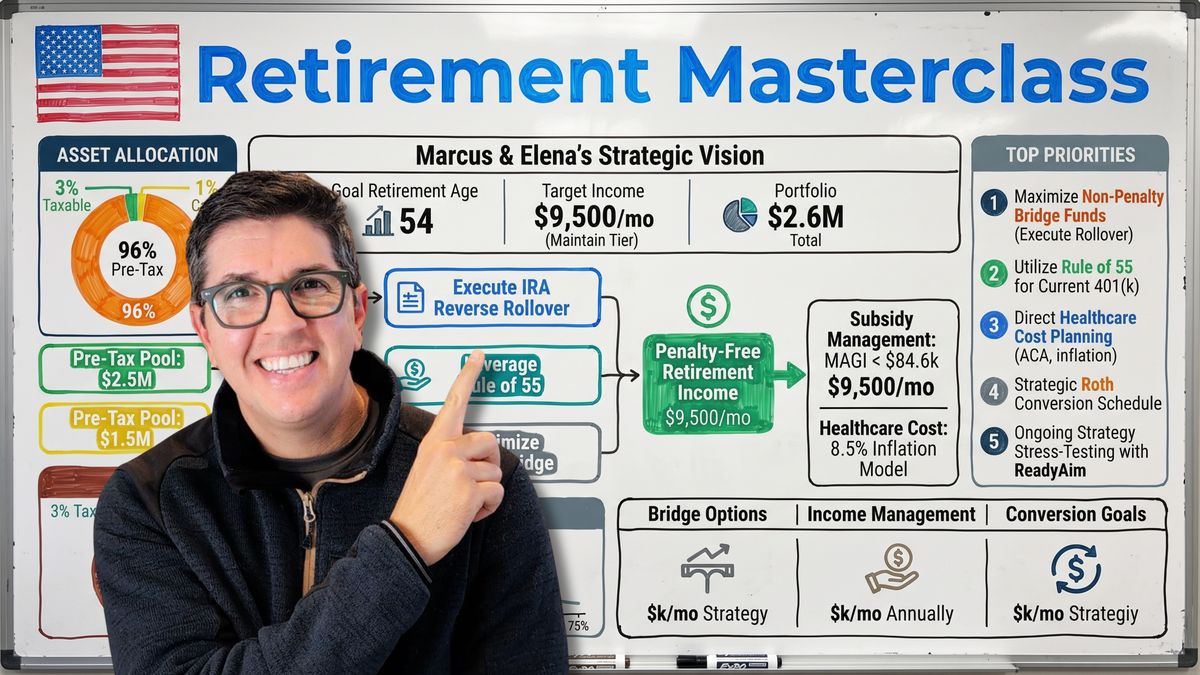
About 1.8% of American households have $2 million or more in retirement accounts. Marcus and Elena are in that club. At 54, with $2,600,000 spread across their accounts, they've out-saved roughly 98 out of every 100 households in this country.
And they still shouldn't hand in their notice this year.
Not because the number is too small. The number is great. It's where the money sits, what health insurance costs in 2026, and a calendar technicality that flips on their next birthday.
Here's the thing I wish somebody had told me a decade ago: early retirement in your 50s is almost never a portfolio-size problem. It's a bridge problem. You're trying to cross the gap between the day the paychecks stop and the days when 59½, 65, and Social Security finally show up to lend a hand. Build a bad bridge and a top-2% portfolio starts acting like a shaky one.
So let me walk you through what happened when we ran their plan through ReadyAimRetire, and why moving the exit date by 24 months changed almost everything.
- 96% of Marcus and Elena's $2.6 million sits in pre-tax accounts. Only $100,000 is penalty-free and liquid today.
- They're 54. The IRS Rule of 55 doesn't unlock until the calendar year they turn 55, so resigning now locks nearly everything up.
- The ACA subsidy cliff at $84,600 of household income sits below even their lean spending tier once funded from pre-tax withdrawals.
- A Monte Carlo run shows 56% success at their maintain tier retiring today. Waiting 24 months pushes that to 83%.
The fix isn't working to 65. It's two intentional years spent building a liquid, low-tax bridge.
Meet Marcus and Elena
Marcus put in 25 years in corporate operations. Elena is a senior project manager in tech. They did everything right. Lived below their means, automated the 401(k) contributions, never gave much thought to the shape of their savings. Only the size.
Then burnout showed up, the way it does. Elena ran every free retirement calculator on the internet and kept slamming into the same wall. That's not surprising, most retirement calculators are built to answer the wrong question. She kept feeling like something structural was missing.
What if a bad market lands in month three? What does private health insurance actually cost for a decade? And the one she said out loud last, quietly, the way people do when it's the real fear: if we're wrong, who hires a 60-year-old who's been out of the workforce for six years?
Then I looked at their account structure and the anxiety made perfect sense.
| Account | Balance | Tax status |
|---|---|---|
| Elena's 401(k) | $1,600,000 | Pre-tax |
| Marcus's traditional IRA | $650,000 | Pre-tax |
| Marcus's 401(k) | $250,000 | Pre-tax |
| Taxable brokerage | $75,000 | After-tax |
| Cash / high-yield savings | $25,000 | Liquid |
| Total | $2,600,000 | 96% pre-tax |
Ninety-six percent of their net worth is locked inside tax-deferred accounts. Their entire penalty-free, spend-it-tomorrow balance is $100,000.
That's not a rounding error in their plan. That is the plan's biggest problem.
Step 1: Ditch the Scoreboard, Build Spending Tiers
"$2.6 million" is a scoreboard. Nobody buys groceries with a scoreboard.
So we turned the portfolio into a monthly paycheck across three honest lifestyle tiers:
Lean
$7,500/month ($90,000/year)
Defensive mode. Housing, food, utilities, insurance, essentials. No padding whatsoever.
Maintain
$9,500/month ($114,000/year)
Their current life, no belt-tightening.
Luxury
$11,500/month ($138,000/year)
The full vision. International travel, hobbies, money for the kids.
Now the question stops being "is $2.6 million enough?" and becomes something you can actually answer: can this portfolio reliably deliver $7,500 to $11,500 every month for 35 to 40 years, after taxes and after healthcare?
Hang onto that lean number. It comes back later. And not in the way you'd expect.
Every retirement plan is different, which is exactly why a generic scoreboard number never satisfies anyone. ReadyAimRetire lets you test how these same spending tiers hold up against your own accounts, your own timeline, and your own risk tolerance.
Step 2: Price the Expenses Nobody Sees Coming
Early retirees almost never blow the budget on groceries. They get hit by the lumpy structural stuff that never shows up on a monthly statement.
Pre-Medicare healthcare is the monster, and 2026 made it bigger.
The enhanced premium tax credits expired on December 31, 2025, and Congress hasn't brought them back. The House passed a three-year clean extension on January 8, 2026 (that's HR 1834, 230 to 196, with 17 Republicans crossing over after a discharge petition forced the vote to the floor). Senate talks stalled about a week later. As I'm writing this, nothing has been enacted.
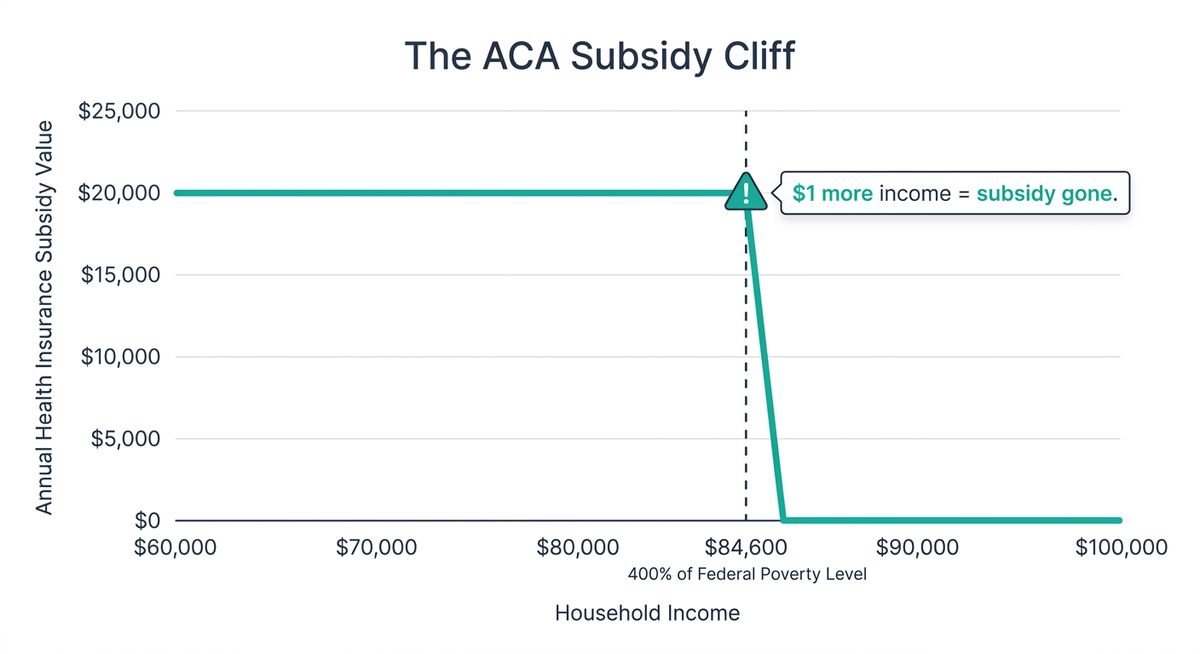
Which means the old subsidy cliff is back at 400% of the federal poverty level: $84,600 for a couple in 2026.
The Subsidy Cliff, Explained
At 400.00% of the federal poverty level you get a premium tax credit. At 400.01% you get zero. There's no gentle phase-out, no partial credit. One dollar of extra income can erase thousands in subsidy. Each plan year also uses the prior year's poverty guidelines, so the $84,600 threshold governs 2026 coverage while the 2027 threshold, built on 2026 guidelines, runs roughly $86,560.
Unsubsidized benchmark coverage for a couple in their mid-50s now runs somewhere around $1,800 to $2,000 a month nationally. That national range is real, but your county matters enormously. Go pull your own number from the KFF Marketplace Calculator before you build a plan on mine, because a reader in a high-cost rating area could easily land 30% above that range. For Marcus and Elena we budgeted $21,600 a year in premiums plus about $3,500 for deductibles and out-of-pocket. And that's before inflation does its thing.
Speaking of which. Most calculators badly underestimate healthcare inflation, modeling premiums at just 3% to 5% a year. PwC's medical cost trend for the individual market is 8.5% for 2026 and 8.5% again for 2027, after PwC revised its 2026 individual number upward from 7.5%. The group market number is 9% for 2027, the highest reading in 17 years.
Now run that compounding across an 11-year bridge from 54 to 65. At 8.5%, that $21,600 premium becomes about $29,900 by year five and roughly $48,800 by year eleven. Total 11-year premium outlay: about $369,000.
Model the same premium at a comfy 3% and you get about $277,000. That one assumption quietly hides a $92,000 error. And that's premiums only. Add out-of-pocket costs growing at the same clip and the bridge runs closer to $429,000.
Fidelity's famous $371,000 retiree healthcare estimate for a couple is a post-65, Medicare-era number. It doesn't include a single one of Marcus and Elena's 11 bridge years.
One more thing, because almost every article I read blurs this and it drives me a little crazy. Fidelity's famous $371,000 retiree healthcare estimate for a couple is a post-65, Medicare-era number. It doesn't include a single one of Marcus and Elena's 11 bridge years. Stack them and their lifetime healthcare bill gets close to $800,000, before we talk about long-term care at all.
Cars. At $25,000 net per vehicle every ten years, that's $50,000 a decade for the two of them. Fair warning though: $25,000 doesn't buy an average used car anymore. The average used transaction price hit $27,028 in July 2026. Average new car that same month: $49,855. If they want new cars, double the line.
Home maintenance. The old 1% rule on their $600,000 house gives you $6,000 a year. The average American homeowner actually spent $8,808 in 2025, up 42% from $6,200 in 2020. My neighbor Tom replaced a water heater and a section of roof in the same summer and laughed at the 1% rule for about a year straight. We modeled 1.5%, or $9,000.
Add it up. Healthcare at $25,100, cars at $5,000 a year amortized, home maintenance at $9,000. That's roughly $39,000 a year of non-negotiable cash flow before they buy a single plane ticket.
Step 3: The Liquidity Crunch
Early retirement before 59½ runs through three distinct phases:
- Phase 1, age 54 to 59½: the liquidity crunch
- Phase 2, age 59½ to 65: accounts unlock, healthcare gap keeps going
- Phase 3, age 65 and up: Medicare, Social Security, eventually RMDs
Phase 1 is where plans go to die.
The IRS Rule of 55
Lets you take penalty-free distributions from your current employer's 401(k), but only if you separate from service during or after the calendar year you turn 55. It does not apply to IRAs, and it does not apply to former employers' plans. Marcus and Elena are 54. Resign this year and that door stays locked.
So their $100,000 of reachable money funds about ten months at the maintain tier. Thirteen at lean. After that, getting to the other $2.5 million means either eating a 10% early withdrawal penalty stacked on top of ordinary income tax, or locking themselves into a 72(t) SEPP schedule that runs five years or until 59½, whichever is longer, with retroactive penalties plus interest on every prior distribution if they break it.
And if you're pricing a SEPP right now, don't assume the floor. The calculation uses the greater of 5% or 120% of the mid-term applicable federal rate for one of the two months before you start. Rates have been drifting up through 2026. The 5% floor was binding for most of the year, but by August 2026 the 120% mid-term ceiling hit 5.23%, which is above the floor. Price it against the current month's AFR.
Step 4: The Monte Carlo, and What It Actually Means
We ran a Monte Carlo simulation: one thousand randomized market trials, including historical drawdowns and inflationary stretches, retiring at 54:
Lean
84% success
$7,500/month
Maintain
56% success
$9,500/month
Luxury
39% success
$11,500/month
Before we get to the fix, there's a piece of tension here worth sitting with for a minute.
Bill Bengen, the guy who invented the 4% rule, raised his own safe withdrawal number to 4.7% in 2025. He's gone as far as saying early retirees may be "cheating themselves" by withdrawing too little. At 4.7%, $2.6 million supports about $122,200 a year, comfortably above the $114,000 maintain tier.
So why does our model spit out 56%?
Because 4.7% is calibrated to a 30-year retirement. Marcus and Elena need 35 to 40. That extra decade of horizon is most of the gap right there, and it's the single most common reason a couple reads a cheerful headline and then gets an uncomfortable simulation.
Now here's where a lot of articles overplay their hand, and I'm not going to do that to you.
A 56% success rate is not a 56% chance of eating cat food at 80. Michael Kitces makes a strong case that these numbers are better understood as a probability of adjustment: the odds you'll need to trim spending somewhere along the way. In his analysis of a hypothetical couple, targeting 95% success meant starting at $6,769 a month, while targeting 50% meant starting at $8,462. And median lifetime spending came out nearly identical. What actually differed was the size of the estate left behind. Vanguard separately finds that 78% of retirees make at least one spending adjustment in their first five years anyway.
So the honest argument for waiting isn't "56% is scary." It's this:
Marcus and Elena can't execute an adjustment.
The whole guardrails approach assumes you can dial spending down when markets fall. With 96% of their assets penalty-locked and a contractual $25,100 healthcare bill showing up whether or not the S&P feels cooperative, their floor is rigid. There's nothing to trim.
This is sequence of returns risk, and it's brutal in the fragile decade: Morningstar finds nearly 70% of failed retirement plans involved losses in the first five years. Wade Pfau calls the window from five years before retirement to five years after "the fragile decade," because that's when your balance is at its lifetime peak and a 20% loss costs you the most actual dollars you will ever lose.
Waiting doesn't just buy percentage points. It buys options.
The Part Nobody Is Writing About: The Rule of 55 Runs Straight Into the ACA Cliff
This is the section that changed how Marcus and Elena saw their entire plan, and honestly it's the reason I wanted to write this piece.
Every dollar pulled from a 401(k) under the Rule of 55 is ordinary income. And ordinary income counts toward ACA modified adjusted gross income.
So: fund the $114,000 maintain budget entirely from pre-tax accounts, and their MAGI lands about $29,400 over the $84,600 cliff. Poof. There goes a subsidy worth $15,000 to $22,600 a year, every year from 56 to 65. Call it $150,000 to $200,000 of avoidable cost, buried inside a plan that supposedly "solved" the liquidity problem.
Now go back and look at that lean tier again.
Even $7,500 a month is $90,000 a year. Funded entirely from pre-tax accounts, lean spending also busts the cliff, by $5,400. To stay under $84,600 on pre-tax withdrawals alone, they'd have to cap gross draws at roughly $7,050 a month, and then pay their income taxes out of that.
The ACA cliff doesn't just constrain their comfortable life. It sits below their austerity budget.
Read that twice. The ACA cliff doesn't just constrain their comfortable life. It sits below their austerity budget.
Which is exactly why the composition of a withdrawal matters more than the size of it. A dollar out of a traditional 401(k) is a dollar of MAGI. A dollar out of a taxable brokerage account is mostly return of your own basis, so only the realized gain counts. A dollar of qualified Roth money counts as nothing at all. Same spending, completely different subsidy outcome.
The Two Problems Are One Problem
The liquidity problem and the healthcare problem are the same problem wearing two different hats. Solve one with pre-tax withdrawals and you make the other one worse.
And check out the inversion this creates. The 0% long-term capital gains ceiling for a couple in 2026 is $98,900 of taxable income, roughly $131,100 gross once you add back the $32,200 standard deduction. The ACA cliff is $84,600. For pre-65 early retirees, the health insurance constraint now binds about $46,500 tighter than the tax constraint. So the standard advice you've read a hundred times, harvest gains up to the top of the 0% bracket, is for this couple in these years actively expensive.
Want to see how stark the cliff gets? A 60-year-old with $62,000 of income pays roughly $515 a month for benchmark silver coverage. Take one extra $2,000 IRA withdrawal, land at $64,000, and the premium jumps to about $1,244 a month. That $2,000 just cost roughly $8,750 in lost subsidy. An effective marginal rate north of 400%.
One partial escape hatch: COBRA. My man David left a job at 56 last year and assumed the exchange would be cheaper. It wasn't, not even close. Because COBRA premiums are set by your former employer's group plan and don't depend on your income at all, the cliff simply doesn't apply for the 18 months COBRA runs. Leave at 56 and COBRA covers you to 57½, which buys you a year and a half of freedom to pull pre-tax money without watching your MAGI like a hawk. Run both quotes before you assume the exchange wins, and it's also worth pricing a part-time bridge job with employer coverage against both options, since for some couples it beats them.
The practical takeaway here: their taxable brokerage isn't just a convenience account. It's the only low-MAGI fuel source they own. And it has $75,000 in it.
Two Moves Most Plans Miss Completely
1. Read the Summary Plan Description before you pick a date.
"Just wait until 55 and tap the 401(k)" quietly assumes your plan will let you take money out in pieces. Only 43% of plans permit terminated participants to take partial ad-hoc withdrawals, though 68% offer installments.
If Elena's plan is lump-sum-only, invoking the Rule of 55 would dump $1.6 million into a single tax year. Federal tax on that alone runs roughly $500,000.
Now, let's be precise here, because this is where a lot of write-ups cheat. She'd owe tax on that money eventually no matter what, so the real loss isn't the full $500,000. It's the excess created by bunching it all into one year. Spread the same $1.6 million across fifteen retirement years and the federal bill lands closer to $190,000. So the bunching itself costs somewhere around $300,000. Which is nearly double the roughly $160,000 penalty she was trying to dodge in the first place.
That's a painful own goal. And it's completely preventable with one phone call to HR two years early.
2. Look into a reverse rollover for Marcus's IRA.
His $650,000 traditional IRA is not Rule-of-55 eligible. IRAs never are, no exceptions. But if his employer's plan accepts roll-ins, he can move that IRA into his 401(k) before he separates, which brings it under the same penalty exception.
Count what that does to the protected pile. Elena's $1.6 million and Marcus's own $250,000 401(k) are already eligible once each of them separates in or after the year they turn 55, so the baseline is $1.85 million. Roll the IRA in and the Rule-of-55-eligible total reaches $2.5 million. That's every pre-tax dollar they own.
Caveats, and they're real ones: the plan has to accept roll-ins, only pre-tax money can move, and they're trading IRA investment flexibility for whatever's on the plan menu. Creditor protection shifts too, generally in the 401(k)'s favor at the federal level, though IRA protection varies quite a bit by state. Net of all that, it's a nearly costless move if you make it twelve months before you walk. It's impossible afterward.
Skip the Roth Conversion Ladder at 54
A conversion made this year seasons at 59, and at 59½ the five-year conversion clock stops mattering anyway. So the ladder buys them about six months of access. Worse, converting now means paying tax at their peak career marginal rate, which is the worst possible moment to volunteer. Their real Roth window opens between 56 and 65 in the low-income gap years, though even that one collides with the ACA cliff.
The Piece That Waits Until 67
Social Security is the one asset in this plan that gets stronger the longer they ignore it.
Both were born after 1960, so full retirement age is 67 for each of them. Stopping work at 56 does drop some zero-earning years into the 35-year average that sets the benefit. That's real, I'm not going to pretend otherwise. But with roughly 30 high-earning years already banked, the drag is usually smaller than people fear. It's a haircut, not an amputation.
The bigger decision comes later. Delaying from 67 to 70 raises the benefit by 8% a year, which is the cheapest inflation-adjusted longevity insurance available to any human being anywhere.
And it pairs beautifully with the bridge strategy. Those low-income years from 65 to 70, once Medicare takes the ACA cliff out of the equation entirely, are exactly when Roth conversions get cheap. Draw down the pre-tax accounts, convert aggressively in that window, then flip on a maximized Social Security check at 70.
What 24 Months Actually Buys You
We re-ran the model with the exit pushed to 56:
Age 54
56% success
Maintain tier, retiring today
Age 56
83% success
Maintain tier
Age 57
89% success
Maintain-to-luxury tier
Let me be clear about what's actually driving that, because it's easy to tell this story wrong. The Rule of 55 door opens in the calendar year they turn 55. That's next year. Not 2028. Access alone doesn't require 24 months.
The second year is doing different work.
Three things drive the jump. The portfolio compounds untouched through the most fragile stretch of the fragile decade. Two fewer years of private insurance saves more than $50,000, and more than that once you inflate it honestly. And they get 24 months to build the thing they don't currently have: a genuine liquid bridge.
That third one is the real story.
At 2026 limits, Marcus and Elena can each defer $24,500 plus an $8,000 catch-up. Redirecting two years of pre-tax deferrals is $98,000 of gross pay, which is roughly $68,600 once taxes take their cut.
The catch-up is a different animal. As high earners with prior-year wages above $150,000, their $8,000 catch-up must be Roth under SECURE 2.0. Those dollars are already taxed. So steering that $32,000 into a brokerage instead moves dollar for dollar, no haircut.
New liquid capital: about $100,600. Add the $100,000 they already have and they're sitting on roughly $200,000 entirely outside the pre-tax system. That's about 27 months of lean spending that generates almost no MAGI.
One qualifier, and please don't skip it: do not redirect past the employer match. A 50% or 100% match is an instant return no brokerage account is going to beat. The sensible version is defer to the match, redirect everything above it. Yes, that trims the bridge a bit. It's still the right trade.
And one caution, because the data insists on it.
In EBRI's 2026 Retirement Confidence Survey, 46% of retirees left the workforce earlier than they'd planned, up from 40% the year before. Most often because of layoffs, health problems, or caregiving demands.
Think about what that means. A "24-month sprint" is a plan with meaningful odds of getting overruled by somebody else. My friend Hannah in Denver had a tidy three-year runway mapped out and then her mother got sick in month eight. The runway became the plan, ready or not.
So the liquid bridge isn't a nice-to-have. It's the thing that makes an involuntary exit at 55 survivable instead of expensive. Treat 56 as the target, not the assumption.
The Intentional Exit
Marcus and Elena didn't need to work until 65. They needed 24 more months, used on purpose:
🎯 Their Five-Step Bridge Plan
- Break the pre-tax reflex above the match. Capture the full employer match, then send every surplus dollar to high-yield savings and the taxable brokerage. That buffer pulls double duty: it's their sequence-risk cushion and their low-MAGI fuel for the ACA years.
- Audit the plan documents. Pull both Summary Plan Descriptions. Confirm post-separation partial or installment withdrawals in writing. Ask whether Marcus's plan accepts IRA roll-ins.
- Price COBRA against the exchange. Get the actual COBRA rate from HR now, not during the exit interview.
- Test-drive the budget. They cut to $9,500 a month immediately, while a paycheck still backstops the experiment. Much easier to find out now.
- Reframe the finish line. Elena stepped off the optional committees. Marcus drew hard lines around overtime and travel.
Work stopped being an open-ended grind and turned into a 24-month sprint with a finish line they could see.
Start by modeling your own version of this bridge at ReadyAimRetire. Here's what I'd leave you with if you're weighing early retirement yourself: your account balance is the least interesting number in your retirement plan. Model the bridge years. Price healthcare with real 2026 inflation instead of a friendly 3%. And verify in writing that you can actually reach your own money without a penalty or a tax bomb waiting on the other side.
Do that, and when you finally walk away, you get to stay away.
Thanks for reading if you made it this far. Peace!
Healthcare, tax, and interest rate figures reflect law and pricing as of September 15, 2026. ACA subsidy rules remain under active legislative negotiation. A Senate framework known as the CARE Act would restore credits with a new income cap and a minimum monthly premium, but nothing has been enacted. Verify current figures at HealthCare.gov before you act on any of this.
Sources: CRS R48290 · healthinsurance.org · IRS 2026 limits · PwC Behind the Numbers · Fierce Healthcare · CNBC Fidelity · AHA on HR 1834 · CNBC capital gains 2026 · 401(k) Specialist / Vanguard · EBRI 2026 RCS · SmartAsset · KBB July 2026 ATP · Pearl home maintenance · imagisoft 120% mid-term AFR table