

The 25 Rules That Actually Build Wealth, Part 1: Mindset, Margin, and the Machinery of Compounding


The guy who wrote "never spend your money before you have it" died $107,000 in debt. Stick with me, because that has everything to do with building wealth for your retirement.
Personal finance is taught like a math problem, but it's lived like a behavior problem. This is Part 1 of a two-part walk through 25 pieces of wealth-building wisdom, organized around the three things that actually decide whether the plan works:
- Part I — What you believe about "enough." The goalpost that never stops moving is the most expensive belief in personal finance.
- Part II — What you do with the gap between income and spending, and how that automation needs to run in reverse once you retire.
- Part III — Whether you can leave the machine alone long enough to let compounding do the two-thirds of its work that happens in the last decade.
Behavior runs the show while you're building wealth. Structure runs the show once you're spending it — that's where Part 2 picks up.
Around 1811, Thomas Jefferson sat down and mailed his granddaughter Cornelia a list of twelve rules for living. He called them his Canons of Conduct. Number three was this:
"Never spend your money before you have it."
Jefferson died in 1826 owing roughly $107,000. Millions in today's money. Monticello was sold to cover it. So were 130 enslaved men, women, and children.
Here's the thing. The rule was right. Jefferson knew it was right. He wrote it down in his own hand and mailed it to a kid. And he still couldn't pull it off. Monticello's historians are careful about this, and they should be: a lot of that debt came from his father-in-law, got worse in the Panic of 1819, and got worse again when friends defaulted on notes he'd personally guaranteed.
That's not the exception to the story. That's the story. Knowing the rule and surviving the conditions are two completely different skills, and only one of them ever gets taught.
Which is what this whole article is about. We teach personal finance like it's a math problem. You live it like a behavior problem. The arithmetic of retirement fits on an index card. The temperament to actually follow that card for forty years does not.
So what follows is Part 1 of a two-part walk through 25 pieces of wealth-building and retirement planning wisdom that outlived the people who said them. I've grouped them into the three things that genuinely decide whether this works: what you believe about "enough," what you do with the gap between what comes in and what goes out, and whether you can leave the machine alone long enough to let it run.
One caveat before we start, because almost nobody in this genre bothers. Behavior runs the show while you're building. Structure runs the show once you're spending. No amount of good temperament saves you from a botched Roth conversion, a missed RMD, an IRMAA cliff, or the rule that kicked in this year requiring 401(k) catch-up contributions to be Roth for anybody who earned more than $150,000 in FICA wages from that employer in 2025. Those are technical failures. They cost real money. Part 2 goes there. Part 1 is the half that's actually about you.
Part I: The Psychology of Enough
Morgan Housel opens The Psychology of Money with the claim the whole field of behavioral finance is built on:
"Doing well with money has little to do with how smart you are and a lot to do with how you behave."
Buffett got there decades before. Adam Smith asked him to name the most important quality in an investor, and Buffett said it's a temperamental quality, not an intellectual one. He put a number on it somewhere else too: if your IQ is 160, go ahead and give thirty points away, you won't need them. What you need instead is the emotional wiring to not follow the crowd into greed or panic. Which, by the way, are the same instinct wearing different outfits.
Want proof that brains were never the bottleneck? Go read any investing forum. It's full of credentialed professionals posting threads that amount to "I know the correct allocation, I've read the research, and I'm sitting in cash anyway."
The most expensive behavioral failure of all is status spending. Robert Quillen wrote the line back in 1928, defining "Americanism" as "using money you haven't earned to buy things you don't need to impress people you don't like." (You've almost certainly seen that one credited to Will Rogers. It isn't his. I'll get to that.) Status spending is a tax on insecurity, and the receipts compound.
Which brings us to what Housel calls the hardest financial skill there is:
"The hardest financial skill is getting the goalpost to stop moving."
If your expectations climb right alongside your income — the lifestyle inflation trap — you will never once feel wealthy. Not once. Every raise gets swallowed inside a quarter and you're back where you started, just with a nicer car.
The Version Nobody Writes
In retirement, the goalpost moves backwards, and it's just as costly. EBRI's May 2026 analysis of thirty years of Health and Retirement Study data found that about a third of retirees still hold 100% or more of what they started with two decades in. Median non-housing assets drop only 30% to 43% across twenty-plus years of retirement. EBRI comes right out and calls it possible "unnecessary underspending."
Picture that person. Their private definition of "enough to feel safe" ratcheted up a little every single year. They died solvent. They also left behind a list of trips they never took. By accumulation-phase scoring, that's a perfect game. By any human measure, it's a planning failure.
P.T. Barnum figured out the mechanism in 1880, and the full passage from The Art of Money Getting is better than the fragment everybody quotes:
"Money is in some respects like fire; it is a very excellent servant but a terrible master... But let money work for you, and you have the most devoted servant in the world."
Three more from this pillar, and each one earns its keep. "It's not what you make, it's what you keep." A big salary sitting on top of a big burn rate is just fragility in a nice suit. Your savings rate sets your runway. Your gross paycheck doesn't. Then Jonathan Swift: "A wise person should have money in their head, but not in their heart." Run it with strategy, sure, but never let your net worth become your moral identity, because that's the belief that turns an ordinary market drawdown into a personal verdict on your character.
And the one usually credited to Samuel Johnson, which Buffett borrowed and made famous:
"Chains of habit are too light to be felt until they are too heavy to be broken."
Lifestyle inflation never announces itself. It shows up one subscription, one upgraded trim level, one standing Thursday dinner reservation at a time. Here's the action item: audit every recurring charge once a year on a fixed date, and cancel anything you can't immediately remember using.
Part II: Cash Flow Mechanics, and the Inversion Nobody Tells Retirees
The most-repeated savings line in existence gets pinned on Buffett, even though there's no primary source for it anywhere in his letters or interviews:
"Do not save what is left after spending; instead spend what is left after saving."
Pay yourself first. Automate the transfer for the day your paycheck lands, so you make the decision one time instead of twenty-four times a year. It's one of the oldest saving strategies there is, and still the most effective.
Now Flip It
Odds are decent you're reading this within ten years of retiring. The same automation that built the portfolio is the tool that lets you actually enjoy it. Ameriprise's landmark survey of retirees found only 21% felt confident drawing down their assets, and roughly seven in ten hadn't withdrawn a dollar beyond their required minimums. The fix here is structural, not emotional. Set up an automatic monthly transfer from the portfolio into checking. Fixed date, fixed amount. Give yourself a paycheck. People spend paychecks. Almost nobody willingly liquidates a nest egg.
Dickens handed us the arithmetic back in 1850, through the permanently broke Wilkins Micawber:
"Annual income twenty pounds, annual expenditure nineteen nineteen and six, result happiness. Annual income twenty pounds, annual expenditure twenty pounds ought and six, result misery."
Sixpence. That's the whole distance between structural calm and a low hum of dread you carry around for thirty years. Margin isn't a number. It's a nervous system state.
Benjamin Franklin, in Poor Richard's Almanack, named the thing that eats it: "Beware of little expenses; a small leak will sink a great ship."
The Leak That Never Shows Up on a Statement
Vanguard's average expense ratio is now 0.06%, after the firm cut fees on 84 share classes across 53 funds in February 2026, averaging 27% reductions. A typical actively managed alternative runs ten to twenty times that. On a $600,000 portfolio, the gap between 0.06% and 1.00% is about $5,600 in year one — charged again every year, on a balance you're also drawing down. Go check the expense ratio on every fund you own this week. It's the highest-return twenty minutes available to you.
Ramit Sethi gives us the antidote to joyless penny-pinching:
"Spend extravagantly on the things you love, and cut costs mercilessly on the things you don't."
Read that as a retiree and it flips meaning entirely. For a 32-year-old it's permission to spend less. For a 68-year-old sitting on a portfolio they've never touched, it's permission to spend more, on purpose, on the two or three specific things that actually matter, while the knees still work.
My friend Charlie in Denver put it better than I can. She told me she spent forty years being careful and about four minutes deciding to fly her whole family to San Diego for a week. Guess which one she brings up every time I see her.
Sophia Amoruso's "money looks better in the bank than on your feet" is true right up until the point where it isn't. Past a certain multiple of what you actually need, an extra dollar in the account stops buying security and starts buying the feeling of security. And the exchange rate on that gets worse every year you wait.
Two guardrails still apply at any age. "If you buy things you do not need, soon you will have to sell things you need." So install a mandatory 48-hour cooling-off period on any discretionary purchase above a threshold you pick in advance, before you're standing in the store. And keep Jefferson's rule in its correct wording, because counting on a future bonus, an inheritance, or a good market run to justify a purchase today is exactly how the man himself lost the house.
Bill Perkins closes the loop the older maxims leave hanging. In Die With Zero, he argues you should be actively planning the specific experiences you intend to have, and roughly how many of each you've got left. That's a spreadsheet exercise, not a greeting card. Some experiences expire a long time before the money does.
Quick aside: a few of these quotes are not what they claim to be
We've spent two sections on things that go unexamined for decades, so let's audit our own source material.
| The Quote | Popularly Credited To | Actually From |
|---|---|---|
| "Using money you haven't earned to buy things you don't need..." | Will Rogers | Robert Quillen, 1928. Attribution to Rogers doesn't appear in print until 1975, forty years after his death. |
| "Do not save what is left after spending; instead spend what is left after saving." | Warren Buffett | No verifiable source anywhere in his letters or interviews. Folk wisdom in a borrowed suit. |
| "Chains of habit are too light to be felt until they are too heavy to be broken." | Samuel Johnson, verbatim | A paraphrase. Johnson's 1748 original described chains "so slender... and so silently fastened" that you couldn't feel the weight until it was unbreakable. The compressed version came later, mostly via Maria Edgeworth. |
| "Compound interest is the eighth wonder of the world." | Albert Einstein | An unsigned 1925 newspaper ad in the Cleveland Plain Dealer, placed by a savings and loan. Bolted onto Rothschild in 1965, Rockefeller in 1981, and Einstein by 1983. |
So an advertising copywriter wrote the most-quoted sentence in the history of personal finance, and it spread for a hundred years anyway, because the math is true no matter whose name is on it. Wisdom that survives is wisdom people steal. The theft is the evidence.
So let's look at the math.
Part III: The Machinery of Compounding
| Time Horizon | $10,000 Left Alone at 7% Annual Growth |
|---|---|
| 10 years | ~$19,700 |
| 20 years | ~$38,700 |
| 30 years | ~$76,100 |
Two-thirds of that final number shows up in the last decade. Which is precisely the part nobody has the patience for.
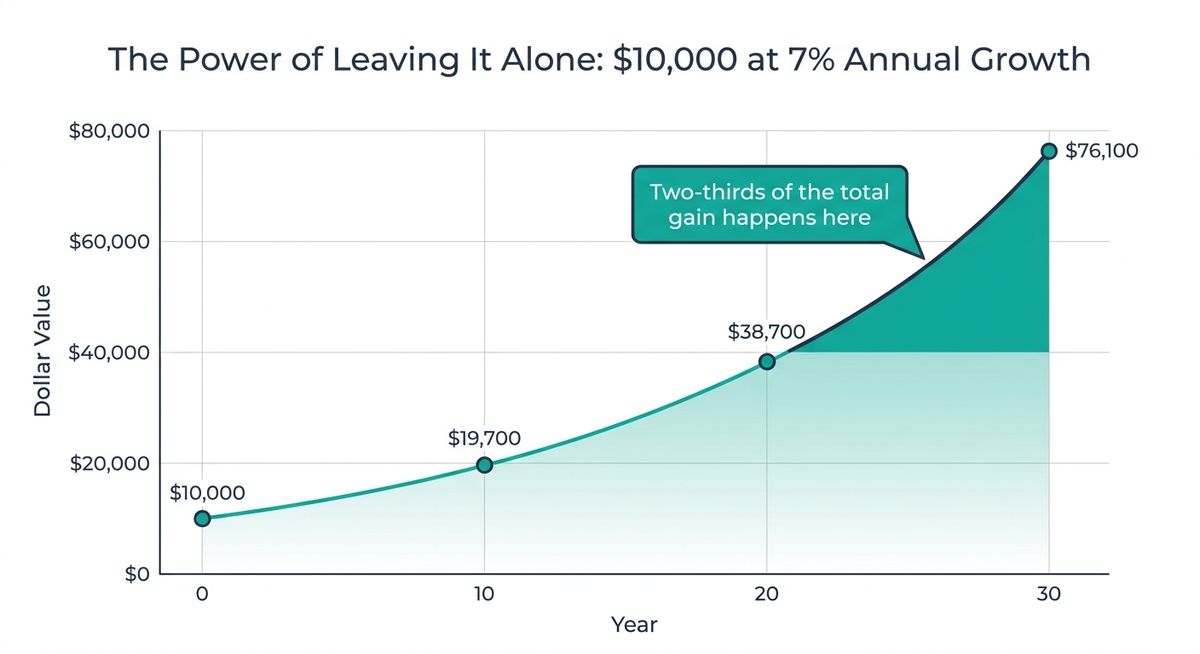
You can run these numbers for your own situation at ReadyAimRetire.com, plugging in your actual balance and timeline instead of a round number picked for a blog post.
The copywriter was right. Compounding is back-loaded, and the entire skill is not interrupting it.
Charlie Munger, who died in 2023 after roughly seven decades of doing exactly that:
"The big money is not in the buying and selling, but in the waiting."
Inactivity is the edge. It's also the single hardest thing in finance to sell, because from the outside it looks identical to doing nothing.
John Bogle made inactivity investable: "Don't look for the needle in the haystack. Just buy the haystack." That one line is index fund investing distilled to its essence. The data since then has been brutal. Over the 15 years ending December 2024, S&P's SPIVA scorecard found that in zero of 22 U.S. equity fund categories did a majority of active managers beat their benchmark. Zero. And in 2025, 79% of active large-cap funds trailed the S&P 500, the fourth-worst showing in SPIVA's 25-year history.
Buffett's version explains why: "The stock market is a device for transferring money from the impatient to the patient."
One Panicked Afternoon, Priced Out
That transfer happens faster than people think. Vanguard ran the numbers on the 2025 tariff selloff. An investor in a balanced portfolio who bailed on April 8 and bought back a week later finished the first half of the year roughly 5 percentage points behind somebody who did absolutely nothing. Anyone who sat in cash through June 24 was nearly 10 points behind. That's the price of one panicked afternoon, paid out of a balance you spent thirty years building.
Now, a word on what the behavior gap actually costs, because this is where most articles oversell it. Morningstar's Mind the Gap 2025 found the average dollar in U.S. funds earned 7.0% a year over the decade ending 2024, against 8.2% for the funds themselves. A 1.2-point drag, about 15% of total gains. You've seen that stat everywhere. It's also contested now. A May 2026 Financial Analysts Journal study by Fulkerson, Jordan, Riley and Yan concluded that bad timing costs investors closer to 0.10% a year, not 1.2%, and that most of the measured gap is an artifact of how dollar-weighted returns get calculated.
Here's what I love about that fight: both camps land on the same prescription. Whether flinching costs you 15% of your gains or a rounding error, nobody in either study is telling you to trade more.
Two rules keep you from needing to flinch in the first place — both are cornerstones of value investing. Peter Lynch: "Know what you own, and know why you own it." If you can't explain the thesis in two sentences a kid would follow, you're not investing. You're betting. And Sir John Templeton: "The four most dangerous words in investing are: 'This time it's different.'" The technology changes every single cycle. Greed, leverage, and fear never do.
Buffett's contrarian rule, from the 1986 Berkshire letter, deserves to be quoted exactly as he wrote it, because the popular paraphrase drops one crucial word: "we simply attempt to be fearful when others are greedy and to be greedy only when others are fearful." Only. Not habitually. Not on a hunch at 11pm.
And then Housel's, which is the quietest one here and probably the truest:
"Good investing isn't necessarily about earning the highest returns. It's about earning pretty good returns that you can stick with and which can be repeated for the longest period of time."
Repeatability beats optimization — that's the entire case for long-term investing over market timing. A boring 7% you hold through three recessions will absolutely flatten a brilliant 12% you abandon in month nine.
What Part 1 Adds Up To, and Where Part 2 Goes
Three wealth-building ideas, in order. Define "enough" before your income defines it for you. Build margin on purpose and automate it in both directions, into the portfolio while you're working and back out of it once you stop. Then leave the machine alone.
Now hold all of that up against the number most readers are actually working with. Fidelity's 2026 data puts the average Baby Boomer 401(k) balance at $260,300. Run that against Morningstar's 2026 safe withdrawal rate of 3.9% and you get about $10,150 a year. Every rule above matters more when that's the starting line, not less.
Every retirement plan is different, though, and $260,300 is just an average sitting in a press release. ReadyAimRetire lets you test how these strategies actually hold up against your specific numbers instead of a national median.
Which brings me to the one quote I saved on purpose.
"Rule No. 1: Never lose money. Rule No. 2: Never forget Rule No. 1."
To a 30-year-old chasing financial independence with forty years of runway, that reads like a bumper sticker. To a 66-year-old in September 2026, it's an operating instruction. The Shiller CAPE ratio is sitting near 41, more than double its long-run average of about 17, and inside the 99th percentile of every month going back to 1881. The only readings ever higher came at the top of the dot-com bubble. Meanwhile the ten biggest S&P 500 companies now make up roughly 40% of the whole index, the heaviest concentration on record.
Fidelity's illustration is the one I want you to sit with. Two retirees. Each starts with $1,000,000. Each pulls $50,000 a year. Each earns an identical 6.8% average annual return over 30 years.
Retiree A
- Starting Balance $1,000,000
- Annual Withdrawal $50,000
- Avg. Annual Return (30 yrs) 6.8%
- Outcome Lasts the full 30 years
Steep losses do not hit in the first few years.
Retiree B
- Starting Balance $1,000,000
- Annual Withdrawal $50,000
- Avg. Annual Return (30 yrs) 6.8%
- Outcome Runs out in year 27
Steep losses hit in the first few years instead.
Identical averages. Opposite lives.
The Structural Problem Mindset Can't Fix
Sequence of returns, not average of returns, is what separates Retiree A from Retiree B. And that one is not a mindset problem. No amount of good temperament touches it. It's a structural problem, which means it needs a structural answer.
Part 2 takes it head-on with the technical side of retirement planning: sequence risk and the retirement red zone, the honest use and abuse of leverage, buying back your own time as the highest-return asset you'll ever purchase, and what it takes to build a legacy on purpose instead of by accident.
Jefferson wrote the right rule and still lost the house. Getting the rule right was always the easy half.
📋 Before Part 2: What to Actually Do This Week
- Audit every recurring charge on a fixed date once a year. Cancel anything you can't immediately remember using.
- Check the expense ratio on every fund you own. The gap between 0.06% and 1.00% on a $600,000 portfolio is about $5,600 a year, every year.
- Set up an automatic monthly transfer from your portfolio into checking if you're within ten years of retiring. Fixed date, fixed amount. Give yourself a paycheck.
- Set a mandatory 48-hour cooling-off period, and a dollar threshold, for any discretionary purchase above that line.
- Model your own numbers at ReadyAimRetire before Part 2 gets into the technical fixes.
Thanks for reading if you've made it this far. Go check those expense ratios.
Peace!