

The Gen X Retirement Shift: Why the Next Generation of Retirees Is Rewriting the Playbook


Boomers retired on a three-legged stool. Gen X retirement is that same stool with one leg sawed off, and the response hasn't been panic, it's been precision.
Only 14% of private-sector Gen X workers have pension access. Here's how the generation is closing the gap with evidence instead of guesswork.
- Gen X expects to retire with $711,771 but says it needs $1,116,747, a $405,000 gap, the widest of any generation.
- Shift One: "Retiring backward" into hobbies you've already proven you love, instead of gambling on untested ones like golf.
- Shift Two: Skipping Florida for the Appalachian/Piedmont "halfback" corridor, driven by family proximity and insurance costs.
- Shift Three: Renting instead of buying in early retirement, since a home stops producing income once your portfolio funds your life.
Action: Test the hobby, map the geography, and run the rent-vs-buy math before you commit real money to any of it.
I'm not being dramatic here. That's the Bureau of Labor Statistics talking. As of March 2025, 14% of private-sector workers have access to a defined benefit pension, while 70% have access to a defined contribution plan like a 401(k). Back in 1990, those two numbers were basically tied, about a third each. The National Institute on Retirement Security ran a separate study in 2023 looking at Gen X specifically and landed on the same 14%. Two different measurements, same answer. For most of this generation, Social Security is the only check that shows up for life, guaranteed.
Here's the thing about a smaller margin for error: it changes how you behave.
Gen X has one advantage nobody before them had. They're going second. Their parents and their older coworkers retired right in front of them, out in the open, and the results are in. Some were fantastic. Some involved a Florida condo, a five-figure special assessment nobody saw coming, and a golf membership that stopped getting used somewhere around year two.
That's what this whole shift is about. Gen X is swapping out assumption for evidence, and you can see that swap most clearly in how 401(k) retirement strategies for this generation are taking shape.
The Numbers Behind the Nervousness
Schroders put actual figures on the anxiety in their 2025 US Retirement Survey. Gen X investors between 45 and 60 expect to retire with a specific number, and it doesn't match what they say they'll actually need.
What Gen X Expects to Have
- Expected at Retirement $711,771
What Gen X Says It Needs
- Target Number $1,116,747
That gap of roughly $405,000 is the biggest of any generation, and only 16% feel like they've saved enough. If you're trying to see where you actually land against that number, our breakdown of the best retirement rules of thumb is a useful gut check.
And this isn't abstract. Pew Research reported in August 2026 that 54% of Americans in their 40s and 45% of those in their 50s are sandwiched between an aging parent and their own kids. Of the sandwiched 50-somethings, 61% are financially supporting an adult child. Allianz Life found that 59% of sandwich-generation adults have cut back or stopped their retirement contributions. If that's your situation, this sandwich-generation case study walks through the math of retiring while still covering a parent's bills.
The gap between what you have and what you'll need is worth putting real numbers to rather than a feeling. You can run these numbers for your own situation at ReadyAimRetire.com and see exactly where your own savings and target line up.
So the response hasn't been panic. It's been precision. Three specific changes keep showing up in planning conversations, and every one of them takes a Boomer-era guess and replaces it with something you can actually go test.
Shift One: Retiring "Backward" Instead of "Forward"
Credit where credit's due. The whole "retiring backward" framing comes from Benjamin Brandt, CFP®, who hosts Retirement Starts Today, and it got a big audience through a Fortune feature back in July 2026. His one-liner is the cleanest version of it:
Baby boomers look forward and make a guess. Whereas Gen X is going backwards with known information.
Retiring Forward
You build retirement around stuff you've never actually done. Golf five days a week. A woodworking shop. Serious gardening. These sound reasonable, and they're hypotheses with zero data behind them. You liked the idea of golf during a brutal Q3. That's not the same as liking golf at 10 a.m. on a random Tuesday in February, every year, for twenty years.
Retiring Backward
You go back to something you already have proof you love. The band you played in at 19. Trail riding. Tabletop gaming. Competitive swimming. Restoring the gear you were obsessed with before somebody told you it wasn't practical.
The Research Behind It
Robert Atchley mapped out six phases of retirement: pre-retirement, honeymoon, disenchantment, reorientation, stability, termination. The honeymoon runs a few months to a year. Then boredom shows up, and people burn a year or two figuring out what they actually want. Retiring backward is an attempt to skip disenchantment by front-loading the reorientation. Retirees also report a lower sense of purpose than same-age peers who are still working, and men get hit harder, since so much identity is welded to the job. We've written before about what happens when the money shows up without an identity plan attached.
The $500 Time Machine
Brandt's exercise is the most useful thing in this whole article, and running it costs you nothing.
Somebody hands you $500 and sends you back to your 13th birthday. You have to spend all of it on yourself before the day is over. What do you buy?
Thirteen is a deliberate pick. You're old enough to know what $500 actually means. And you're young enough that no career counselor has sat you down yet to explain there's no money in music, no future in art, and nothing practical about whatever you were building in the garage.
What comes out is usually really specific. A drum kit. A mountain bike. A stack of Magic: The Gathering boosters. A Dungeon Master's guide. A darkroom enlarger. A telescope.
Then Go Do the Cheap Version First
A used drum kit runs about $400. A weekend at a mountain bike park is around $200. A Magic pre-release event is thirty bucks. These hobbies come with a known cost, a built-in social circle, and basically no startup risk. Compare that to a golf membership you've never tried, at a club you've never joined, in a town you've never lived in. Test the idea for a few hundred dollars before you build a retirement around it for a few hundred thousand.
Ready to see how your own numbers line up? Try It Free →
Shift Two: The Halfback Bypass
The old retirement migration went Northeast and Midwest to Florida. Then came the "halfback" pattern: folks who moved to Florida, figured out it wasn't what the brochure promised, and moved halfway back north to the Carolinas or Tennessee. Gen X is just skipping step one.
HireAHelper's New Retirement Map came out in February 2026, built on nearly 15 million tracked moves during 2025, and it's got one number that tells you everything.
Florida: 45,696 retirees in, 44,881 out. Net gain for the whole year: 815 people. South Carolina netted +5,427. Texas +5,156. North Carolina +3,202. Tennessee +3,191.
Florida still pulls in more retirees than anywhere else in the country. Almost none of them stay.
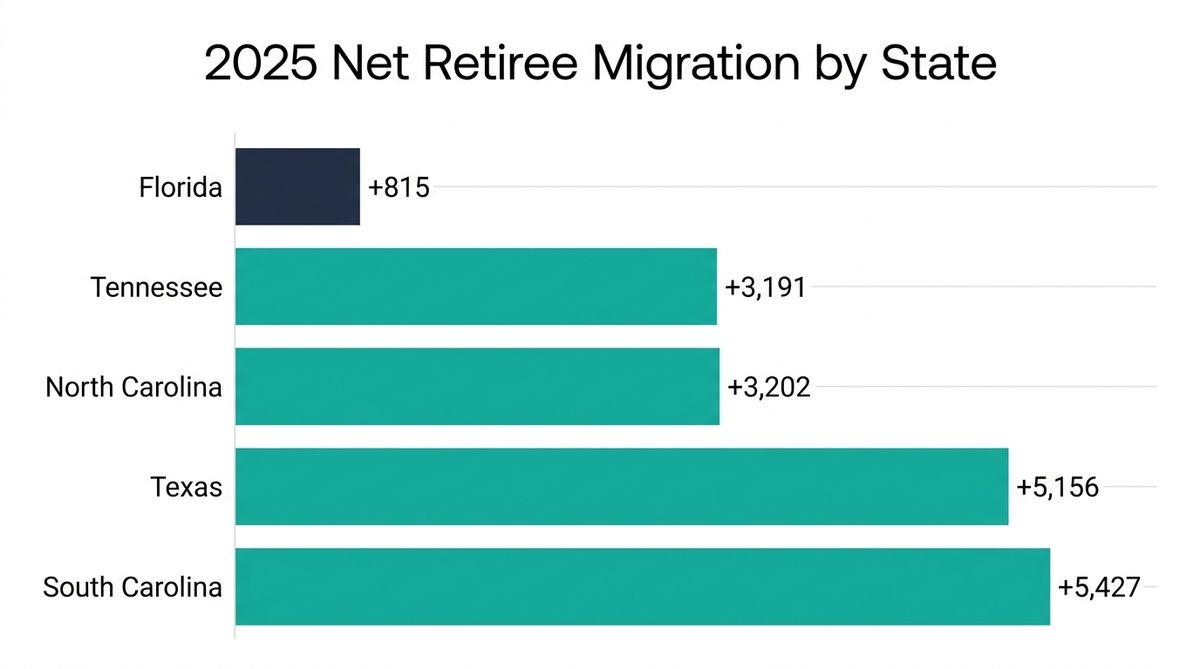
Three things are pushing Gen X straight into the Appalachian and Piedmont corridor: western Carolinas, eastern Tennessee, north Georgia, Virginia.
Proximity, which is really just logistics. With more than half of 40-somethings sandwiched, that corridor splits the difference between adult kids up north and aging parents down south. The average 65+ relocation distance is 223 miles (the median is only 11.7 miles, since most retirees just move across town). That average is roughly Charlotte to Asheville, or Atlanta to Knoxville. The halfback corridor sits one average retiree move from just about everywhere.
Lifestyle. Hiking and mountain biking instead of country club leisure. Same backward-facing logic, just applied to a map.
Economics. Insurify put Florida's average homeowners premium at $8,292 in 2025, an 18% jump in a single year, and they're projecting $8,458 for 2026, more than three times the national average. Then there's the condo math. After Surfside, Florida's SB 4-D requires milestone structural inspections and structural integrity reserve studies for any building three stories and up, and as of January 1, 2026, associations can't vote to waive full reserve funding anymore. Buildings that used to collect $50 to $100 a month in reserves now need $300 to $800 per unit. Monthly dues are up 20% to 40% in typical buildings, 50% to 100% in older beachfront towers, with one-time special assessments running from $10,000 to well north of $100,000 per unit. Whatever you save on state income tax gets eaten alive, and then some.
Two Honest Caveats
Florida Is Getting Better, Not Worse
For the first time since 2015, the trend has bent. Citizens Property Insurance cut rates 8.7% statewide at Spring 2026 renewals (14% in Miami-Dade and Broward), 18 new private insurers have come in since the 2022 reforms, and 51 of 67 counties saw rates drop in 2026. Florida's 2025 HB 913 also gave condo boards a little breathing room on reserve timing. The real argument against Florida is the level and the assessment risk, not the direction.
The Mountains Have Their Own Climate Risk
Hurricane Helene proved that inland elevation is not immunity, and any honest version of this halfback thesis has to say so out loud. Nearly two years out, western North Carolina is recalibrating rather than falling apart. Buncombe County Q1 2026 home sales came in at 394, down from 431 a year before, but sales inside Asheville city limits actually rose to 255 from 242. By Q2 2026, months of supply hit roughly six and average days on market reached their highest second-quarter level since 2015. Median prices are flat to down from pre-Helene highs, the region has received an additional $225 million in recovery funding, and the corridor has tipped into a buyer's market for the first time in years. If you're shopping that corridor, that's a real window, and a great reason to pay close attention to the next section.
Shift Three: Renting vs. Buying in Retirement, on Purpose
"Renting is throwing money away" might be the most expensive piece of conventional wisdom ever aimed at retirees. The math that makes it true while you're working quietly flips the moment you stop.
While You're Working
A mortgage payment converts earned income into home equity. Your labor funds it, and that conversion is genuinely productive.
In Retirement
Buying a home converts invested capital into illiquid brick and mortar. Your portfolio funds it now, and that conversion has a real cost.
Let's run it with actual numbers. Say you're looking at a $500,000 house with $150,000 down at 6.66% (Freddie Mac, late August 2026).
Buy
- Cash flow from the $150k down payment $0
- Cost to convert equity back to cash 8–10% of sale price
Rent
- $150k stays invested Liquid
- Income at a 3.9% withdrawal rate ~$487/mo
That last part matters and I want to be straight about it. The 3.9% figure, from Morningstar's 2026 base case, assumes a 30-year horizon, a portfolio of 30% to 50% equities, and a 90% success probability. It's not a perpetuity. But it is a real income stream, which is more than your home equity does for you while you're living in it. Every retirement plan is different, and ReadyAimRetire lets you test how these strategies work with your specific numbers, weighing rent-versus-buy math against your own portfolio and withdrawal rate instead of a generic example.
Then add the carrying costs everybody forgets. Beyond principal and interest, US homeowners spend roughly $21,400 to $24,500 a year on property taxes, insurance, utilities, maintenance, and repairs. Maintenance alone should get budgeted at 1% to 3% of the home's value every year, and it scales with age: about 0.5% for a house under 10 years old, 2% or more once it's past 30.
Nationally, people are following the math. 2.4 million Americans 65 and up became renters between 2013 and 2023, a 30% surge and the fastest growth of any age group. Roughly 10.4 million renters are now 65 or older, 13.4% of every renter in the country.
The Time Horizon Rule
Selling costs real money. Total commissions average 5.70%, and they went up after the NAR settlement, not down. Add 1% to 3% in seller closing costs, plus repairs, staging, and moving. Consensus total: 8% to 10% of the sale price. On a $400,000 home that's $32,000 to $40,000 walking out the door.
| Time Horizon | Who Comes Out Ahead |
|---|---|
| Under 7 years | Renting wins, usually by a lot |
| 8 to 10 years | Call it a wash |
| Beyond 10 to 15 years | Ownership pulls ahead |
Two honest qualifications. Standard breakeven calculators put the 2026 national average at about 5 years 8 months, shorter than the rule above. But those calculators assume a working buyer paying down a mortgage out of earned income, not a retiree paying cash and giving up a 3.9% withdrawal stream. The retiree horizon really is longer. Second, breakeven is wildly local: roughly 3.8 years in Charlotte and 4 in Cleveland, versus 14 years in San Francisco. Treat any national rule as a starting point, not a verdict.
The Three Things Nobody Tells You
- You're going to move twice. The rent-versus-buy debate always gets framed as one decision. It isn't. The second move usually lands 7 to 15 years later, triggered by a spouse's death, a grandchild in a different metro, or a body that doesn't cooperate anymore. That move carries $100,000 to $150,000 in total relocation friction. Buying at 62 doesn't dodge that cost. It doubles it. Related reality check: 40% of movers say the move cost at least twice what they expected.
- Every reason you relocate has an expiration date. You moved to be near a grandchild? That kid turns 18 in a decade. You moved to be near your 84-year-old mom? That's a five-to-eight-year window. You moved for the hiking? Knees are roughly a fifteen-year asset. Only one of those three plausibly outlasts a ten-year breakeven, and even that one depends on your body cooperating.
- Home equity in retirement stops being emergency money the day your W-2 stops. Lenders underwrite HELOCs on income, and W-2 income qualifies a whole lot more easily than Social Security, pension income, or portfolio distributions. Retirees find out all the time that their equity is locked up at the exact moment they need to get at it. If you're going to own, open that line while you're still working.
The Objections, Answered
"Rent goes up and I'm on a fixed income." This is the strongest objection of the bunch, and it deserves a straight answer instead of a convenient one. Right now, national median rent is $1,390, down 0.8% year over year. But rents have also risen month over month for seven straight months, and August 2026 was the first positive August reading since 2022. The soft patch is real, and it's ending. The more durable point is structural: a paid-off house isn't inflation-proof either. It still carries $21,400 or more a year in taxes, insurance, and maintenance, all of which inflate, and two of which (Florida insurance, condo assessments) have inflated way faster than rent has. Owning doesn't remove your exposure to housing inflation. It just changes which line item hands it to you.
"Homeowners have 38 times the median net worth of renters." True, and heavily confounded by income, age, and selection. Owning a home didn't create that gap on its own.
"Studies say renting only wins if you invest the difference." Also true, and the operative word is systematically. If that $150,000 down payment ends up sitting in a checking account instead of a portfolio, buy the house. This strategy requires the discipline it assumes.
The Insight Underneath All Three
These three Gen X retirement trends look unrelated on the surface: a purpose exercise, a migration map, a housing decision. They're actually one behavior.
Forward Is a Gamble. Backward Is Evidence.
Gen X is swapping assumption for data at every layer of the retirement decision, and holding onto optionality precisely because the data might change on them. Test the hobby before you fund it. Pick the location based on your actual family logistics instead of a resort brochure. Rent until your time horizon justifies the friction cost of owning.
With 14% pension access and a self-reported $405,000 gap, that's not pessimism. That's just the correct response to having less room for error.
🎯 Your Three-Step Start
- Run the time machine this weekend. Answer the $500 question, then spend $200 or less testing your answer. A day at a bike park. A used amp. A Saturday tournament. You're gathering data, not signing up for a lifestyle.
- Map your geography around people and terrain, not marketing. Plot your adult kids, your aging parents, and whatever activity you just tested. Look at the midpoint. Then check insurance costs, property tax rates, and HOA reserve funding status before you look at a single listing.
- Run your own rent-versus-buy math with the real inputs. Include the 8% to 10% exit friction, the $21,400-plus annual carrying cost, the 3.9% you give up on the down payment, and an honest guess at how long the reason for this move will still be true. Start by modeling your retirement at ReadyAimRetire with your own savings, timeline, and target spending, then layer the location and housing assumptions on top.
Boomers had to guess. Fortune framed this whole shift as something cold economic reality forced on Gen X, with nostalgia handed over as a consolation prize. I think that reading is too gloomy. You've got a full case study sitting right there in front of you and roughly a decade to do something with it. Going second isn't settling. It's the best information any generation has ever walked into retirement holding, and the only real mistake left is ignoring it.
Thanks for reading if you've made it this far. Peace!