

The Stupid Money Habits You Must Stop Right Now If You Want to Finally Retire


You've got a plan. Work until 65, maybe 67, hit the number, walk out clean and go do whatever it is you've been promising yourself for twenty years.
Here's the uncomfortable part, and it's one of the retirement mistakes nobody plans for: the data says you probably won't get to choose.
In EBRI's 2026 Retirement Confidence Survey, the median worker expects to retire at 65. The median retiree actually walked at 62. About 46% of retirees stopped working earlier than they'd planned, and 76% of those exits were driven by something the person didn't control. The two big ones: 41% of early retirees pointed to a health problem or disability (that was 31% a year earlier), and 35% pointed to a layoff, a closure, or a reorg.
That changes the whole shape of the problem. "I'll just work a few more years" isn't a plan. It's a hope, and it comes up short about half the time.
Which leaves exactly one lever you actually control: what your life costs to run.
Nearly half of retirees leave earlier than planned, and most of those exits aren't a choice. The one thing you fully control is what your life costs to run. Here's what's quietly inflating that number:
- Oversized homes, underused toys (RVs, boats, cars) and extra vehicles are recurring bills disguised as assets.
- Funding adult kids and clinging to career-status spending both quietly drain retirement security.
- Lifestyle creep, home-equity debt, high-interest debt, cash-hoarding, and fund fees each cost far more than they look like on paper.
- Three 2026 rule changes — the ACA subsidy cliff, the Roth-only catch-up rule, and a 13-year Roth conversion window — need action now, not "eventually."
Action: Pick your single biggest recurring cost, run the Three-Question Filter below, and start a 60-day test before you decide to keep it.
And that lever is a big one. At a 4% withdrawal rate, every $1,000 of annual spending you permanently delete is $25,000 less money you have to go accumulate. (Morningstar's 2026 base case is 3.9%, which makes it $25,640, though that assumes a pretty conservative 30% to 50% stock allocation. Bill Bengen, who invented the 4% rule in the first place, bumped the number up to 4.7% in 2025. Call it 4% and know the honest range is somewhere around 3.9% to 4.7%.)
Quick Refresher: The 4% Rule
The math behind "safe withdrawal rate" is simple multiplication run backward. If $1,000 a year in spending needs roughly $25,000 in capital to support it forever, then killing $1,000 in recurring spending permanently is the same as finding $25,000 in your portfolio. It works in both directions — spend more, need more; spend less, need less.
Cut $10,000 a year in recurring costs and you just erased a quarter of a million dollars from your required nest egg. You also freed up $10,000 a year to invest. Double win. And it doesn't require a raise, a bull market, or your boss's permission. You can run these numbers for your own situation at ReadyAimRetire.com to see exactly what a given cut is worth against your actual portfolio and timeline.
Retirement readiness isn't only about what you pile up. It's about what you're willing to put down. Here's what's quietly costing you years.
Category 1: The Burdens We Cling To
The Big Empty House
The mistake: Treating 2,800 square feet you no longer use as an asset.
Redfin found in April 2026 that empty-nest boomers in one and two-adult households own 28% of all U.S. homes with three or more bedrooms. Millennials with kids actually living in them own 16%. So the people who need the space don't have it, and the people who have it are vacuuming rooms nobody sleeps in.
The hidden cost: Square footage isn't stored value. It's a recurring bill. Zillow puts the hidden, non-mortgage cost of owning a home at $15,979 a year. Bankrate says $21,400. The gap is just what they count: Bankrate includes utilities, internet, and cable, Zillow doesn't. Either way, those costs went up 4.7% last year while incomes grew 3.8%, and home insurance is up 48% nationally over five years.
The fix, and I'm going to be honest with you here: Most articles about downsizing promise you a windfall. The evidence doesn't really back that up. Selling costs run $55,000 to $65,000. Buying the next place runs another $30,000 to $40,000. And small, desirable homes often cost 65% to 75% per square foot of what you're leaving, so you don't save proportionally. That $250,000 "windfall" realistically nets around $155,000. Then the condo or active-adult community hits you with HOA fees and special assessments of $4,800 to $9,000 a year, which quietly reimports the exact liability you just sold. Move across town and your net savings are close to zero.
Downsizing pays reliably in two situations: when you cross a cost-of-living boundary, or when you rent instead of buy.
But the check was never the real prize anyway. Killing the recurring bill is. Cut 30% to 40% off $16,000 to $21,400 a year and you've deleted $5,000 to $8,500 annually, which is $128,000 to $218,000 less capital you need. Permanently. The equity is gravy. Vanguard figures that fully leveraging housing wealth could improve retirement readiness by 20 percentage points, though I'll note that's a fund company grading its own homework.
The Toys You Bought for a Person You Aren't Anymore
The mistake: Keeping the RV, the boat, or the classic car because selling it feels like admitting something about yourself.
I get it. I really do. My friend Marcus has a boat in Annapolis that hasn't left the slip in two summers, and every time it comes up, the conversation turns into something other than a conversation about a boat.
The hidden cost: Stop calculating cost per year. Start calculating cost per use.
RV owners use their rig a median of 30 nights a year. For Class B camper vans and Class C motorhomes, the median is 21. Run the real numbers on a used Class C: loan interest, insurance, storage, maintenance, and depreciation come to roughly $11,280 a year. Divide that by 21 nights and you're at $537 a night before you've bought a drop of fuel or paid for a single campground.
Would you book a hotel room at $537 a night? Twenty-one times a year?
Boats run the same math. The industry rule of thumb is 10% to 15% of purchase price annually, so a $50,000 boat costs $5,000 to $7,500 a year. Use it fifteen times and that's $333 to $500 per outing. A wet slip alone goes for $30 to $50 per foot per month, so $900 to $1,500 a month just to park a 30-footer.
Owning It
- Annual cost $11,280–$12,000
- Cost per use $333–$537
- Capital required (×25) $282,000–$300,000
Renting Instead
- Annual cost (3 weeks/yr) ~$4,000
- Cost per use ~$190
- Capital required (×25) ~$100,000
The fix: Rent instead of own. If ownership costs $12,000 a year and renting for three weeks costs $4,000, that $8,000 difference is about $205,000 less retirement capital you need. Same trips. Same photos. Nobody winterizes anything.
And while we're here: the average storage unit is $133 a month, roughly $1,600 a year, to warehouse things you have not looked at since the day you put them in there.
The Third Car Nobody Drives
The mistake: Running a fleet sized for a commute that's about to end.
The hidden cost: AAA puts the all-in cost of a new vehicle at $11,577 a year, and $4,334 of that is pure depreciation happening while it sits. Even with no loan payment at all, Bankrate found $6,894 a year in costs: insurance $2,679, gas $1,650, maintenance $1,384, taxes $1,182. Auto insurance jumped 15% last year, and just adding a second car to a policy costs an average of $1,185 a year on its own. Transportation eats 14.8% of median household income, second only to housing.
The fix: Sell the least-driven one first. One car plus the occasional rental or rideshare beats two depreciating assets sitting in a driveway staring at each other. A lightly driven, paid-off car still costs $3,500 to $6,900 a year, which is $90,000 to $177,000 off your number.
Category 2: The Relationship and Identity Traps
Funding Your Adult Kids Out of Your Own Retirement
The mistake: Roughly half of parents financially support an adult child. Some surveys put it closer to 60%. Average support runs $1,474 a month per Savings.com, $1,589 per Ameriprise.
The Stat That Stopped Me Cold
Working parents put 2.3 times more into their adult kids' lifestyle ($1,589 a month) than into their own retirement savings ($673 a month). 79% say they're worried about their own retirement anyway.
Almost half say they've sacrificed their own financial security. One in seven lowered their own standard of living after lending money to family.
If this is hitting close to home because you're also managing an aging parent's bills on the other side, that's a related squeeze worth reading about on its own — see how one reader's sandwich-generation math actually pencils out.
Do the math. That $1,474 a month is $17,688 a year. Redirect it into a 7% portfolio for ten years and it compounds to about $244,000. Use the higher number and it's $263,000. And what's getting funded? Groceries (83%), cell phone bills (65%), and vacations (46%).
There are loans for houses, cars, and degrees. There are no loans for retirement. Nobody underwrites you at 78.
The fix: Set a sunset date. You wouldn't be a pioneer here, 37% of supporting parents already plan to stop within two years. Put it in writing. Turn open-ended cash flow into something specific, finite, and attached to a purpose. And explain the math to your kids like adults, because the alternative isn't that you help them less. The alternative is that they're supporting you at 80, which is a lot harder on everybody.
Paying to Stay the Person You Were at Work
The mistake: Still funding the wardrobe, the club membership, the car, and the dinners that signaled professional status, long after the audience has gone home.
Empty Desk Syndrome
Research consistently finds that the people with the highest career centrality struggle most in their first year of retirement. The most accomplished ones (executives, physicians, attorneys, senior officers) report the roughest adjustment — routines gone, social network shrinking, and an identity with nowhere to go on a Tuesday morning. It's the sharp edge of what we've written about before as the retirement identity crisis.
The hidden cost: Spending is the fastest way to fake continuity, and it's also the most expensive.
The fix: Build the new identity before you need it. A board seat. Teaching. Coaching. A hobby you take seriously enough to be bad at in public. A volunteer role you'd be embarrassed to quit. Do it in the two years before you retire, not the two years after.
An identity you have to purchase is a subscription, and it's one you can't afford on a fixed income.
Category 3: The Structural Money Habits
These are the quieter retirement mistakes — the ones baked into how you already manage money, not the stuff sitting in your driveway or garage.
Lifestyle creep at peak earnings. Every $1,000 a month you add to your standard of living in your 50s adds roughly $300,000 to the portfolio you need. Your peak earning years are supposed to widen the gap between what you make and what you spend, not close it. The fix: bank the raise before it becomes a habit. Route it to the 401(k) the same week it lands, not next January when it's already spent.
Treating home equity like an ATM. The share of homeowners aged 65 to 79 still carrying a mortgage went from 24% to 41% over three decades, with median mortgage debt up 400%. For folks 80 and up, it went from 3% to 31% (Harvard JCHS). The average HELOC balance hit $48,298 in 2025, up 9% year over year. Every cash-out refi restarts a 30-year clock you're not going to outlive comfortably. The fix: stop rolling consumption into a mortgage, and set a payoff date that lands before your retirement date. Whether to accelerate a low-rate mortgage you already have is a genuine coin flip. Whether to add to it is not.
Carrying high-interest debt while "investing." Half of workers carry credit card debt. Nearly one in three carries more than $25,000 in non-mortgage debt. People in their 50s carry the highest average balance, about $9,200 (Experian), at roughly 22% APR on accounts actually accruing interest (Federal Reserve G.19). The fix: pay the card first. Killing that balance is a guaranteed, tax-free 22% return. Long-run stock returns are around 7% before tax and guaranteed by absolutely nobody. "But I'm investing instead" isn't a strategy. It's a story we tell ourselves.
Sitting on cash because the market scares you. The average savings account pays 0.38% while inflation ran 3.4% year over year in July 2026. Park $200,000 there and in ten years you'll have $207,700 on paper, worth about $148,700 in today's dollars if inflation holds. That's a 26% loss of purchasing power. In a 6% balanced portfolio, that same money is worth roughly $256,400 real. Playing it safe cost you $107,700. CNBC called cash "a silent wealth killer." Advisors I know just call it dead money. The fix: keep six to twelve months of expenses in cash and put the rest somewhere that earns more than nothing.
Ignoring fees. Take $1,000,000 at 7% over 30 years, lump sum, nothing added: $7,612,255. Now skim 1% off the top every year: $5,743,491. That fee cost you $1,868,764, which is 24.6% of your ending balance (over 20 years it's 17.1%). Meanwhile index equity mutual funds average 0.05% and active U.S. equity funds average 0.60%. That legacy fund sitting in your old 401(k) charging north of 1% costs about 20 times its index equivalent, and it does not reliably deliver anything extra for the privilege.
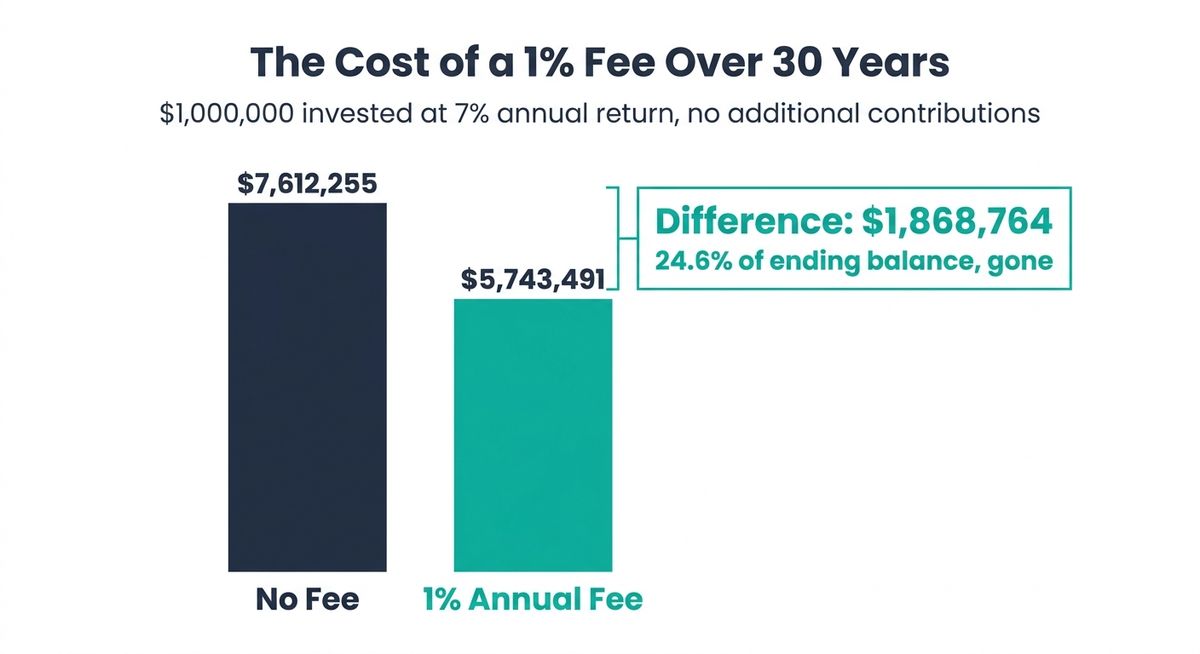
The fix: pull up every account this weekend and write down the expense ratio next to it. Anything above 0.20% needs a reason you can say out loud.
Late-career swinging for the fences. The urge to catch up with something aggressive is completely understandable and completely dangerous. Bitcoin went from an all-time high of $126,210 on October 6, 2025 to a low of $60,074 on February 11, 2026. That's a 52% drawdown in four months. Crypto in a retirement account carries no FDIC or SIPC protection. At 55, you don't have the runway to recover from a sequence-of-returns disaster. The fix: boring compounding is the strategy. It was always the strategy. If you need a little action, cap it at money you could set on fire without changing your retirement date.
Category 4: The 2026 Rules That Changed Underneath You
Three things landed recently that almost nobody writing about retirement has caught up to yet.
Retiring before 65 got a lot more expensive. The enhanced ACA premium tax credits expired on December 31, 2025. Net premiums for subsidized enrollees rose an average of 114%, and KFF projects the average annual net premium going from $888 in 2025 to $1,904 in 2026, hitting roughly 22 million people.
The subsidy cliff is back, and it's a cliff, not a slope. Above 400% of the federal poverty level, about $60,240 for a single filer, you get zero assistance. So picture a single 60-year-old earning $63,000. That's about $400 over the line. Zero help, full premium, which runs north of $1,200 a month for a benchmark silver plan in a lot of counties. One dollar of income is the whole difference. Budget for it or manage your MAGI on purpose.
And know what you're budgeting toward: Fidelity estimates a 65-year-old retiring in 2026 will spend $185,500 out of pocket on healthcare over the course of retirement. It's $371,000 for a couple. That excludes long-term care.
High earners lost the pre-tax catch-up. If you had more than $150,000 in FICA wages in 2025 from the employer sponsoring your plan, every dollar of your 2026 catch-up contributions has to be Roth. (2026 limits: $24,500 elective deferral, $8,000 catch-up at 50 and up, and an $11,250 super catch-up for ages 60 to 63, so a possible $35,750.) Here's the part that gets people: if your plan doesn't offer a Roth option, you can't make catch-up contributions at all until it does. Check this week. Not eventually. This week.
You have a 13-year Roth conversion window and you might not know it. Under SECURE 2.0, anyone born in 1960 or later has an RMD age of 75. If you're between 40 and 62, that's you. Retire at 62 and you've got thirteen years of low taxable income before RMDs and Social Security shove you back up the brackets. That is the best Roth conversion runway in the entire tax code, and stuffing 100% of your savings into pre-tax accounts throws it away.
Three guardrails when you use it. First, IRMAA is a cliff too, not a ramp. The 2026 surcharges are based on your 2024 MAGI, and going one dollar over $109,000 single or $218,000 married filing jointly costs $95.70 a month per person, about $2,296 a year for a couple. Second, that two-year lookback means the first conversion year that touches your Medicare premium is the year you turn 63. Conversions at 62 are IRMAA-free. Everything after isn't. Third, the OBBBA senior deduction of up to $6,000 per person age 65 and up ($12,000 per couple) starts phasing out at $75,000 single and $150,000 MFJ, and it expires after tax year 2028.
Size your conversions against all three. Fill your bracket deliberately instead of converting a round number because it looks tidy on a spreadsheet. Every retirement plan is different, and conversion math that works fine for your neighbor might blow through your own IRMAA threshold. ReadyAimRetire lets you test how these strategies play out with your specific numbers before you file anything.
The Three-Question Filter
Before any big spending or keep-it decision, run these:
- Does this serve my future life or my past life?
- What's the full cost of ownership? The direct dollars, the opportunity cost (take the annual cost and multiply by 25), and the energy cost, meaning the hours of maintenance, scheduling, and low-grade worry.
- If I let this go, what does it unlock?
Then run the 60-to-90 Day Test. Don't sell anything yet. Store the boat off-site. Park the third car. Move the storage unit contents into the garage and live without touching them for a full quarter.
The Endowment Effect
As the St. Louis Fed explains it, we systematically overvalue things simply because we already own them. Take away the possession and the bias loses its grip. Its cousin, the sunk cost fallacy, is what makes you price the RV at what you paid instead of what it's actually worth to the life you're living now.
You're not weak for feeling any of this. You're a person. The protocol is what beats it.
Your Weekend Audit
| Action | Time | Annual savings |
|---|---|---|
| List every recurring cost over $100/month | 30 min | Baseline |
| Calculate cost-per-use on every toy | 20 min | $3,000 to $12,000 |
| Look up expense ratios in every account | 30 min | 0.5% to 1% of assets |
| Total credit card and HELOC balances and APRs | 15 min | Up to 22% guaranteed return |
| Check cash above 12 months of expenses | 10 min | ~3% real per year |
| Confirm your plan offers a Roth 401(k) option | 10 min | Preserves catch-up eligibility |
| Write your RMD year (birth year + 75) on a sticky note | 2 min | Defines your conversion window |
| Set a sunset date for family support | 1 hard conversation | $17,000 to $19,000 |
Add up what you can cut. Multiply by 25. That's how much smaller your retirement number just got, sitting at your kitchen table on a Saturday. Start by modeling your retirement at ReadyAimRetire and plug in each cut to see exactly how it moves your actual number.
🎯 This Weekend: Do the Math
- Pick one recurring cost over $100/month and run the Three-Question Filter on it before you do anything else.
- Check every account's expense ratio. Anything above 0.20% needs a reason you can say out loud.
- Total your credit card and HELOC balances. Paying them off is a guaranteed, tax-free return no market can match.
- Confirm your 401(k) offers a Roth option if you earned over $150,000 in FICA wages last year — you need it before making 2026 catch-up contributions.
- Write your RMD year on a sticky note (birth year + 75) so you know exactly how many years you have to convert.
Just Pick One
Nearly half of retirees leave earlier than they planned, and three quarters of those exits weren't anybody's choice. You can't schedule your health. You can't schedule your employer's next reorg. You can't schedule when your parents need you.
You can decide, this weekend, what your life costs to run — which is really just financial independence measured one recurring bill at a time.
So pick the single biggest recurring cost on your list. Just the one. Start its 60-day test today. Cutting $10,000 a year is worth $250,000 in capital you no longer have to go out and earn, and that reduction becomes permanent the moment you make it.
Which means every year you wait costs you twice. Once for the $10,000 you spent instead of invested, and again for a retirement number that stayed a quarter million dollars too high so you could keep things you've already stopped using.
Thanks for reading if you've made it this far. Go look at the boat.
Peace!
Sources: EBRI 2026 RCS · Morningstar SWR 2026 · KFF enhanced PTC · 2026 subsidy cliff · BLS July 2026 CPI · Bankrate savings rates · Kiplinger 2026 IRMAA · Chase 2026 catch-up rules · IRS senior deduction · Redfin housing mismatch · AAA driving costs · AOL RV cost-per-night · Bitcoin ATH drawdown