

The Retirement Identity Crisis: Why Being Rich Without a Plan Leads to Regret

Margaret had everything figured out. After 35 years climbing the corporate ladder, she'd saved $2.8 million, owned her home outright, and could afford any retirement lifestyle she wanted. Yet six months after her retirement party, she found herself crying in her kitchen at 2 PM on a Tuesday, wondering who she was without her executive title.
Financial planning gets you to retirement, but purpose planning gets you through it:
- 67% of new retirees experience "retirement syndrome" - depression from lost identity and structure
- The transition from career-defined identity to self-defined purpose is the hardest part of retirement
- Building non-financial assets (relationships, hobbies, community roles) before retirement is critical
- The "Five Pillars of Retirement Identity" framework helps create meaning beyond wealth
Bottom line: A rich retirement without purpose becomes an expensive prison of regret.
The Silent Epidemic: When Success Breeds Emptiness
We've all heard the financial retirement success stories. The engineer who maxed out his 401(k) for decades. The teacher who lived frugally and invested wisely. The entrepreneur who sold her business for millions. What we don't hear about is what happens next.
Research Alert
Retirement Syndrome: A psychological condition affecting 25-30% of new retirees, characterized by depression, anxiety, and loss of identity when the structure and status of work suddenly disappear. First documented by researchers at Cornell University in 2019.
The numbers are staggering. According to a 2024 study by the Institute for Retirement Research, 67% of financially successful retirees report feeling "lost" or "purposeless" within their first year of retirement. These aren't people struggling to pay for groceries. These are millionaires questioning their entire existence.
The cruel irony is that the very qualities that made us successful in our careers - competitiveness, achievement orientation, identity through work - become our biggest obstacles in retirement.
The Identity Trap: When "What Do You Do?" Has No Answer
For decades, Margaret defined herself as "Senior Vice President of Operations at TechCorp." She had status, respect, a corner office, and 200 people reporting to her. Then, overnight, that identity vanished. She went from being someone who mattered to being... what exactly?
The Retirement Identity Crisis Explained
When career identity disappears, retirees face what psychologists call "role exit" - the painful process of disengaging from a role that was central to one's identity and finding new sources of meaning and self-worth.
This isn't about money. Margaret could afford anything she wanted. She could travel the world, buy a yacht, or hire a personal chef. But none of that answered the fundamental question that haunted her: Who am I if I'm not an executive?
The Four Stages of Retirement Identity Loss
Research from the Stanford Center on Longevity identifies four predictable stages of retirement identity transition:
Stage 1: Honeymoon Phase
- Duration 3-6 months
- Mood Euphoric
- Focus Freedom & leisure
- Reality "I'm finally free!"
Stage 2: Disenchantment
- Duration 6-18 months
- Mood Confused
- Focus Lost purpose
- Reality "Now what?"
The third stage - Reorientation - is where many get stuck. Without a plan for rebuilding identity, retirees spiral into the fourth stage: Depression and regret.
Beyond the Balance Sheet: The Five Pillars of Retirement Identity
Financial advisors focus on your portfolio. But what about your purpose portfolio? After studying hundreds of successful retirees (those who report high life satisfaction 5+ years into retirement), researchers have identified five critical "non-financial assets" that predict happiness in retirement.
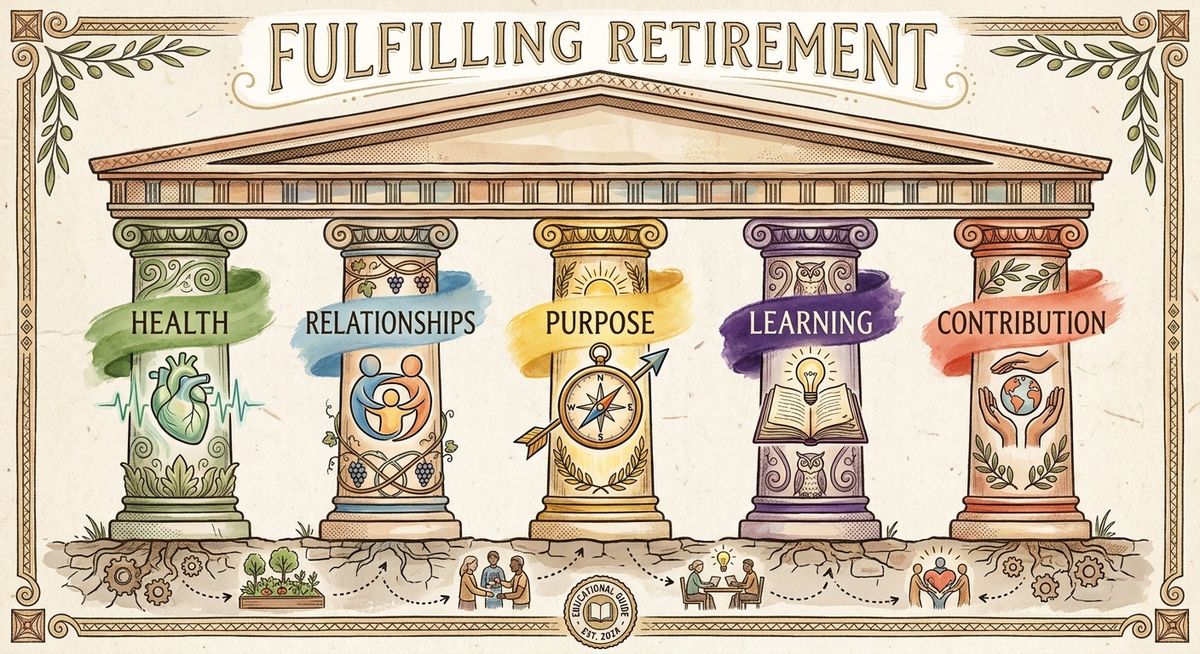
| Pillar | What It Means | Pre-Retirement Action | Warning Signs |
|---|---|---|---|
| Health | Physical & mental wellness | Build exercise habits, manage stress | All health plans start "after retirement" |
| Relationships | Deep connections beyond work | Invest in friendships, family bonds | Only work colleagues, no personal friends |
| Purpose | Reason to get up in the morning | Volunteer, mentor, create | Can't imagine life without work deadlines |
| Learning | Intellectual stimulation & growth | Develop hobbies, take classes | Haven't learned anything new in years |
| Contribution | Making a difference in others' lives | Find ways to help others | See retirement as "finally getting to relax" |
The Margaret Turnaround: A Case Study in Purpose Planning
Remember Margaret? Here's what changed everything for her. Instead of trying to fill her calendar with leisure activities, she started building her purpose portfolio two years before retirement.
Margaret's Pre-Retirement Strategy
"I realized I was planning for the first day of retirement, not the first decade. So I started 'practicing' retirement while still working - volunteering at literacy programs, taking art classes, building real friendships outside the office."
The transformation was remarkable. By the time she retired, Margaret wasn't losing her identity - she was graduating to a fuller version of herself. She went from crying in her kitchen to running a nonprofit literacy program that helps 300 adults per year learn to read.
The Relationship Recession: Why Money Can't Buy Community
Here's a harsh truth: Your work colleagues aren't your friends. They're your work colleagues. When you retire, those relationships often evaporate because they were built on professional proximity, not personal connection.
The average American retiree loses 78% of their social interactions within six months of leaving work.
This creates what researchers call "social poverty" - having money but lacking meaningful human connections. It's why some of the wealthiest retirees are also the loneliest.
Work-Based Social Network
- Basis Professional proximity
- Topics Projects, deadlines, office politics
- Longevity Ends with retirement
- Depth Surface level
Personal Social Network
- Basis Shared interests & values
- Topics Life, dreams, personal growth
- Longevity Continues through retirement
- Depth Meaningful connection
Building Your Personal Board of Directors
Just as you diversify your investment portfolio, you need to diversify your relationship portfolio. Successful retirees cultivate what I call a "Personal Board of Directors" - a network of relationships that serve different needs:
- The Challenger: Someone who pushes you to grow and try new things
- The Supporter: Your emotional anchor during difficult transitions
- The Connector: Someone who introduces you to new people and opportunities
- The Mentor: Someone you can learn from and seek advice from
- The Mentee: Someone you can guide and contribute to
The Purpose Paradox: Why Retirement Planning Stops Too Soon
We obsess over withdrawal rates and asset allocation, but when was the last time your financial advisor asked about your purpose allocation? The brutal reality is that traditional retirement planning only gets you to the starting line.
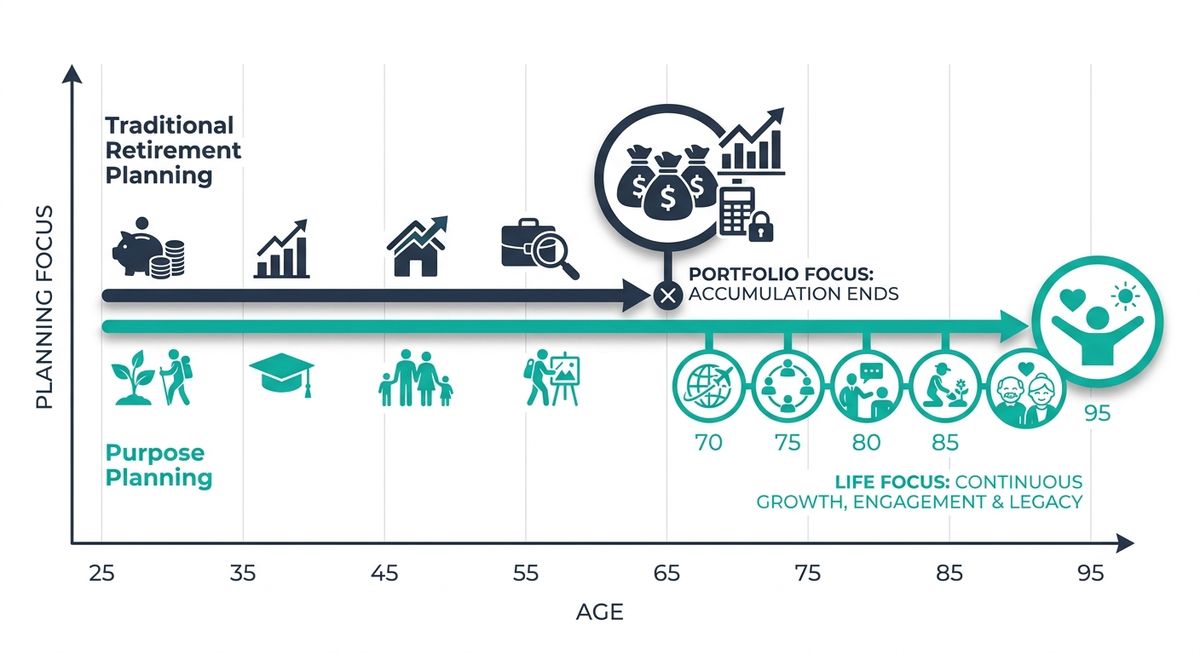
The 30-Year Gap
The average retirement lasts 25-30 years. That's longer than most careers. Yet 90% of retirement planning focuses only on the financial transition, ignoring the psychological and social challenges that define retirement satisfaction.
From Financial Independence to Emotional Intelligence
The FIRE movement (Financial Independence, Retire Early) has done amazing work helping people achieve financial freedom. But it's also created a generation of young retirees who are financially independent but emotionally adrift.
Consider Jake, who retired at 35 with $1.2 million. By 40, he was considering going back to work - not for the money, but for the meaning. "I achieved everything I thought I wanted," he told me, "but I didn't know what to do with myself."
Financial independence without emotional intelligence is just expensive unemployment.
The Action Framework: Your Retirement Identity Audit
Here's the uncomfortable question: If you couldn't tell anyone your job title, how would you introduce yourself? If your answer is "I don't know," you're at risk for retirement identity crisis.
🎯 The Five-Question Retirement Identity Audit
- Identity Question: Who are you beyond your job title? List 5 non-work identities (parent, musician, volunteer, etc.)
- Relationship Question: Do you have close friends who have never been your colleagues? Name them.
- Purpose Question: What would you do if money wasn't a factor and you couldn't work in your current field?
- Growth Question: When was the last time you learned something completely unrelated to your career?
- Contribution Question: How do you currently make a difference in someone's life outside of work?
If these questions make you uncomfortable, you're not alone. But discomfort is data. It's telling you where to focus your non-financial retirement planning.
The 5-Year Pre-Retirement Strategy
Don't wait until retirement to start building your post-career identity. Here's a year-by-year approach:
| Years to Retirement | Focus Area | Specific Actions |
|---|---|---|
| 5 years | Explore & Experiment | Try new hobbies, volunteer opportunities, take classes |
| 4 years | Build Relationships | Join clubs, reconnect with old friends, make new ones |
| 3 years | Develop Purpose | Identify what gives you meaning, start small projects |
| 2 years | Practice Retirement | Take extended vacations, reduce work hours if possible |
| 1 year | Plan Transition | Set up your first year's activities, establish routines |
Redefining Success: From Net Worth to Life Worth
Margaret's story has a powerful ending. Three years post-retirement, she's happier than she ever was as an executive. Her literacy nonprofit has expanded to serve three counties. She's married a fellow volunteer (her second marriage, after finding real love at 58). She's learning Spanish and planning to spend part of each year teaching literacy in Guatemala.
Her net worth? About the same as when she retired. Her life worth? Immeasurable.
The Ultimate Retirement ROI
"I spent 35 years building financial security," Margaret reflects. "But the five years I spent building my purpose portfolio before retirement? That's what gave me a life worth living."
Your Next Steps: Beyond the Numbers
As you plan for retirement, remember: Your 401(k) balance is important, but it's not sufficient. You need a purpose plan as much as a financial plan. You need relationship goals as much as asset allocation goals.
Start now. Not when you're 64 and facing retirement in six months. The Margaret who was crying in her kitchen waited too long to start building her post-career identity. The Margaret who's thriving started building it while she still had time.
Ready to build your purpose portfolio alongside your financial portfolio?
Calculate Your Complete Retirement Readiness
Our comprehensive assessment evaluates both your financial and purpose preparedness for retirement.