

The Ultimate Retirement Readiness Test: 6 Questions You Must Answer Before Putting in Your Notice


You've spent decades building a career. Early mornings, late nights, promotions you earned the hard way, fires you put out that nobody even thanked you for. And now, somewhere between your third cup of coffee and your fourth meeting that absolutely could have been an email, a thought keeps popping up: Is it time?
Most retirement advice focuses exclusively on the money. Do you have 25 times your annual expenses saved? Can you safely withdraw 4% per year? These questions matter, but they're incomplete. Retirement readiness isn't just about having enough money. It's about being ready for the most dramatic life transition you'll ever make.
After analyzing hundreds of successful (and unsuccessful) retirement transitions, we've identified six dimensions of readiness that determine whether retirement will be the best chapter of your life or your biggest regret.
- Desire: Are you living for tomorrow instead of today?
- Health: Is career burnout damaging your health?
- Flexibility: Is work-life balance impossible in your current role?
- Relationships: Do you wish you had more time for people who matter?
- Emotional: Are you emotionally ready for retirement?
- Financial: Can you actually achieve financial independence?
If you can answer "yes" to all six questions, you're not just ready to retire—you're probably overdue.
Meet Karen: A Case Study in Retirement Readiness
Karen Stephens, 58, has been a marketing director at a Fortune 500 company for 23 years. She makes $140,000 annually, has $1.8 million in retirement accounts, and owns a mortgage-free home worth $450,000. By traditional metrics, she's financially ready to retire.
But Karen can't shake the feeling that something's missing from the equation.
"I keep running the numbers, and they all say I can retire. So why am I terrified to actually do it?"
Karen's question reveals the gap in most retirement planning: the focus on financial capacity while ignoring emotional, physical, and social readiness. Let's walk through our six-question framework using Karen as a guide.
Question 1: Desire — Are You Living for Tomorrow Instead of Today?
The Deferred Life Plan Test
If you find yourself constantly saying "When I retire, I'll finally..." you might be suffering from Deferred Life Plan syndrome.
This isn't about being excited for retirement. It's about whether your current life feels like a placeholder for your "real" life that starts when you retire.
Signs you're living for tomorrow:
- You have a mental list of things you'll "finally" do when you retire
- You feel like you're enduring your current life rather than living it
- Most of your interests and hobbies are on hold "until you have time"
- You catch yourself frequently saying "someday" or "when I retire"
Definition: Deferred Life Plan
Deferred Life Plan: A mindset where you postpone meaningful experiences, relationships, and personal fulfillment until some future date—typically retirement—while treating your current life as temporary or incomplete.
Karen's Answer: "I realized I've been saving travel brochures for five years, waiting until I retire to visit Italy. I tell myself I'm too busy now, but the truth is I could take that trip next month if I wanted to. I think I'm using retirement as an excuse to avoid living now."

Question 2: Health — Is Career Burnout Damaging Your Health?
Chronic stress from work doesn't just make you tired. It literally changes your body at the cellular level, accelerating aging and increasing your risk of heart disease, diabetes, and depression.
Burnout Symptoms
- Sleep Quality Poor/Disrupted
- Energy Levels Consistently Low
- Illness Frequency Frequent Colds
- Blood Pressure Elevated
- Depression Risk 3x Higher
Post-Retirement Health
- Sleep Quality Improved
- Energy Levels Restored
- Illness Frequency Reduced
- Blood Pressure Normalized
- Life Satisfaction 85% Increase
Warning signs your career is damaging your health:
- You need caffeine to function and alcohol to unwind
- You get sick more often than you used to
- Your sleep is disrupted by work thoughts
- You feel anxious or depressed more often than happy
- Physical symptoms (headaches, back pain) have no clear medical cause
Research Finding
Stanford Study (2023): Workers experiencing chronic job burnout have a 23% higher risk of heart attack and a 40% higher risk of depression compared to satisfied workers. The health benefits of retirement often appear within 6-12 months of leaving a stressful job.
Karen's Answer: "My doctor has mentioned my blood pressure three visits in a row. I'm taking medication for anxiety, and I haven't slept through the night in months. I used to think this was normal for my age, but maybe it's not normal at all."
Question 3: Flexibility — Is Work-Life Balance Impossible in Your Current Role?
Some jobs can be dialed down. Others are all-or-nothing by design. If you're in senior management, running your own business, or in a client-facing role that demands constant availability, "phased retirement" might be impossible.
Signs your job doesn't allow for gradual transition:
- Your role requires travel, irregular hours, or emergency availability
- You've tried to reduce your workload but it always creeps back up
- Part-time or consulting arrangements aren't viable in your field
- Your industry culture views anything less than full commitment as career suicide
- You're responsible for other people's livelihoods (employees, clients, etc.)
If your current role is binary—either you're all in or you're out—early retirement might be your only path to reclaiming your time.
Karen's Answer: "I've tried to delegate more, but as a director, I'm ultimately responsible for everything my team does. I can't really work part-time when I'm accountable for a $15 million budget. It's all or nothing."
Question 4: Relationships — Do You Wish You Had More Time for People Who Matter?
Career success often comes at the cost of relationships. Missing family dinners, declining social invitations, postponing visits with aging parents. The question isn't whether you love your family—it's whether your current schedule allows you to show it.

Relationship readiness indicators:
- You feel disconnected from spouse, children, or close friends
- You miss important events due to work commitments
- You have aging parents you don't see enough
- Your social circle has shrunk to mostly work relationships
- You daydream about having unstructured time with loved ones
Karen's Answer: "My mother is 82 and lives two hours away. I see her maybe once a month, and when I do visit, I'm usually checking emails. I want to be present for whatever time she has left, but I can't do that with my current schedule."
Question 5: Emotional — Are You Emotionally Ready for Retirement?
Retirement represents the single biggest identity shift most people ever experience. For decades, you've been defined by your career. Who are you when that's gone?
The Identity Question
Complete this sentence: "I am a..." If your career title appears in the first three answers, retirement will require significant emotional adjustment.
Signs you're emotionally ready:
- You have interests and identities beyond your career
- You don't derive your entire sense of self-worth from work achievements
- You can imagine a fulfilling life without professional validation
- You're curious rather than terrified about retirement
- You have realistic expectations about retirement challenges
Signs you're not emotionally ready:
- You can't imagine what you'll do with your time
- Your social identity is entirely tied to your career
- You feel guilty when you're not being productive
- You worry about becoming irrelevant or forgotten
- You expect retirement to solve all your life problems
Karen's Answer: "This question scared me. I realized I introduce myself as 'Karen, marketing director' even at social events. I don't know what I'd say if I couldn't say that. I think I need to work on this before I retire."
Question 6: Financial — Can You Actually Achieve Financial Independence?
Now we get to the money question. But notice it's last, not first. Financial capacity without the other five elements often leads to a miserable retirement. The other five elements without financial capacity leads to continued work stress.
| Retirement Scenario | Annual Expenses | Target Net Worth (25x) | Safe Withdrawal (4%) |
|---|---|---|---|
| Lean FIRE | $40,000 | $1,000,000 | $40,000 |
| Standard Retirement | $70,000 | $1,750,000 | $70,000 |
| Comfortable FIRE | $100,000 | $2,500,000 | $100,000 |
| Fat FIRE | $150,000 | $3,750,000 | $150,000 |
Key financial readiness factors:
- Net worth calculation: Assets minus debt
- Expense analysis: Realistic estimate of retirement spending
- Income replacement: Social Security, pensions, investment income
- Healthcare costs: Insurance premiums and out-of-pocket expenses
- Inflation buffer: Purchasing power protection over 30+ years
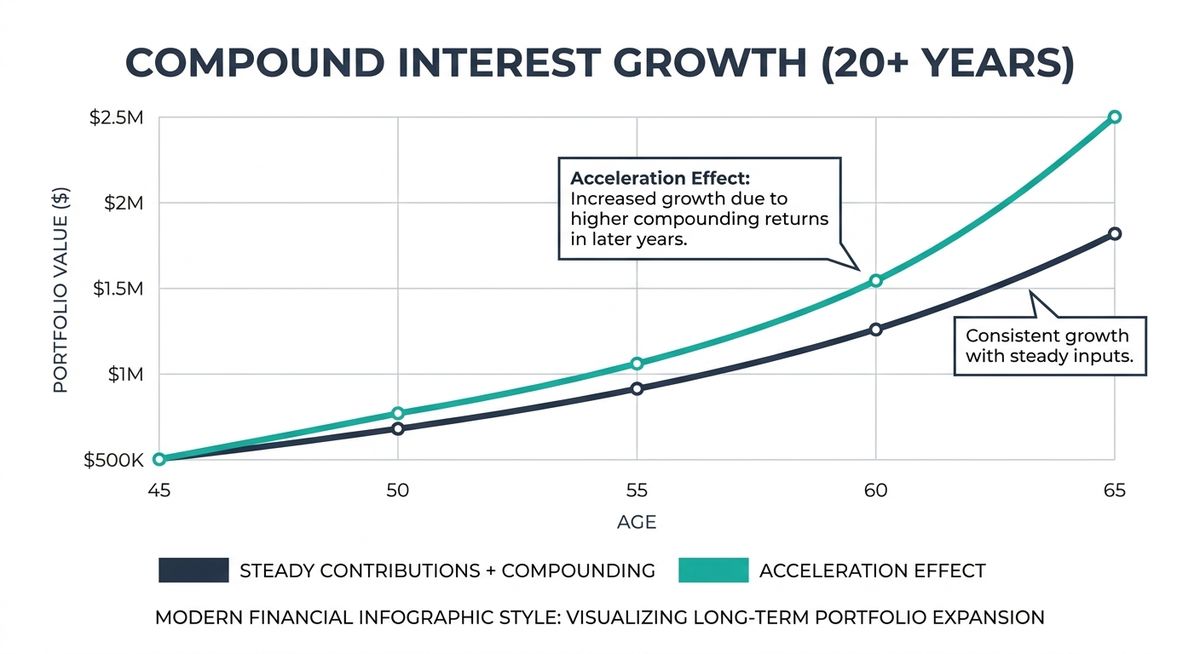
Karen's financial snapshot:
- Net worth: $2.25 million ($1.8M retirement + $450K home)
- Annual expenses: $65,000 (mortgage-free)
- 4% withdrawal: $72,000 from investments
- Social Security (at 67): $28,000 annually
- Healthcare: COBRA for 18 months, then marketplace insurance
Karen's Answer: "The numbers work. I can cover my expenses with investment income, and Social Security will be additional cushion when it kicks in. The financial piece isn't what's holding me back anymore."
Putting It All Together: Karen's Decision
After working through all six questions, Karen scored herself:
Karen's Readiness Scores
- Desire Need to Work On
- Health Ready
- Flexibility Ready
- Relationships Ready
- Emotional Need to Work On
- Financial Ready
Her Action Plan
- Next 6 Months Start Living Now
- This Year Book Italy Trip
- Develop Identity Join Photography Club
- Target Date December 2026
- Retirement Confident & Ready
"I'm not going to quit tomorrow," Karen decided. "But I'm also not going to wait until I'm 'perfect' to start living. I booked the Italy trip for this October. I joined a photography group that meets on weekends. And I set a target retirement date of next December—that gives me time to work on my identity issues while still honoring the fact that I'm ready in every other way."
Retirement readiness isn't about perfection. It's about honest self-assessment and intentional preparation across all dimensions of your life.
Your Next Steps
The six-question framework isn't a test you pass or fail. It's a diagnostic tool to identify what needs attention before you make the retirement decision.
🎯 Your 30-Day Retirement Readiness Action Plan
- Week 1: Complete the six-question assessment honestly. Write down your gut reaction to each question.
- Week 2: For any "not ready" areas, brainstorm specific actions you could take. Don't try to solve everything—just identify concrete steps.
- Week 3: Start implementing changes in your current life. If you're living for tomorrow, plan something meaningful for next month. If you're burned out, schedule a real vacation.
- Week 4: Run the financial numbers using our retirement calculator. Don't guess—know exactly where you stand.
Remember: You don't need to score "ready" on all six dimensions to start planning. But you do need to be honest about your gaps and intentional about addressing them.
Some people will discover they're more ready than they thought. Others will realize they have work to do beyond just saving money. Both discoveries are valuable.
The goal isn't to retire as soon as possible. It's to retire when you're truly ready to make the transition successfully. That might be sooner than you think, or it might be later than you hoped—but it will be the right time for you.
Ready to dive deeper? Our comprehensive retirement calculator can help you model different scenarios and timelines based on your specific situation. And if you want to explore the emotional and identity aspects of retirement, check out our guide on navigating retirement identity transitions.