

The Top 20 "Killers" of Retirement Plans


Retirement plans almost never blow up in one dramatic moment. There's no margin call, no scary envelope from the bank, no Tuesday morning where you check the account and the money is just gone. They go flat like a tire goes flat — slowly, quietly, over about six months, usually from something the owner noticed once, back in March, and figured he'd deal with later.
Researchers at Boston College found that 83% of retiree households get hit with an unexpected expense in a given year, averaging about $7,100 — and 27% couldn't cover even one year of that after draining every dollar of cash and retirement savings they have. This isn't a market problem, it's a planning problem.
Below are the 20 most common ways retirement plans fail, grouped into four categories, each tagged with how reversible it is once it happens — plus a 21st killer that ignores the other twenty and takes the decision out of your hands entirely.
That's not a market problem. That's a planning problem. Those are very different animals.
So here are the 20 retirement plan mistakes most likely to take your plan out, grouped by category. I've added a note on reversibility for each one, because that's the part nobody bothers to tell you. Some of these you can fix at 70 over a long weekend. Some of them lock in forever the day you sign the form.
Category 1: Structural and Mindset Mistakes
1. Not having a written income plan
Only about a third of Americans have a written financial plan. Everybody else is doing mental math on a number that has to last thirty years. That's a lot of mental math.
A real plan names the source of every month's income (Social Security, pension, portfolio withdrawals, that rental in Tucson), the order you'll pull from accounts, and the year each source turns on. My rule is simple: if you can't write your retirement income on one page, you don't have a plan. You have a hope. Hope is lovely. It's just not a plan.
There's a second reason to write it down, and it's the one people don't like talking about. Financial decision-making ability peaks around age 53. Among adults over 85, roughly 30% have dementia and another 30% show measurable cognitive impairment. A plan that lives only inside your head can't be run by anyone else when you need someone else to run it. Write it down while writing it is easy — and while you're in there, name a durable power of attorney and add a trusted contact to every account.
Reversible? Yes, at any age. Cheapest fix on this whole list.
2. Starting too late
Compounding does its heaviest lifting in exactly the years you least feel like funding it. Your twenties. When you're broke and there's a trip to Thailand on the table.
Start at 25
- Annual deposit $5,000
- Assumed return 7%
- Balance at 65 ~$998,000
Start at 35
- Annual deposit $5,000
- Assumed return 7%
- Balance at 65 ~$472,000
That skipped decade cost you $50,000 in deposits and about $526,000 in ending wealth. Ten grand a year of vanished future money, give or take.
And here's where most people actually are, because context matters more than shame: Vanguard's How America Saves 2026 reports an average 401(k) balance of $167,970 at the end of 2025, but a median of just $44,115. The distance between those two numbers is basically the entire American retirement story in one line.
Reversible? Partly. Catch-up contributions genuinely help. But you can't buy back the compounding. Nobody sells it.
3. Underestimating longevity
Planning to average life expectancy is planning for a coin flip. You're building a thirty-year financial structure on 50/50 odds.
Society of Actuaries data gives a 65-year-old couple a 50% chance that at least one of them reaches 92. So build the plan to 95, and pay special attention to the part that covers whichever spouse is still here at the end.
Reversible? Yes, but only by adjusting spending, and that adjustment gets a lot less fun the longer you put it off.
4. The "go-go" years overspend
The first five years of retirement are the expensive ones. The trips. The kitchen. The boat. The place in Portugal you've been talking about since 2011.
I get it. I've done a version of it. But spending in those specific years does outsized damage, because that money compounds against you at the exact rate it was supposed to compound for you.
The real safe withdrawal rate
Morningstar's 2026 research puts the safe withdrawal rate at 3.9% for someone taking a fixed, inflation-adjusted income from a portfolio holding 30% to 50% stocks. Not 4%. And definitely not the 5% or 6% that early-retirement excitement tends to produce around month three.
But here's the good news buried in that same research: retirees who are willing to flex their spending down in bad markets can start as high as 5.7%. That's a huge difference, and it's the single best argument I know for building flexibility into your plan before you need it. That flexibility only means something if you know your own numbers, and you can run these projections for your own situation at ReadyAimRetire.com to see what withdrawal rate actually fits your portfolio and spending pattern.
Reversible? Partly. Overspending in year one, you can recover from. Overspending for five straight years, usually not.
5. Extreme miserliness and fear of spending
The opposite failure is way more common than anybody admits, and honestly it makes me sadder.
EBRI's decumulation research found that retirees with $500,000 or more in non-housing assets spent down only 11.8% in their first 20 years of retirement. Twenty years. When asked why, 31% gave a purely emotional reason: they just feel better when the balance stays high.
I understand that feeling completely. But there's a modeling error hiding underneath it. David Blanchett's "retirement spending smile" research, updated in Financial Planning Review in 2026, shows that real spending actually declines through roughly age 84, bottoming out around 26% below where it started, before ticking back up at the very end of life. A lot of people are hoarding against a straight-line inflation assumption that doesn't match how actual retirees actually live.
The saddest thing isn't running out of money. It's dying with money you were too scared to use on the people you love.
Reversible? Yes. But every year you don't spend is a year you don't get back.
Category 2: Investment and Portfolio Pitfalls
6. Sequence of returns risk
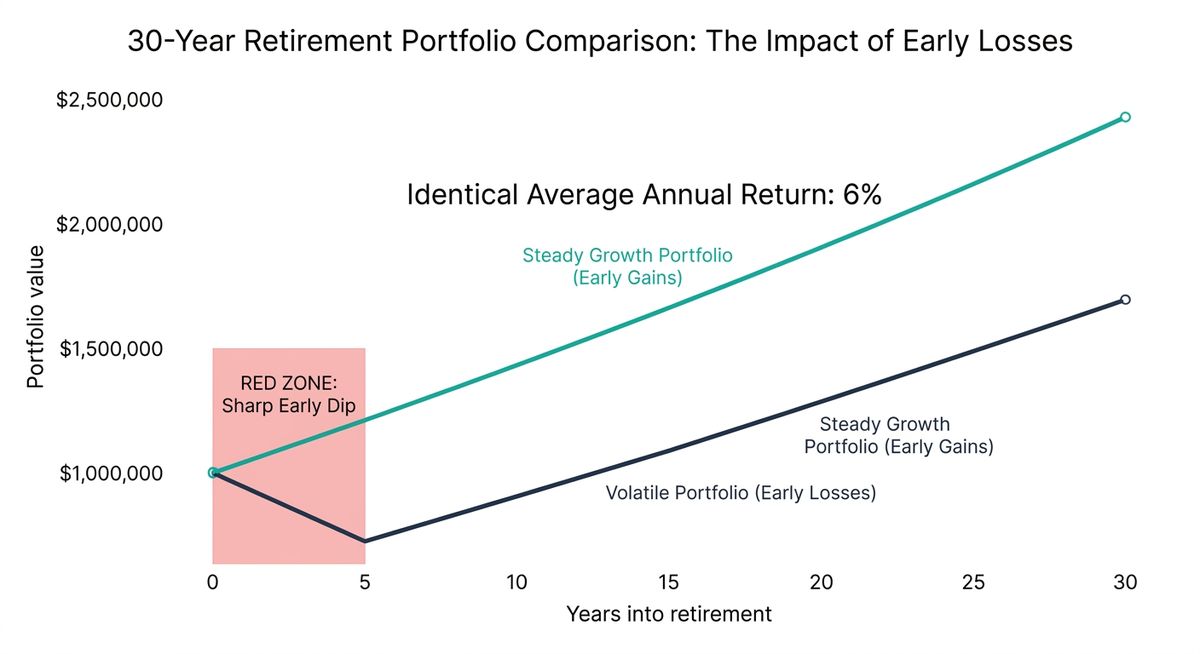
Two people can earn the identical average return over thirty years and end up in completely different places, purely based on what order those returns showed up in. That's not intuitive, and sequence of returns risk is the single most important thing on this list that most people have never heard of.
Here's why it works that way. A downturn in your first three to five years, while you're selling shares to buy groceries, permanently removes shares that would have participated in the recovery. They're gone. They don't come back when the market does. That window — roughly five years before retirement through five to ten years after — has a nickname: the "retirement red zone."
The defense
Hold two to five years of expenses outside of stocks. Build a bond ladder for the near-term years. Then let your equity allocation drift up naturally as you spend the fixed income down. Michael Kitces has made the point that bucket strategies and "rising equity glidepaths" are really the same mechanism wearing different hats.
Reversible? No, not once it's happened. Completely preventable beforehand. That's the whole deal with this one.
7. Unrealistic return assumptions
A plan that only works at 9% or 10% a year isn't a plan. It's a bet with a spreadsheet attached.
Want proof that safe spending rates aren't a constant? Morningstar's number rose from 3.7% to 3.9% for 2026, mostly because bond yields went up. Safe withdrawal rates are an output of market conditions — they're not a number you get to assume and then stop thinking about.
Same honesty applies to fees, which are just the return assumption looking in a mirror. Half a million dollars growing at 7% gross for thirty years ends around $3.57 million if you're paying 0.25%. At 1%, it ends around $2.87 million. That's roughly $700,000 for a line item most people have never once seen on a statement.
If you withdraw 4% and pay 1% in fees, your portfolio is actually depleting at 5%. The fee doesn't come out of the returns. It comes out of your retirement.
Every retirement plan is different, which is exactly the problem with rule-of-thumb assumptions. ReadyAimRetire lets you test how your actual return assumptions, fees, and withdrawal strategy work together with your specific numbers instead of a generic average.
Reversible? Yes, and it costs you nothing but honesty in the spreadsheet.
8. Misaligning risk near the fragile zone
At 60, both extremes will get you. Too aggressive, and a crash arrives at the exact moment you have the most to lose. Too conservative, and inflation quietly eats you over the next thirty years instead. Slower, but just as fatal.
The classic breakdown here comes from Mottola and Utkus at Wharton's Pension Research Council, who sorted 401(k) portfolios into green, yellow, and red and found roughly three in ten were "red" — meaning either no stock exposure at all, or a scary concentration in employer stock. Full disclosure though: that study is from 2007, so it predates auto-enrollment and the whole target-date fund era. I'd treat the 31% as a caution flag rather than a current headcount. What hasn't changed even slightly is the two ways it says people fail.
For something current, T. Rowe Price target-date funds still hold 63% to 77% stocks at age 58. So being 80% in stocks after 55 is defensible — it's just only defensible if you've also got two to five years of expenses in cash, or if Social Security and a pension already cover your baseline.
Reversible? Yes, before the crash. Not after. There's no third option.
9. Emotional and panic selling
March 2025 was the busiest month for 401(k) trading since October 2020. One Monday hit roughly ten times normal daily volume as people bailed into stable value funds.
Meanwhile, 97% of Vanguard 401(k) participants made no trades whatsoever that year. And the average balance closed 2025 at a record $167,970.
The people who did nothing won. They almost always do. Doing nothing is a skill, and nobody puts it on a resume.
Reversible? No. Selling low takes a paper loss and makes it a real one. Permanently.
10. Lack of diversification
Any single position over 5% of your portfolio counts as concentrated. That's the whole rule.
Company stock is the classic trap, and it's a trap because it's double jeopardy: your salary, your equity comp, your career path, and your nest egg all riding on one company's fortunes. When companies go down, they tend to take the job and the retirement account in the same quarter. Ask anyone who was at Enron, or at a certain regional bank in 2023.
Reversible? Yes, though you'll want tax planning to unwind it without a big bill.
Category 3: Health, Debt, and Income Drains

11. Ignoring long-term care
This is the biggest unfunded risk most retirees are carrying, and most of them don't know they're carrying it.
HHS data shows 70% of adults who make it to 65 develop severe long-term care needs before they die. Per the Administration for Community Living, 20% will need care for more than five years, with women averaging 3.7 years and men 2.2.
| Care type | Median annual cost |
|---|---|
| Private nursing home room | $129,575 |
| Assisted living | $74,400 |
| In-home care (44 hrs/week) | $80,080 |
Source: CareScout 2025 Cost of Care survey, released March 2026.
And here's the part that catches almost everybody: Medicare does not cover custodial care. It covers up to 100 days of skilled care after a qualifying hospital stay, and then it's done. Medicaid picks up roughly 60% of nursing home residents, but only after you spend down to a $2,000 asset limit in most states, and there's a 60-month look-back on anything you gave away.
If you do shop for insurance, shop hard. A 2026 study found an Illinois couple, both 60, quoted anywhere between $4,591 and $7,173 a year for identical coverage — a 56% spread. Over twenty years of premiums, it's more than $50,000 for the same policy. One afternoon of quotes.
Reversible? Barely. Insurability drops off fast after 65, and a claim can show up with zero warning.
12. Underestimating healthcare and insurance gaps
Fidelity's July 2026 estimate says a 65-year-old retiring this year needs $185,500 for healthcare — up 7.5% from $172,500 last year. And it excludes long-term care entirely, so add everything in item 11 on top.
Three specific traps in 2026:
- Part B is $202.90 a month, up 9.7% from 2025. The Social Security COLA was 2.8%. You do that math.
- IRMAA is a cliff, not a ramp. The surcharges kick in at $109,000 MAGI single and $218,000 joint, based on your income from two years earlier. One single dollar over that first threshold takes your Part B premium from $202.90 to $284.10 a month for the whole year. The top tier runs $689.90. A retiree with 2024 MAGI of $109,001 pays exactly the same as a retiree at $135,000.
- The ACA subsidy expiration is the story of 2026. Enhanced premium tax credits lapsed December 31, 2025. Average annual net premiums for subsidized enrollees went from $888 to $1,904, a 114% jump, and KFF names early retirees among the people getting hit hardest. A 60-year-old with $55,000 of income can go from a couple hundred bucks a month to over $1,000.
If you're planning to retire before 65, go reprice your bridge coverage this month. Not next quarter. This month. Whatever you assumed back in 2024 is not true anymore.
Reversible? Partly. IRMAA and ACA exposure are both manageable through income timing, but you need two years of lead time to do it.
13. Carrying high-interest debt into retirement
Average household consumer debt sits at $105,444. And this one genuinely surprised me: federal student loan borrowers aged 62 and older grew from 1.7 million in 2017 to 2.8 million in 2024 — a 65% jump. Counting everyone 60 and up, it's over 3.6 million people.
Debt in retirement is worse than debt while you're working, and the reason is structural. The payment is fixed. Your income source is not. A market drop doesn't pause your minimum payment — it just forces you to sell into weakness to make it.
Reversible? Yes, and for most pre-retirees it's the highest-return move on the board.
14. Claiming Social Security too early
Full retirement age is 67 for anybody born in 1960 or later. Claiming at 62 cuts your benefit by roughly 30%, permanently. For a maximum earner in 2026, that's the difference between $2,969 a month at 62 and $5,181 at 70.
Somewhere between 22% and 30% of people claim at 62 anyway. Fewer than 10% wait until 70. And 19% of retirees say they regret claiming early, with the regret getting stronger among older folks — exactly what you'd expect from a decision whose cost compounds every single year you live.
Delaying the higher earner's benefit is the cheapest longevity insurance money can buy. And it does double duty, which is the part people miss. When one spouse dies, the household keeps the larger of the two checks and loses the smaller one completely. So every dollar you add to the bigger benefit is a dollar the survivor keeps for the rest of their life.
Reversible? No. You get 12 months to withdraw an application. After that, it's carved in stone.
15. Relying on an expected inheritance
Only about 20% of Americans now expect to receive an inheritance, down from 25% just a year earlier. And there's a documented expectation gap that's a little uncomfortable: 32% of Millennials and 38% of Gen Z expect one, but only about 22% of Boomers and Gen X are planning to leave one. Meanwhile, 57% of the people expecting a transfer say it's critical to their long-term security.
Long-term care eats inheritances faster than anything else on earth. One five-year nursing home stay at today's median rate wipes out roughly $648,000. That's the inheritance, and probably the house.
Reversible? Yes, if you find out early. So go have the conversation. Only 60% of people who are planning to leave money have actually mentioned it to the person receiving it. It's an awkward twenty minutes that can reshape a decade.
Category 4: Taxes, Inflation, and Life Events
16. Ignoring tax drag on withdrawals
Roughly 90% of IRA assets sit in traditional, tax-deferred accounts. Every dollar comes out as ordinary income.
So let's be clear about something. A $1 million 401(k) is not a $1 million retirement account. It's a $1 million account with a silent partner who hasn't been paid yet, and he's going to want his cut on your schedule, not his.
A closing window
The $6,000 senior bonus deduction ($12,000 per couple) exists only for tax years 2025 through 2028, and it phases out above $75,000 MAGI single and $150,000 joint. Stack it on the 2026 standard deduction and a couple where both spouses are 65 or older shelters $47,500 before the first dollar gets taxed. That is a Roth conversion window with a countdown clock on it.
And convert while you're still a couple. Here's why: a household with $140,000 of taxable income sits in the 22% bracket in 2026. When one spouse dies, the survivor keeps most of that income but now files single — $115,000 of taxable income, less money coming in the door, and a 24% bracket. IRMAA thresholds for a single filer are exactly half the joint amounts, so that can bite too. This one is only preventable while both spouses are alive, which is a hard sentence to write and a harder one to act on. Do it anyway.
Reversible? Yes, through conversions. But the cheap window closes in 2028.
17. RMD surprises
Required minimum distributions start at 73 if you were born 1951 through 1959, and 75 if you were born in 1960 or later. Go find out which side of that line you're on. It takes ten seconds and people get it wrong constantly.
The classic trap works like this. Your first RMD can be deferred to April 1 of the following year, which sounds like a gift. Take it and you end up with two RMDs in one tax year, which can jump you a bracket and trigger an IRMAA tier two years down the road. The penalty for missing an RMD is 25% of the shortfall, knocked down to 10% if you fix it within two years.
If you're still working, know your 2026 limits: $24,500 for a 401(k), $8,000 catch-up at 50 and over, and a super catch-up of $11,250 for ages 60 to 63. New this year, and this one's catching people flat-footed: if your 2025 wages with the plan sponsor topped $150,000, your catch-up contributions must be Roth. If your plan doesn't offer a Roth option, you might lose catch-up eligibility altogether. Confirm with HR before you set your deferral, not after.
Reversible? The tax bill, no. The bracket management leading up to it, absolutely yes.
18. Overlooking inflation
At 3% inflation, your purchasing power gets cut in half in about 24 years. Somebody spending $60,000 a year at 65 needs over $125,000 to buy that same life at 90. Even at a mild 2%, you lose nearly 40% over 25 years.
And of course the category that inflates fastest is the one you're going to use most. Medical inflation runs 4% to 5% while general CPI sits near 2.4%.
Reversible? No, but a plan with real stock exposure and flexible spending soaks it up just fine.
19. Providing financial support to adult children
Half of parents are financially supporting an adult child right now, a three-year high, at an average of $1,474 a month.
But here's the number that should stop you cold. Working parents are putting $1,589 a month toward their children's lifestyle versus $673 a month toward their own retirement. That's 2.3 times more going out than going in. Over ten years, that's roughly $190,000 redirected — and that's before you count what the compounding would have done.
I want to be careful here, because I know why people do this and it comes from love. Nobody's a villain for helping their kid. But your kids can borrow for school. They can borrow for a house. They can borrow for a car.
You cannot borrow for retirement. There is no loan for that.
Reversible? Yes, but it's the hardest conversation on this entire list. By a mile.
20. Lack of an emergency cash buffer
And we're back where we started.
Those unexpected expenses show up in very specific, very boring forms: 60% of retiree households face rainy-day costs averaging $3,300, 58% face healthcare costs averaging $4,100, and 29% face family emergencies averaging $5,700. Smooth all that across retirement and it's about $6,000 a year, roughly 10% of annual income.
Without cash, every water heater becomes a forced stock sale. And the water heater always seems to pick a down month. They know. I'm convinced they know.
Hold one to three years of planned withdrawals in cash and short-term bonds. It's the single most effective defense against killer #6 up there, and it costs you almost nothing to set up.
Reversible? Yes, and you could start fixing it this week.
The 21st Killer: The One Nobody Puts on the List
Every single item above quietly assumes you get to pick when you retire.
According to EBRI's 2026 Retirement Confidence Survey, 46% of retirees left the workforce earlier than they planned. Workers say they expect to retire at 65. The average retiree actually stopped at 62. And among 2025's early retirements, 76% were driven by things the retiree had no control over: health issues, disability, employer downsizing, and caregiving for someone else.
This is the most dangerous one on the page, and it's dangerous precisely because it isn't a mistake you make. It's a thing that happens to you. And it converts every assumption in items 1 through 20 into a false one, all at once, on a Tuesday. The retirement date jumps up five years. The Social Security claim gets pulled forward. That ACA bridge you figured you'd need for two years now has to stretch seven.
The defense isn't exciting: build the plan so it survives retiring three years early. If it only works when everything goes right, it isn't a plan.
Three more things that happen to you, not because of you
Americans 60 and older lost $7.75 billion to fraud in 2025, a 59% jump in a single year, averaging $38,500 per victim, with AI voice cloning now supercharging the old grandparent scam. Divorce among people over 65 has tripled since 1990, and both spouses typically walk away with about half their wealth. And Social Security's retirement trust fund is projected to run dry in late 2032, which triggers an automatic 22% benefit cut unless Congress acts.
None of those three is a planning error. All three deserve a line in your stress test anyway.
What to Do Monday Morning
Not all twenty of these retirement plan mistakes deserve equal attention this week. Sort them by reversibility, because reversibility is what actually determines urgency.
Sort your risks by how reversible they are
- Permanent once done, so slow down and think: Social Security claim timing, panic selling, and inflation exposure. Get these wrong and there's no undo button.
- Needs two years of lead time: IRMAA and ACA income management, Roth conversions before the senior deduction sunsets in 2028, and long-term care insurance while you're still insurable.
- Fixable this month: Writing down your income plan. Building the cash buffer. Killing the high-interest debt. Repricing your pre-65 health coverage. Auditing what you're actually paying in fees. Having the talk with your adult children, and the other talk with your parents about inheritance.
Start by modeling your retirement at ReadyAimRetire, so you can see which of these twenty actually apply to your numbers instead of guessing. Then start with the written income plan, because you can't triage the other nineteen until you can see them all on one page. Then build the cash buffer, because it neutralizes the two most destructive items on the list simultaneously. Then check which side of that 1959/1960 RMD line you're on, and go reprice your health insurance for 2026.
Because here's the thing I've come to believe after years of watching this up close. The retirees who do best aren't the ones who dodged all twenty. Nobody dodges all twenty.
They're the ones who knew which three were coming for them.
Thanks for reading if you've made it this far. Go write the one page.
Peace!