

Navigating Social Security: Claiming at 62, 67, or 70


Dave Ramsey tells you to claim at 62 and invest the checks. Suze Orman tells you to wait until 70 and lock in the biggest guaranteed paycheck you'll ever own. Same Social Security program. Same rules. Same retiree sitting at the same kitchen table. They land in opposite places because they're answering different questions. And here's the thing nobody says out loud: neither one is asking the question that actually matters.
- The break-even ages for claiming (roughly 78.7, 82.5, and 80.5, depending on which two ages you compare) sit well before the joint life expectancy of a 65-year-old couple, which is about 89.
- Social Security isn't an investment you time — it's inflation-adjusted longevity insurance you buy with checks you choose not to cash.
- In 2026, four things shifted the math: an earlier trust-fund depletion date (an argument against claiming early, not for it), a new senior tax deduction that only matters for people turning 65 by 2028, a survivor benefit floor that's better protected than most articles claim, and WEP/GPO repeal that reset the numbers for roughly three million public-pension retirees.
- For married couples, the usual best move is sequencing: the lower earner claims early for cash flow, the higher earner delays to 70 to maximize what the survivor keeps for life.
Bottom line: stop asking when you break even, and start asking what happens if you or your spouse lives to 95.
Almost everything you'll read about claiming strategy is really answering a break-even question. When do the bigger delayed checks finally catch up to the smaller early ones? Fine. Let's answer it. Using a $2,000 Primary Insurance Amount, the break-evens are age 78 and 8 months for 62 versus 67, right around 82 and a half for 67 versus 70, and about 80 and a half for 62 versus 70.
Now let me put a number next to those that hardly anyone puts next to those.
The joint life expectancy of a 65-year-old couple, meaning the age by which at least one of the two is expected to still be around, is about 89. That's six and a half years past the latest break-even on that list. Roughly half of 65-year-old couples will see at least one spouse make it past 90. About one in five will see somebody make it past 95.
So for most couples this isn't a close call that needs a spreadsheet and a long weekend. It's the wrong frame entirely. The break-even ages aren't a coin flip you might lose. They're numbers you're statistically likely to fly right past.
Social Security isn't an investment you're trying to time. It's inflation-adjusted longevity insurance, and you buy it with checks you choose not to cash. And in 2026, four things changed about how that purchase should be priced.
The Mechanics, Explained Like a Human
Three rules run the whole show.
Primary Insurance Amount (PIA)
Your baseline. Social Security takes your 35 highest years of inflation-adjusted earnings and averages them. Work fewer than 35 years and zeros get dropped into that average. They drag it down. No mercy.
Full Retirement Age (FRA)
When you're entitled to 100% of your PIA. Born in 1960 or later? Your FRA is 67. And "full" does not mean "maximum" — you can go past 100%. A lot of people don't realize that.
The adjustments run both directions
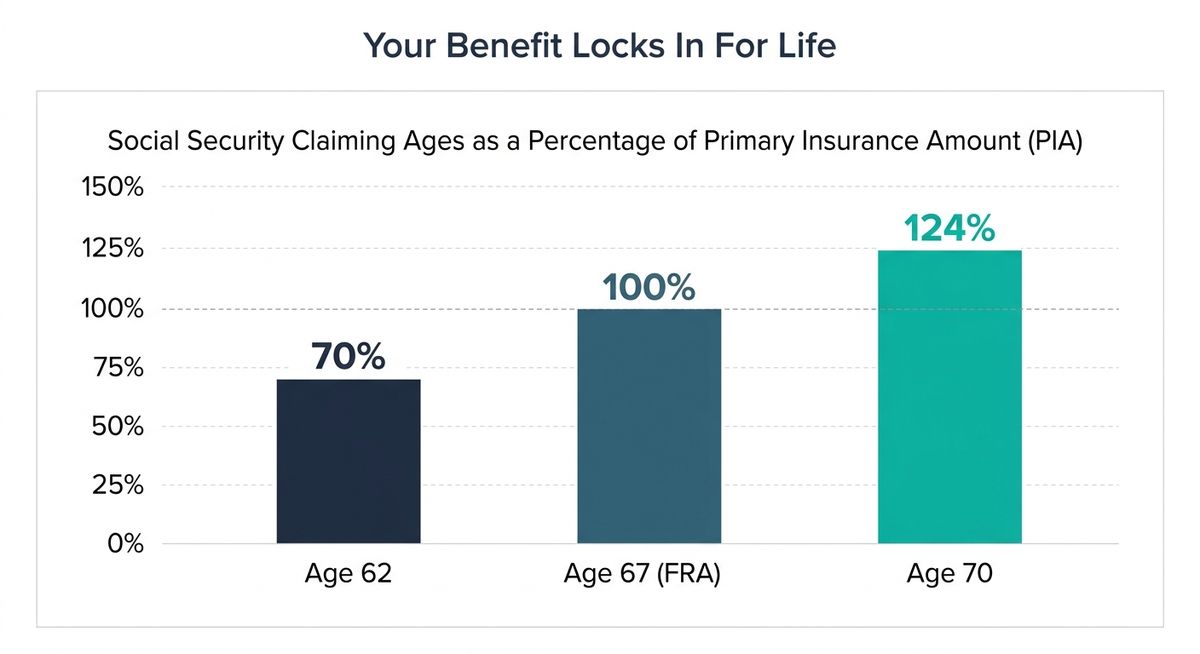
Claim early and your benefit gets permanently reduced by 5/9 of 1% per month (0.5556%) for the first 36 months before FRA, then 5/12 of 1% per month (0.4167%) for every month beyond that. With an FRA of 67, the steeper reduction covers ages 64 through 67, and the gentler one covers 62 through 64. Total damage if you claim at 62: a permanent 30% cut. You get 70% of your PIA. For life.
Go the other way and you earn delayed retirement credits worth 2/3 of 1% per month, which is 8% a year. From 67 to 70 that's a permanent 24% bump, or 124% of PIA.
Two wrinkles worth knowing. Those credits pile up monthly, but they generally don't get paid out until January of the following year. So if you start benefits mid-year, your check catches up a few months later. Don't panic and call SSA. Second wrinkle: delayed retirement credits only attach to your own retirement benefit. Spousal benefits earn nothing from waiting. Zero. We'll come back to that one.
In 2026, the max possible benefit is $2,969 a month at 62, $4,152 at FRA, and $5,181 at 70. The average retired worker gets about $2,080. Benefits went up 2.8% with this year's COLA.
These are averages and maximums, not your number. You can run these calculations for your own situation at ReadyAimRetire.com, plugging in your actual PIA and seeing how the 62, 67, and 70 scenarios play out against your own savings and spending.
Quick Comparison
Age 62
- Payout 70% of PIA
- Cash flow Available now
- Earnings test Applies if working
- Best for Health concerns, no buffer
Age 67 (FRA)
- Payout 100% of PIA
- Reductions None
- Earnings test None
- Best for Standard, balanced longevity
Age 70
- Payout 124% of PIA
- Survivor protection Maximum
- If you don't live to collect Zero payout
- Best for Good health, protecting a spouse
Option 1: Claiming Social Security at 62
About 26% of newly awarded retirees start here. That's the lowest share in at least four decades, down from roughly 60% back in 1985. The average claiming age has climbed from about 63 to about 65 over that same stretch. Early claiming isn't the automatic default it used to be, but it's still the single most common age to file.
What you get. Cash, now. And that matters enormously if you've got thin savings, a health condition that shortens your runway, or a job your body has simply stopped agreeing to do. My buddy David spent 30 years on commercial roofs in Phoenix. At 62 his knees had opinions. Every Social Security dollar is a dollar you don't yank out of your portfolio, so claiming early also softens sequence-of-returns risk during the exact years your balance is biggest and most exposed.
What you give up. A permanent 30% haircut, applied to every check for the rest of your life and to every future COLA calculated off it. And if you retire at 62 after a career that peaked in your late 50s, you may be leaving those skinny early-career years parked in your 35-year average, which quietly penalizes the baseline itself. This is the exact trap that cost Dana, at 60 with $600K saved, the single most expensive line item in her entire retirement plan.
What almost everyone gets wrong. Claim before FRA and keep working, and Social Security withholds $1 for every $2 you earn above $24,480 in 2026. Most articles stick this under "penalties" and move on. It is not a penalty.
The earnings test gives your money back
Benefits withheld under the earnings test come back to you at FRA through something called an Adjustment of the Reduction Factor, which recalculates your benefit as if you'd claimed later by the number of months withheld. Picture a 63-year-old making $50,000. He's over the limit by $25,520, so SSA withholds $12,760 — a little more than nine months of a $1,400 check. (SSA holds whole months, so it actually holds ten and refunds the difference.) At FRA, his benefit gets permanently recalculated as though he'd claimed nine months later. That's about a 5% raise. He didn't lose that money. He deferred it, and he bought a bigger lifetime benefit with it.
Two more details the standard treatment skips right over. In the calendar year you hit FRA, the limit jumps to $65,160, the withholding rate drops to $1 for every $3, and only the earnings from months before your FRA month even count. After FRA, no limit at all. Work as much as you want.
And the test only touches wages and self-employment income. Pensions don't count. IRA and 401(k) withdrawals don't count. Investment income doesn't count. Your spouse's paycheck doesn't count against you either.
Option 2: Claiming Social Security at 67 (Full Retirement Age)
Claim at Full Retirement Age and you get exactly 100% of your PIA. No reductions, no earnings test, no drama. It's the default choice and it's a perfectly reasonable one for a whole lot of people.
The tax treatment here is better than most income, and worse than you've probably been told.
The good part: at most 85% of your benefit is ever subject to federal income tax, so at least 15% is permanently tax-free. In 2026 exactly eight states tax benefits at all: Colorado, Connecticut, Minnesota, Montana, New Mexico, Rhode Island, Utah, and Vermont. West Virginia finished phasing its tax out this year. And most of those eight use income-based exemptions that fully shield low- and middle-income retirees anyway.
Now the part the cheerful version leaves out.
The provisional income thresholds that decide how much of your benefit gets taxed ($25,000 and $34,000 if you're single, $32,000 and $44,000 if you're married filing jointly) have been frozen since 1984. Nineteen eighty-four. They are not indexed to inflation and they never have been.
Inside the phase-in range, every extra dollar of ordinary income drags up to 85 cents of your benefits into taxation right alongside it. A retiree sitting in the 22% bracket can face an effective marginal rate north of 40% on one more dollar of IRA withdrawal.
This is what planners call the tax torpedo, and here's the cruel part: it's a middle-income problem, not a wealthy one. Folks nowhere near any bracket you'd call high get hit the hardest.
Here's the connection almost nobody makes. The torpedo is an argument for delaying. Waiting until 70 gives you years to draw down and convert tax-deferred balances while no benefits are in the provisional income calculation at all. That shrinks the RMDs and the provisional income that would otherwise blow up on you later. Delaying isn't just an income strategy. It's a tax strategy.
The honest knock on claiming at 67 is that it optimizes nothing in particular. It doesn't hand you capital during your low-60s go-go years, and it doesn't max out your guaranteed floor. If your health or family history points short, 62 collects more total dollars. If it points long, 70 does. Age 67 really wins when you genuinely need the income at 67 and not a day sooner.
Option 3: Claiming Social Security at 70
Michael Kitces calls delaying Social Security a triple hedge, and honestly it's the best framing anybody has come up with for this decision.
Here's his arithmetic. A 66-year-old with a $1,000 PIA who delays one year is putting $12,000 at risk. Break-even shows up around 86. But by age 100, that one single year of delay has thrown off roughly $48,000 in extra lifetime benefits. Four times what was risked.
And that comparison isn't against cash sitting in a coffee can. It's against a portfolio assumed to earn 8% nominal with 3% inflation, so a 5% real return, on the risk budget of a government-backed instrument. Change the weather to high inflation and weaker returns and the delay looks better, not worse. Break-even shrinks to 15 years and the payoff climbs toward $80,000.
"It won't necessarily win for every client, but as any good hedge should, it wins the most in the times the client will need it the most."
Delaying hedges longevity risk, lousy investment returns, and inflation all at once. And those three have an unfortunate habit of showing up to the party together.
There's a second benefit that Monte Carlo modeling makes visible, and I think it's underrated. Delaying reduces the severity of failure, not just the odds of it. If your portfolio runs dry at 88, a maxed-out 124% benefit means the essentials still get paid. The plan degrades. It doesn't collapse. Those are very different retirements.
The costs are real though, and I'm not going to soft-pedal them. You spend down retirement accounts between the day you stop working and 70, which shrinks your liquid capital at exactly the moment you might want it sitting there. And Social Security is social insurance, not an asset. Pass away at 69 having delayed, and you collect nothing. There's nothing to hand your kids.
Worth naming, though: the drawdown approach has actual research behind it. Alicia Munnell and Gal Wettstein at the Center for Retirement Research formalized what they call the Social Security bridge. You retire, you pull from the 401(k) an amount equal to what your Social Security check would have been, and you delay claiming. Their finding is the interesting bit. It's most valuable for households with roughly $250,000 or less saved — the kind of balance this Phoenix electrician was staring down at 62. Which is to say, the exact people who assume they can't possibly afford to wait.
And the broader evidence leans hard toward delay. NBER researchers found that more than 90% of workers aged 45 to 62 would maximize lifetime benefits by claiming at 70, and fewer than 1% do best by claiming before 66. Meanwhile only about 10% of new retirees actually start at 70, and 44% of people not yet retired plan to file before 67.
Big gap between what the math says and what people do. There usually is.
The Four Things That Changed in 2026
1. The trust fund headline argues against claiming early, not for it
The June 2026 Trustees Report moved OASI depletion to the fourth quarter of 2032, one quarter earlier than last year's projection, with 78% of scheduled retirement benefits payable after that. The 75-year shortfall jumped 16%, from 3.82% to 4.42% of taxable payroll. Call it $30.5 trillion. CBO models a deeper cut than SSA does, around 28% versus 22%.
(The combined OASDI number, which is the one SSA led its press release with, still shows 2034 and 83% payable. But combining those funds requires legislation that does not currently exist. Keep that in your back pocket.)
This is setting off a wave of panic-claiming. J.P. Morgan Asset Management put it plainly: "Should clients claim early out of fear of a future cut? We don't believe so."
And the arithmetic settles it, no opinion required. A benefit cut gets applied across the board to whatever you're already receiving. Claim at 62 and you take 70% of PIA, then absorb a 22% cut on top of that, and you land near 55% of PIA. Wait until 70, take 124% of PIA, absorb the same cut, and you land near 97%.
Claiming early doesn't dodge the reduction. It stacks with it.
2. The senior deduction reshaped the Roth conversion window, but only for one specific group
The conventional wisdom says ages 62 to 70 are a clean Roth conversion window. Low taxable income, low brackets, convert like crazy. The One Big Beautiful Bill Act made that messier.
It created a $6,000 per-person deduction ($12,000 married filing jointly) for people 65 and older, available for tax years 2025 through 2028, phasing out at 6% above $75,000 MAGI single and $150,000 joint, and gone completely at $175,000 and $250,000.
So if you're 65 or older right now, an aggressive conversion between now and 2028 can phase out that deduction at 6% on top of your regular bracket. Hidden marginal-rate spike. Conversions you do before you turn 65 don't touch it at all.
Here's the timing detail that matters, and it's the thing the "just convert at 62 to 64 instead" advice floating around online has completely backwards: the deduction sunsets after 2028. If you're 62 in 2026, you turn 65 in 2029, and by then the deduction doesn't exist. It's a non-issue for you unless Congress extends it.
The people actually facing this trade-off are the ones turning 65 between now and 2028. Born roughly 1961 through 1963. They've got a handful of pre-65 tax years to use aggressively, and then a phase-out to steer around.
Also worth stating flat out: this is a deduction, not a repeal. The 85% inclusion cap and the underlying taxation thresholds are completely untouched.
Then there's IRMAA, which is a cliff, not a ramp, and uses a two-year lookback. In 2026, one dollar of 2024 MAGI over $109,000 single or $218,000 joint pushes your standard Part B premium from $202.90 to $284.10. That's $81.20 a month triggered by a single dollar. One dollar. And practically speaking, IRMAA constrains how hard you can convert during a delay far more than the senior deduction ever will.
3. The survivor floor is better than you've been told, and worse in one narrow case
You'll read all over the internet that claiming at 62 leaves your surviving spouse permanently stuck with your reduced 70% payment. That's wrong.
When the deceased claimed before FRA, the RIB-LIM rule sets the survivor benefit at the higher of what the deceased was actually receiving or 82.5% of the deceased's PIA. There's a floor under there.
The real trap is narrower and sneakier. That 82.5% figure is a ceiling calculation, not a guaranteed payment, and it's still subject to the survivor's own early-claiming reduction. A survivor who claims at 60 gets 71.5% of that 82.5%, which works out to roughly 59% of the deceased's PIA.
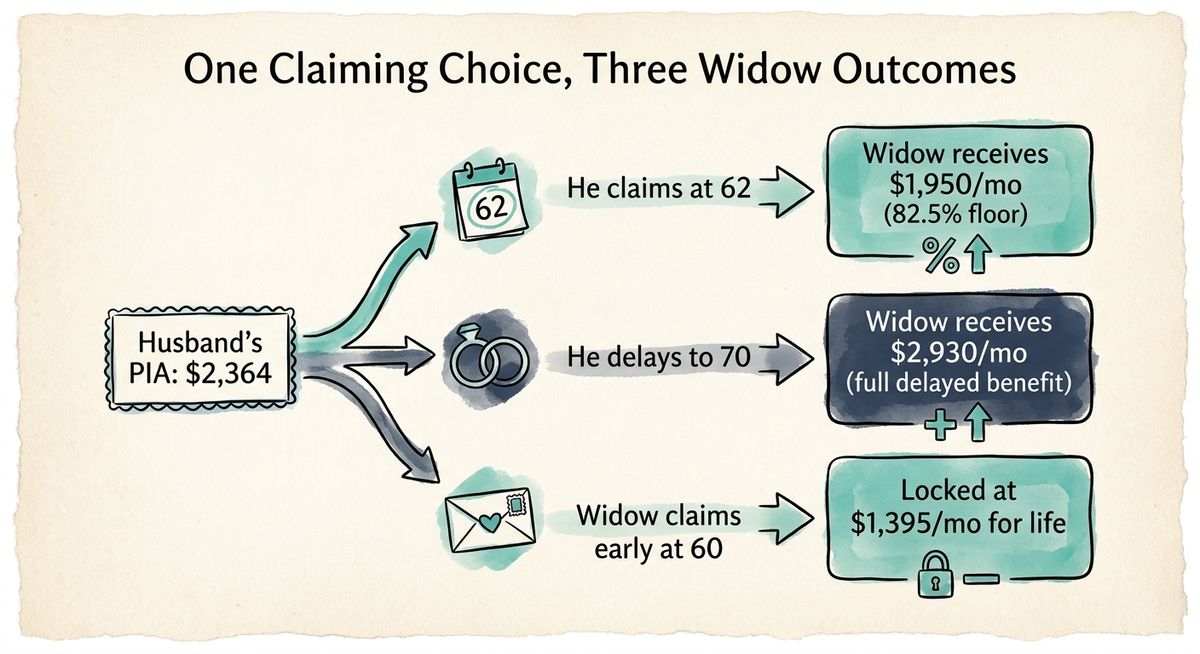
Let's make it concrete. A husband with a $2,364 PIA claims at 62 and collects about $1,655 a month. He passes away at 71. His widow, claiming at her own FRA, receives $1,950. That's the 82.5% floor, not the $1,655 he was getting. Nice surprise.
Had he delayed to 70, RIB-LIM wouldn't apply at all and she'd receive his full delayed benefit, about $2,930. And had she claimed at 60 instead of waiting for her FRA, she'd have locked in roughly $1,395 for the rest of her life.
Same family. Three very different outcomes. All decided by timing.
For a broader playbook on protecting a surviving spouse financially once that timing decision lands, see our widow's financial survival guide.
4. WEP and GPO repeal reset the math for three million people
The Social Security Fairness Act, signed January 5, 2025, repealed the Windfall Elimination Provision and the Government Pension Offset, retroactive to January 2024.
Former WEP-affected retirees picked up about $360 a month on average. GPO-affected spouses and survivors picked up $700 to $1,190.
So if you're a teacher, a firefighter, a police officer, anyone with a public pension who wrote off spousal or survivor benefits years ago as worthless, that assumption is now expired. Throw it out. Run the whole decision again from scratch. I know a retired school administrator in Sacramento who found out eighteen months late and it changed her entire plan.
If You're Married, Social Security Claiming Is a Sequencing Decision
Treating your claiming age as an individual choice is the single most common planning mistake couples make. Kitces has shown it rarely pays for both spouses to delay all the way to 70.
The standard optimum
The lower earner claims early for cash flow, and the higher earner delays to 70 to maximize the survivor benefit. Whichever record is larger keeps getting paid for as long as either spouse is alive. So the higher earner's delay buys protection across two lifetimes, while the lower earner's delay only buys it for one.
Four rules most articles skip:
- Spousal benefits earn no delayed retirement credits. They cap at 50% of PIA at the spouse's FRA. Delaying past FRA purely to grow a spousal benefit gains you nothing at all.
- Deemed filing applies to anyone born on or after January 2, 1954. File for either your own benefit or a spousal benefit and you've filed for both. Restricted applications are done for this group.
- Divorced spouses married 10 years or more don't have to wait around for the ex to file, as long as the divorce is at least two years old and the ex is at least 62. Note that divorced-spousal benefits don't include the ex's delayed credits.
- Widows and widowers are the exception, and it's a big one. Survivor benefits are exempt from deemed filing, which enables what might be the single most valuable move in the entire system: claim a reduced survivor benefit at 60, let your own benefit keep growing, then switch to your own delayed-credit-maximized benefit at 70.
Side-by-Side: Claiming Social Security at 62 vs. 67 vs. 70
| Factor | Age 62 | Age 67 (FRA) | Age 70 |
|---|---|---|---|
| Payout as % of PIA | 70% | 100% | 124% |
| Max benefit, 2026 | $2,969/mo | $4,152/mo | $5,181/mo |
| Earnings test | Applies ($24,480) | None | None |
| Survivor receives | 82.5% of PIA (RIB-LIM floor) | 100% of PIA | 124% of PIA |
| Years of low-income tax planning | 0 | 5 | 8 |
| Best suited to | Health concerns, no savings buffer, immediate need | Standard longevity, balanced goals | Good health, protecting a spouse, longevity insurance |
Survivor figures assume the survivor claims at their own FRA or later. Claiming at 60 cuts each of those by 28.5%.
The table above uses round averages so it's easy to compare, but your household won't match them exactly. Every retirement plan is different, and ReadyAimRetire lets you test how these three claiming strategies play out with your specific PIA, savings, and spending, including the survivor benefit gap that the averages can't show you.
What To Actually Do This Month
- Pull your earnings record at ssa.gov and count your years. Fewer than 35 means zeros are quietly suppressing your PIA, and one more working year might be worth a lot more than you'd guess.
- Run the couple's number, not the individual's. Ask what your survivor receives under each scenario. That figure, not your break-even age, is usually the whole decision. Start by modeling your household's retirement at ReadyAimRetire, then compare the survivor outcomes side by side.
- Model Roth conversions against the IRMAA cliff, not the senior deduction. IRMAA's two-year lookback and hard thresholds bind way more often. If you turn 65 before 2029, check the deduction phase-out too.
- If you already claimed and you regret it, you've got two moves. Within 12 months of first entitlement you can withdraw the claim using Form SSA-521, but you have to repay everything paid on your record, including benefits paid to family members and amounts withheld for Medicare and taxes. Anyone receiving on your record has to consent, and you get exactly one withdrawal per lifetime. At or after FRA you can voluntarily suspend instead, with no repayment, earning delayed credits the whole time you're suspended, and there's no limit on how often you can do it. Just know that suspension also stops payments to anyone collecting on your record, with a divorced spouse being the exception.
- Sign up for Medicare at 65 no matter what. If you're not collecting Social Security yet, SSA will not auto-enroll you, and you'll get billed for Part B directly instead of having it deducted. Miss the seven-month window and the late-enrollment penalty follows you forever.
The break-even table asks when you get your money back. That's a fine question. It's just not the important one.
The better question is what happens if you live to 95. Or if your spouse does. Or if inflation runs hot for a decade while your portfolio has a bad stretch at the worst possible time.
Those are the scenarios that wreck retirements. And those are exactly the scenarios a maximized, inflation-indexed, government-backed income floor was built to survive.
So buy the insurance if you can afford the premium.
And if you can't? Claim early, don't feel bad about it for one second, and remember that the earnings test isn't stealing anything from you.
Thanks for reading if you made it this far. Peace!