

Retirement Planning 101: The 20 Questions People Actually Ask


A while back a guy posted on Reddit that he'd saved $7 million and still didn't feel ready to retire. "I thought I needed $5 million," he wrote. "I now have $7 million and it still doesn't feel like enough." You'd expect the replies to pile on. Instead, one person after another quietly admitted the same thing. Same fear. Different number.
"I thought I needed $5 million. I now have $7 million and it still doesn't feel like enough."
The fear is bigger than the number
A 2025 Allianz study found that 64% of Americans now worry more about running out of money than about dying. Sit with that one for a second. We've reached a point where the spreadsheet scares people more than the reaper does.
Here's the thing I've learned about retirement planning, mostly from getting money wrong before I got it right: almost all of that fear comes from not having clear answers. So let's fix that. Below are the 20 questions people actually ask me, answered with the real 2026 numbers and the rule changes most guides still haven't caught up to.
- The 25x rule gives you a rough savings target — but Social Security shrinks the number you actually need to save yourself.
- For 2026, 401(k) limits rise to $24,500, plus a new "super catch-up" of $11,250 for ages 60–63.
- Full retirement age is 67. Waiting until 70 pays about 24% more per month than claiming at 67, and far more than claiming at 62.
- Social Security's trust fund is projected to run low in 2032 — not to zero, to about a 22% cut unless Congress acts.
- Healthcare will likely cost a couple around $345,000 in retirement, and Medicare doesn't cover long-term care.
Bottom line: you don't need $1 million to retire. You need a plan built on your own numbers, not a rule of thumb.
Saving for Retirement
1. How much do I actually need to retire?
Quickest back-of-the-napkin math is the 25x rule. Save about 25 times what you spend in a year. If you burn through $60,000 a year, your target is somewhere around $1.5 million. But hold on, because that's before Social Security shows up. If Social Security covers $30,000 of your spending, you only have to fund the other $30,000 yourself, which is about $750,000. That's why "do I need a million?" has no one-size answer. And for what it's worth, more than 95% of retirees never touch $1 million, and they retire anyway.
The 25x Rule
Multiply your annual spending by 25 to estimate your total savings target. Then subtract what Social Security will cover — you only need to save enough to fund the gap, not your entire lifestyle.
If you want to see where you land, you can run these numbers for your own situation at ReadyAimRetire.com, plugging in your real spending and Social Security estimate instead of a rule of thumb.
2. How much should I have saved by my age?
The easiest yardstick is Fidelity's salary multiples: 1x your salary by 30, 3x by 40, 6x by 50, 8x by 60, and 10x by 67. Now, real life is messier than that. Vanguard's How America Saves 2026 puts the median balance for folks 55 to 64 at $107,269. Pay attention to that word "median." The average for that same group is $305,006, but that's because a handful of giant accounts yank the number way up. The median, the person standing dead center in the room, is the honest one. That's the benchmark I trust.
Median Balance
- Ages 55–64 $107,269
What the person standing dead center in the room actually has saved.
Average Balance
- Ages 55–64 $305,006
Skewed upward by a handful of outsized accounts — not the number to benchmark against.
3. What percent of my income should I save?
Aim for 15% of your pre-tax income a year, and yes, that includes whatever your employer chips in. So if your company matches 4% to 5%, your own slice is more like 10% or 11%. Most folks don't get there. The average Vanguard employee sets aside 7.6%. If 15% feels flat-out impossible right now, don't sweat it. Bump your contribution by one percentage point a year until you catch up. You won't even feel it.
4. 401(k) or Roth IRA: which one?
Both, in this order. First, put enough in your 401(k) to grab the full employer match, because that's free money and you never turn down free money. Next, feed a Roth IRA, which grows tax-free and comes out tax-free when you're old and gray. Got a high-deductible health plan? Look at an HSA too. Then loop back and max out that 401(k). A traditional 401(k) trims your taxes today. A Roth trims them later. Splitting the difference gives you room to steer your tax bill in retirement instead of getting steered by it.
The Order of Operations
- Contribute enough to your 401(k) to get the full employer match.
- Max out a Roth IRA (and an HSA, if you have one).
- Circle back and max out your 401(k).
5. How much can I contribute in 2026?
For 2026 you can put in $24,500 to a 401(k) and $7,500 to an IRA. Hit 50 or older and you get an extra $8,000 catch-up, which brings the 401(k) up to $32,500. Here's the fun new wrinkle: if you're 60 to 63, you get a "super catch-up" of $11,250, for a 401(k) total of $35,750, before it settles back to the normal catch-up at 64. One more 2026 change to keep on your radar. If you made more than $150,000 last year, your catch-up money now has to go into a Roth account.
| 2026 Limit | 401(k) | IRA |
|---|---|---|
| Standard | $24,500 | $7,500 |
| Age 50+ (with catch-up) | $32,500 | $8,600 |
| Ages 60–63 (super catch-up) | $35,750 | $8,600 |
6. Should I roll over my old 401(k)?
You've got four moves: leave it where it is, roll it into your new job's plan, roll it to an IRA, or cash it out. Cashing out before 59½ is the worst of the bunch, because you get hit with income tax plus a 10% penalty. If you go the IRA route, always ask for a direct trustee-to-trustee transfer. Do an indirect rollover and the plan holds back 20% before it ever reaches you. Picture rolling over $100,000 the sloppy way. You get a check for $80,000, but you still have to redeposit the full $100,000 within 60 days, which means covering that missing $20,000 out of your own pocket, or the shortfall gets taxed. One heads-up: a 2024 federal rule that required rollover advice to be in your best interest got struck down in March 2026. So if an advisor is really leaning on you to move your money, ask why.
The Indirect Rollover Trap
An indirect rollover triggers automatic 20% withholding — even though you still owe the IRS on the full balance within 60 days. Always request a direct, trustee-to-trustee transfer instead.
Investing Your Savings
7. How should I invest, and what's the right mix?
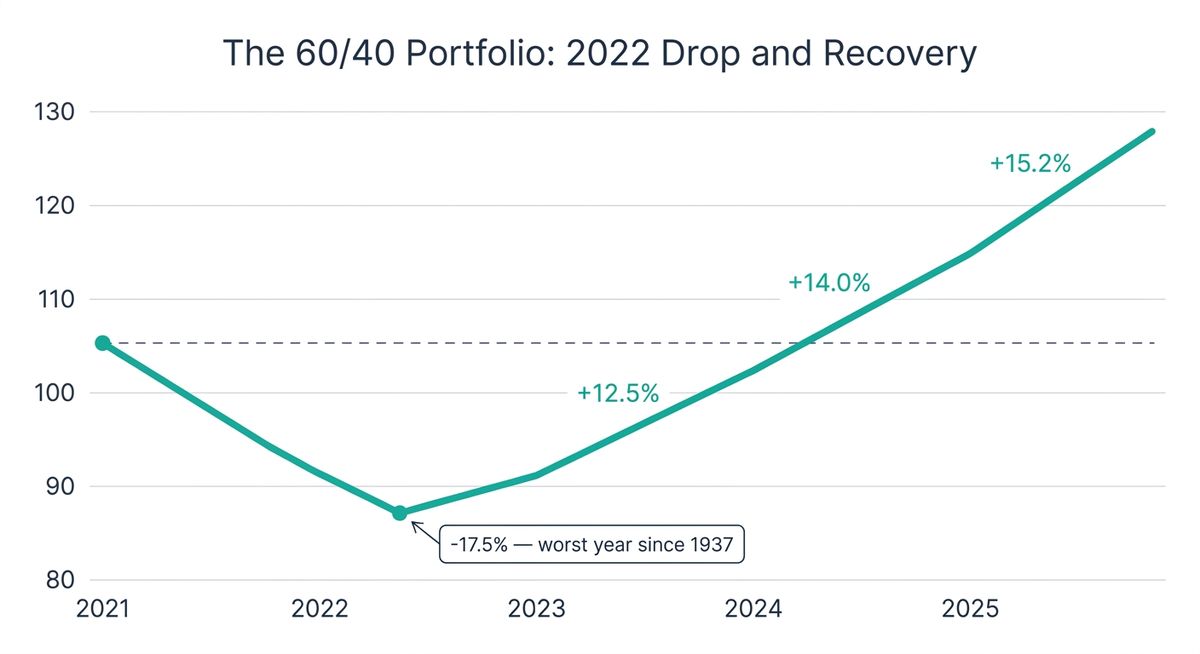
You'll hear little rules of thumb, like "110 minus your age" in stocks, which would land a 60-year-old at 50% stocks. Treat those as a starting line, not scripture. Vanguard's own target-date funds are actually more aggressive than that. They hold roughly 90% stocks until around age 40, then slowly ease down toward 30% by about 72. And remember the classic 60/40 portfolio, 60% stocks and 40% bonds? It dropped about 17.5% in 2022, its ugliest year since 1937. Then it turned around and posted three straight years of double-digit gains. It bent. It didn't break.
8. Can I just use a target-date fund?
For most people, honestly, yes. A target-date fund holds a nicely diversified mix and automatically gets more conservative as your target year rolls up. That's why 84% of participants pick one when it's on the menu. Two things to keep in mind. Choose a "through" fund if you want it to keep dialing down risk after you retire, and don't stack a target-date fund on top of a pile of other funds, because that wrecks the whole all-in-one point of it. Watch your fees, too. Index funds average 0.05% a year while active funds average 0.64%, and over 15 years about 85% of active funds trail their benchmark. That gap adds up to real money.
The default that works for most people
84% of participants choose a target-date fund when it's offered — and for most savers, that's a perfectly reasonable place to stop shopping.
Social Security
9. When should I claim: 62, 67, or 70?
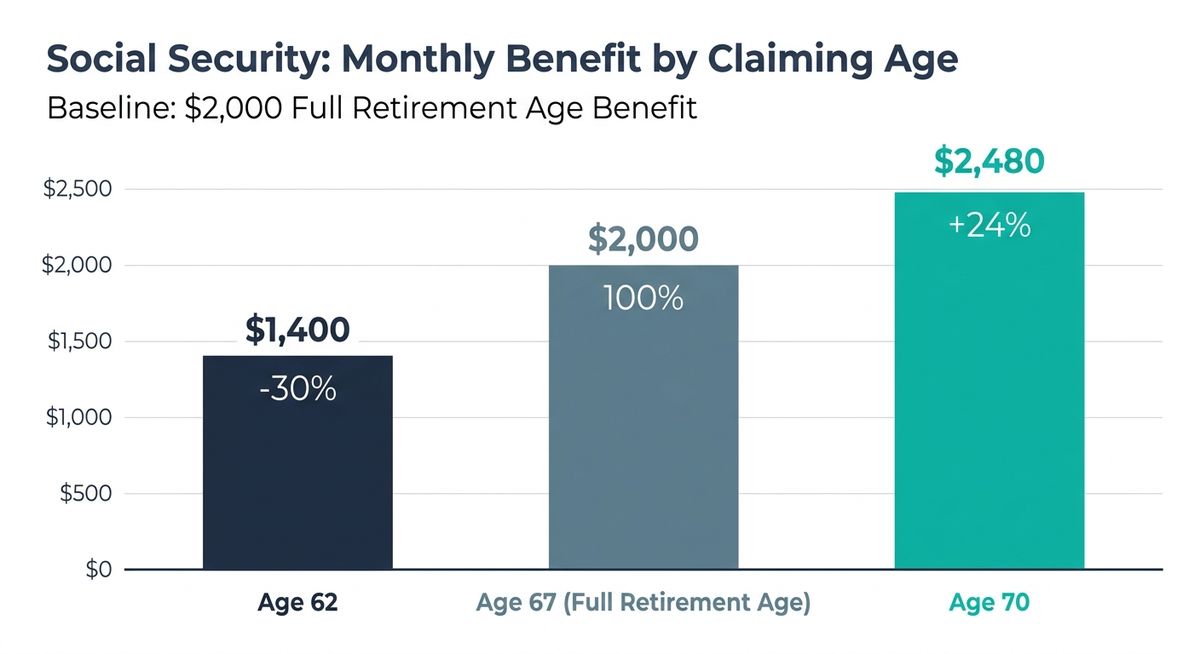
If you were born in 1960 or later, your full retirement age is 67. Claim at 62 and you lock in a permanent cut of about 30%. Wait until 70 and you pick up 24% above your full benefit, thanks to those 8% delayed credits every year. (You might see 32% floating around online, but that was for older folks. If you were born in 1960 or later, it's 24%.) In real dollars: a $2,000 full benefit becomes about $1,400 at 62, or roughly $2,480 at 70. The break-even point between claiming at 62 and waiting to 70 lands around age 80. For the full year-by-year math on what each claiming age actually pays out, see When Should You Claim Social Security? The Age-by-Age Breakdown.
Claim at 62
- Reduction ~30%
- Monthly Check $1,400
On a $2,000 full benefit — permanent for life.
Claim at 70
- Bonus +24%
- Monthly Check $2,480
Same $2,000 baseline. Break-even lands around age 80.
10. Is Social Security going to run out?
No. But your check could shrink if Congress keeps sitting on its hands. The 2026 Trustees Report says the retirement trust fund (OASI) runs dry in 2032, and after that, the payroll taxes still coming in would cover about 78% of scheduled benefits. So we're talking a possible 22% cut, not a shutoff. Count the combined trust funds and the date slides to 2034, with about 83% still payable. (Heads-up: the depletion date actually moved up a year in this latest report, mostly because the 2025 tax law trimmed Social Security's revenue.) Notice the key word there. Depletion, not zero. The payroll taxes keep rolling in, so the real risk is a smaller check, not a canceled one.
Depletion ≠ Zero
OASI alone: runs low in 2032, ~78% of benefits still payable. Combined trust funds: 2034, ~83% still payable. Ongoing payroll taxes mean checks keep coming — just possibly smaller ones, unless Congress acts first.
11. How are Social Security benefits taxed?
Up to 85% of your benefits can get taxed once your "provisional income" clears certain lines ($25,000 for singles, $32,000 for couples, with a higher tier above that). And here's a fun fact that quietly bites people: those thresholds have never once been adjusted for inflation. New for 2025 through 2028, there's a temporary senior deduction of $6,000 per person for anyone 65 and up ($12,000 for a couple), and it phases out at higher incomes. Despite what some headlines shouted, this did not wipe out taxes on Social Security. It's a broad deduction for seniors, not a repeal.
Turning Savings Into Income
12. What's the 4% rule, and does it still hold up?
Bill Bengen cooked up the 4% rule back in 1994. The idea: pull out 4% of your savings in year one, adjust it for inflation each year after, and you shouldn't run dry over 30 years. Here's the debate worth knowing about. In 2025, Bengen bumped his own number up to 4.7% and called it the "Universal Safemax." Morningstar, on the other hand, puts its base case at 3.9%. On a $1 million portfolio, that's $47,000 a year versus $39,000. Neither one is wrong. Bengen is modeling the historical worst case, while Morningstar is running cautious, forward-looking simulations. It's optimism versus caution, and your answer really comes down to how flexible your spending can be when things get bumpy. Every retirement plan is different, and ReadyAimRetire lets you test how both the Bengen and Morningstar assumptions play out with your specific numbers. If you want the deeper dive on why so many planners now think 4% is outdated, we've mapped out the modern safe withdrawal rate debate in detail.
Bengen's "Universal Safemax"
- Withdrawal Rate 4.7%
- On $1M $47,000/yr
Models the historical worst case.
Morningstar's Base Case
- Withdrawal Rate 3.9%
- On $1M $39,000/yr
Runs cautious, forward-looking simulations.
13. What order should I pull from my accounts?
The old-school sequence is taxable accounts first, then tax-deferred (your traditional 401(k) and IRA), then Roth last so it keeps growing tax-free. But the sharper move usually blends these and takes advantage of the "gap years" between retirement and RMDs (roughly ages 62 to 73) to shift traditional dollars into a Roth while you're sitting in a low tax bracket. Done thoughtfully, that sequencing can seriously shrink your lifetime tax bill. It also helps you sidestep the "tax torpedo," where one extra IRA withdrawal makes more of your Social Security taxable and quietly jacks up your effective rate. Sneaky little thing.
What's the "Tax Torpedo"?
One extra dollar of IRA withdrawal can make more of your Social Security taxable at the same time — stacking two effects into one unexpectedly high marginal tax rate. Gap-year Roth conversions (roughly ages 62–73) are one of the best tools for defusing it.
14. When do I have to take RMDs?
Required minimum distributions now kick in at age 73, climbing to 75 in 2033 for anyone born in 1960 or later. Your first RMD is due by April 1 of the year after you turn 73. Miss one and the penalty is 25%, though it drops to 10% if you patch it up within two years. Nice change worth knowing: Roth 401(k)s no longer require lifetime RMDs, so those dollars get to keep compounding, untouched, for as long as you like. RMDs also trip up more retirees than you'd think — see the most common RMD mistake so you don't join them.
Healthcare in Retirement

15. How much will healthcare cost me in retirement?
More than you're bracing for. Fidelity's 2025 estimate is $172,500 for a single 65-year-old and about $345,000 for a couple, and that's before you even get to long-term care. As Fidelity's Shams Talib put it, "Year after year, so many Americans underestimate how much they'll need to save to cover health care costs." So build this into your number now, while it's a line item, instead of later, when it's a surprise.
"Year after year, so many Americans underestimate how much they'll need to save to cover health care costs."
16. How does Medicare work, and when do I sign up?
Medicare starts at 65. Your enrollment window runs seven months, from three months before your birthday month to three months after. Miss it and Part B costs 10% more every year, for the rest of your life. For 2026, the standard Part B premium is $202.90 a month with a $283 deductible. Higher earners pay an income surcharge called IRMAA, which kicks in above $109,000 (single) or $218,000 (couple), based on your income from two years earlier. That two-year lookback is exactly why one big Roth conversion or a home sale can quietly puff up your Medicare bill down the road.
What Is IRMAA?
An income-related surcharge on Medicare Part B and Part D, triggered above $109,000 (single) or $218,000 (couple) — based on your income from two years earlier. A big Roth conversion or home sale can trigger it without you realizing until the bill arrives.
17. What if I want to retire before 65?
The pre-65 stretch is the trickiest part of the whole plan, because Medicare hasn't shown up yet. You'll need private coverage through the ACA marketplace, and this is where 2026 gets pricey. The enhanced subsidies expired at the end of 2025, and the old "subsidy cliff" at 400% of the poverty line is back. Cross that line by a single dollar and you lose the subsidy entirely. One estimate has a 60-year-old couple earning $85,000 staring down premiums roughly $22,600 higher a year. So if you're dreaming about an early exit, price this coverage out before you hand in your notice. Do the math first, then quit.
18. Will I need long-term care, and does Medicare pay for it?
About 70% of today's 65-year-olds will need some long-term care, and here's the misconception that blindsides families: Medicare does not cover custodial long-term care. A private nursing-home room now runs about $129,575 a year on average, and Medicare pays exactly $0 of it. Your options are long-term care insurance, self-funding, or eventually Medicaid. One clever tool here is an HSA, which gives you a triple tax advantage and can even pay your Medicare premiums tax-free later.
The Bigger Picture

19. Can I retire early? What's this FIRE thing?
FIRE stands for Financial Independence, Retire Early, and it comes with a few tools for tapping your money before 59½ without the penalty. The Rule of 55 lets you pull from your most recent employer's 401(k) penalty-free if you leave the job at 55 or later. A 72(t) plan lets you take fixed penalty-free IRA withdrawals even earlier. A Roth conversion ladder lets you move traditional money into a Roth and withdraw each chunk penalty-free after five years. And "Coast FIRE" is the gentle cousin: save hard early, then let compounding do the heavy lifting while you coast on lighter contributions the rest of the way. That last one is my personal favorite. (If none of these labels quite fit your situation, here's a rundown of the different flavors of FIRE and which one actually matches your timeline.)
The FIRE Toolkit
- Rule of 55 — penalty-free 401(k) withdrawals if you leave your job at 55+.
- 72(t) plan — fixed, penalty-free IRA withdrawals, even earlier.
- Roth conversion ladder — convert traditional to Roth, withdraw penalty-free after 5 years.
- Coast FIRE — save hard early, then coast on lighter contributions while compounding does the work.
20. Do I actually need a financial advisor?
Maybe, but go in with your eyes open on the cost. A 1% annual fee can quietly add up to $500,000 or more over 30 years on a $1 million portfolio, while robo-advisors charge 0.20% to 0.25%. If you do hire someone, pick a fee-only fiduciary, which means they're legally required to act in your interest and they aren't getting paid to push products on you. And here's the truth: a good advisor doesn't earn their fee by beating the market. They earn it through tax planning, withdrawal strategy, estate work, and talking you off the ledge when the market has a bad week. That last part is worth more than people admit.
1% Advisor Fee
- 30-Year Cost -$500,000+
Potential drag on a $1 million portfolio.
Robo-Advisor
- Typical Fee 0.20%–0.25%
The going rate for automated portfolio management.
Your Next Three Moves
Remember that knot in the stomach the $7 million guy felt? It almost never comes from the numbers. It comes from not having a plan for them — which is really all retirement planning is. So do three things this week.
🎯 Do This This Week
- Run the 25x math. Take your own spending, subtract what Social Security will probably cover, and you've turned a vague fear into an actual target you can aim at. Model Your Retirement →
- Check your savings rate. Nudge it toward 15%, match included, starting with a single percentage point.
- Map your withdrawal order and healthcare costs if you're within ten years of retiring, while you've still got room to adjust.
You don't need $7 million to feel ready. You need a plan you actually understand. And you just built the foundation for one.
"You don't need $7 million to feel ready. You need a plan you actually understand."
Thanks for reading if you made it this far. Peace.