

Paid-Off House vs. $1.4M 401(k): Which Retiree Is Actually Wealthier?


Two people turn 65 this year. Same career arc, same $850,000 house, same 30 years of steady saving. One of them treated the mortgage like a hostage situation and killed it in 15 years. The other looked at a 3.125% fixed rate, figured the bank was basically paying them, and dumped every spare dollar into a 401(k) instead. One of them is now worth about $570,000 more on paper. The other one can, if the market falls apart tomorrow, stop touching their portfolio completely and live on a Social Security check.
- Retiree A paid off the house and has $600,000 in a 401(k). Retiree B kept a 3.125% mortgage and has $1.4 million. Retiree B looks $570,000 wealthier on paper.
- That gap is mostly an assumption. It only holds at roughly 9% nominal returns for 30 years straight. At 7% it shrinks to about $127,000. At 5% the sign flips and the paid-off retiree comes out ahead.
- Filing status changes everything: a single Retiree B owes real federal tax and hits the Social Security "tax torpedo." A married Retiree B, using the 2026 senior bonus deduction, can owe $0 — but only through 2028.
- Retiree A has the wider cash-flow floor (can drop to $0 portfolio withdrawals). Retiree B has the wider ceiling (can absorb a six-figure long-term care bill without wrecking the household).
- The real risk nobody prices in is the widow's penalty: a surviving spouse's IRMAA headroom can collapse from roughly $110,000 to $11,000 the year filing status flips to single.
Bottom line: net worth picked the winner. Cash flow and tax exposure tell a much closer story.
Here's what almost everybody arguing about paying off the mortgage vs. investing in a 401(k) gets wrong: it was never a question about who's wealthier. Both of these folks are fine. Retiree A's $600,000 401(k) is more than double the $258,800 Fidelity reports as the average balance for ages 65 to 69, and Retiree B's $1.4 million puts them in the small club of seven-figure balances. That context alone should tell you how narrow this fight actually is. The interesting question — really the decumulation strategy question — is who has more moves left. And the answer genuinely surprised me once I ran the 2026 tax code against both of them.
The Scoreboard
| Retiree A (paid it off) | Retiree B (kept the leverage) | |
|---|---|---|
| Home | $850,000 | $850,000 |
| Mortgage | $0 | ($280,000) at 3.125%, 16 years left |
| Payment | $0 | $1,855/mo = $22,260/yr |
| Traditional 401(k) | $600,000 | $1,400,000 |
| Cash and brokerage | $100,000 | $150,000 |
| Net worth | $1,550,000 | $2,120,000 |
| Liquid assets | $700,000 | $1,550,000 |
Two quick mechanical notes, because these details drive everything below. B still has 16 years on the clock at 65 because B refinanced into a fresh 30-year during that low-rate stretch in the 2010s, which is also where the 3.125% comes from. And $1,855 is what $280,000 at 3.125% actually amortizes to over 192 payments. Round it down to a nicer number and none of the tax math works.
Both collect $30,000 a year in Social Security. Retiree A's total living costs run $42,000 a year. Retiree B's are the same $42,000 plus $22,260 to the lender, so $64,260.
That's the whole setup. Now watch what happens when you stop measuring net worth and start measuring cash flow.
Retiree A's Real Advantage Isn't the Low Withdrawal Rate
Retiree A pulls $12,000 a year from a $700,000 portfolio. That's a 1.71% withdrawal rate against Morningstar's 2026 safe withdrawal rate of 3.9%. Conservative barely covers it. That's tucked-in-with-a-blanket conservative.
The standard next move is to say Retiree B is exposed to sequence of returns risk. That claim doesn't survive the arithmetic. Retiree B pulls $38,200 gross from $1.55 million, a 2.46% rate. Drop the market 30% in year one and B's portfolio falls to roughly $1.13 million, pushing the rate to about 3.4%. Still under 3.9%. Wade Pfau's research shows the compounded return of your first ten years explains roughly 77% of where a retirement portfolio ends up, which is exactly why people call it the fragile decade. But B isn't fragile. B is fine.
You can run these numbers for your own situation at ReadyAimRetire.com and see how your withdrawal rate holds up under a similar market shock before you assume you're the fragile one.
The real difference is something more precise, and I think it deserves a name. Call it the flexibility ratio: what share of your spending is contractually non-negotiable.
| Retiree A | Retiree B | |
|---|---|---|
| Total spending | $42,000 | $64,260 |
| Mortgage (contractual) | $0 | $22,260 |
| Non-discretionary living | ~$20,000 | ~$20,000 |
| Hard floor | $20,000 (48%) | $42,260 (66%) |
| Portfolio draw at max austerity | $0 | ~$12,260 |
In a genuinely rough year, Retiree A can cut portfolio withdrawals to zero and live entirely on Social Security. Retiree B can tighten the belt all day long and still owes the bank $1,855 on the first of the month. That right there is what Retiree A actually bought with 15 years of extra principal payments. Not a better return. A wider floor.
And that floor is getting rare. Harvard's Joint Center for Housing Studies found the share of homeowners aged 65 to 79 carrying a mortgage climbed from 24% to 41% between 1989 and 2022. Among owners 80 and up it went from 3% to 31%, with median mortgage debt up 750%. Also: 43% of older owners with mortgages are cost-burdened, meaning they spend more than 30% of income on housing, versus 19% of the folks who own free and clear.
What Retiree B's Mortgage Actually Costs
Here's where the pre-tax 401(k) starts to bite.
Retiree B needs $34,260 in spendable cash after Social Security. But nearly all of B's wealth sits in a Traditional 401(k), so every dollar comes out taxable. Worse, those withdrawals drag B into the Social Security tax torpedo. In that zone, each extra $1 withdrawn makes $0.85 of Social Security taxable, so $1.85 gets taxed at 12%. Effective marginal rate: 22.2%.
Here's how that shakes out for a single filer at 65:
- Retiree A withdraws $12,000. Provisional income lands at $27,000, only $1,000 of Social Security becomes taxable, AGI is $13,000. That's below the $24,150 total deduction available to a 65-year-old single filer in 2026 ($16,100 standard, $2,050 age-based, $6,000 senior bonus). Federal tax: $0.
- Retiree B withdraws $38,200 gross to net $34,260. Provisional income $53,200, so $20,820 of Social Security becomes taxable. AGI $59,020, taxable income $34,870. Federal tax: $3,936.
To hand $22,260 to the mortgage company, Retiree B has to withdraw $28,610. Call it 28 cents of friction on every dollar of principal and interest.
But run the same numbers for a married couple and the whole thing evaporates. A 65-plus couple in 2026 gets $32,200 standard, $3,300 in additional age-based deduction, and $12,000 from the OBBBA senior bonus deduction. That's $47,500. Retiree B's household AGI comes in near $44,700, underneath it. A married Retiree B pays zero federal income tax.
That's Not a Typo
It might be the single most underreported fact in this entire debate. It also has an expiration date. The $6,000-per-person senior bonus deduction runs 2025 through 2028 only, and it phases out at 6% of MAGI above $75,000 single and $150,000 married. Come 2029, absent Congress doing something, married Retiree B's tax bill shows back up. If you're married, modest-income, and 65 or over, you're sitting inside a four-year window right now that's worth planning around on purpose.
One clarification on that math, because it matters: the married version assumes $30,000 is the household Social Security benefit and both spouses are 65 or older. Not $30,000 each.
The IRMAA Warning Everyone Gets Backwards
The usual version of this story ends with Retiree B getting hammered by required minimum distributions and Medicare surcharges. Let's check that.
Correction Most of the Internet Hasn't Caught Up To
Anyone born in 1960 or later doesn't face a first RMD until 75, not 73. Both of these retirees were born in 1961. Every article running this scenario at 73 is using the wrong age and the wrong divisor.
Project both forward at 6% for ten years, net of the withdrawals above. At 75, Retiree A's 401(k) is around $916,000 and B's around $2,004,000. Divide by the age-75 factor of 24.6:
| Retiree A | Retiree B | |
|---|---|---|
| First RMD at 75 | $37,250 | $81,450 |
| AGI with Social Security | $57,263 | $106,951 |
| Federal tax | $4,446 | $14,248 |
| Marginal bracket | 12% | 22% |
These hold 2026 brackets constant against balances that grew in nominal terms, so treat the absolute dollars as directional. The gap between the two is the durable finding.
Retiree B's MAGI at 75 is $106,951. The 2026 IRMAA threshold for a single filer is $109,000, and it indexes up every year. Retiree B does not trip IRMAA from RMDs. For a married couple, at $218,000, it's not remotely close.
But look at that margin. About $2,000. B clears the cliff, and clears it by basically nothing. Hold that thought, we're coming back to it.
The real divergence is quieter and more durable: roughly $9,800 a year in extra federal tax starting at 75. Over two decades that's about $196,000 in today's dollars, undiscounted, eaten straight out of B's head start. And as you'll see in a minute, that stream is bigger than the head start itself.
Now here's the irony. Retiree A is the one more likely to eat a Medicare surcharge. IRMAA is a cliff, not a ramp. One dollar over a threshold triggers the whole tier. Retiree A cruises along at an AGI in the $40,000s, which sounds perfectly safe, but it means any single lumpy withdrawal becomes a cliff event. A $130,000 draw for a long-term care crisis pushes A's AGI to roughly $155,000, straight into Tier 2 and a doubled Part B premium of $405.80 a month. And the medical deduction doesn't rescue you here, because IRMAA is scored on AGI and itemized deductions come after.
IRMAA doesn't punish high steady income in these scenarios. It punishes spikes. And the retiree with no liquid buffer is the one who has to make spikes.
The Widow's Penalty: Where This Argument Actually Lands
The year after a spouse dies, filing status flips from married to single. The house stays. The RMDs stay. Most of the bills stay. But the standard deduction halves from $32,200 to $16,100, the bracket widths roughly halve, the Social Security taxation thresholds halve, and the IRMAA threshold drops from $218,000 to $109,000.
This is where the surcharge warning finally comes true, and this is where that $2,000 margin starts to matter. Married Retiree B pays $0 today and sits roughly $110,000 below the IRMAA threshold. Retiree B's survivor, with the same RMDs and a reduced survivor benefit, lands near $98,000 of MAGI against a $109,000 cliff. Roughly $11,000 of headroom instead of $110,000. At that altitude one Roth conversion, one capital gain, or one bad year of medical bills trips the surcharge.
The Risk to Actually Model
A bigger pre-tax balance makes your survivor structurally more exposed. If you're carrying a seven-figure Traditional 401(k) into retirement as a couple, that's the risk to model. Not ordinary RMDs.
The Key Insight: That $570,000 Lead Is Mostly an Assumption
Retiree B looks $570,000 ahead. Let's audit it. This is the part of the pay-off-mortgage-vs-invest argument that usually gets skipped.
The only behavioral difference between these two people was A's extra principal payments. A $1,855 monthly payment amortizes an original 30-year loan of about $433,000 at 3.125%. Cutting that down to a 15-year payoff costs $3,016 a month, an extra $1,161, or $13,932 a year. That money went into drywall instead of index funds. Fair enough. But in years 16 through 30, Retiree A had no housing payment at all and redirected the whole $22,260 a year into the 401(k) while B was still writing checks to the bank.
Run both sides at three different return assumptions:
| Annual return | A's forgone investing, years 1–15, compounded through year 30 | A's investing, years 16–30 | B's remaining balance | Net advantage to B |
|---|---|---|---|---|
| 5% | +$625,000 | ($480,000) | ($280,000) | ($135,000) |
| 7% | +$966,000 | ($559,000) | ($280,000) | +$127,000 |
| 9% | +$1,490,000 | ($653,000) | ($280,000) | +$556,000 |
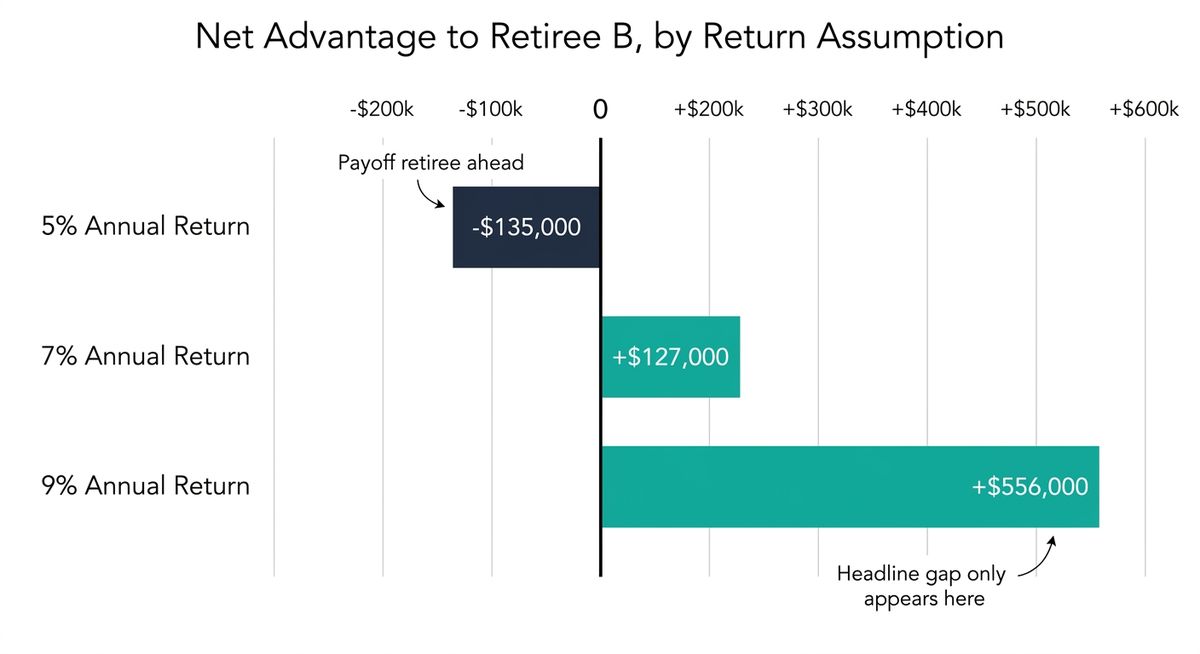
Read that bottom row carefully. The $570,000 gap everybody quotes only shows up if you assume roughly 9% nominal returns for three straight decades. At 7%, the gap shrinks to about $127,000. At 5%, the sign flips and the payoff retiree comes out ahead by $135,000.
The arbitrage on cheap debt is real. But its size is an assumption, not a fact, and it's smaller than the headline number because the payoff retiree gets 15 years of turbocharged catch-up saving that the leverage retiree never gets. (Quick caveat: this models the behavioral difference at a constant payment and ignores taxes and B's refinance history. It's a sensitivity check, not an amortization schedule.)
Every retirement plan is different, and the return assumption you pick changes the answer, sometimes flipping it entirely. ReadyAimRetire lets you test how different return assumptions and payoff timelines play out against your own numbers instead of borrowing someone else's.
Then apply the second haircut. B's $1.4 million is pre-tax. At roughly a 20% effective rate it's worth about $1.12 million spendable. A's $600,000 at roughly 12% is worth about $528,000. So on an after-tax basis the comparison is $1,478,000 to $1,840,000. The gap is $362,000, not $570,000, before you even touch the return sensitivity.
Where Retiree B Genuinely Wins: The Care Event
This is the strongest argument for leverage, and it has nothing to do with optionality or compounding. It's about a nursing home.
The 2025 CareScout Cost of Care Survey puts a private room at $355 a day, which works out to $129,575 a year. Semi-private runs $114,975. Assisted living is $6,200 a month, or $74,400 a year, up 5% year over year.
Two years of private-room care: $259,150.
| Retiree A | Retiree B | |
|---|---|---|
| Liquid assets | $700,000 | $1,550,000 |
| Cost as % of liquid | 37% | 17% |
| Remaining liquid | $440,850 | $1,290,850 |
Morningstar backs up the magnitude independently: a long-term care shock drops the safe withdrawal rate from 3.9% to 3.5%. (One softening note, and it's a real one: unreimbursed medical expenses above 7.5% of AGI are deductible, which meaningfully offsets the income tax on a big care-year withdrawal for both retirees. Does nothing for IRMAA, though.)
Retiree A's answer to all this is "I'll just tap the equity." Check the exits before you count on them. Bankrate had HELOCs at 7.30% and home equity loans at 8.13% in late August 2026, and both require full income qualification, which plenty of retirees living on Social Security fail on debt-to-income. A HECM reverse mortgage has no income test, and the 2026 lending limit of $1,249,125 covers A's house, but it's expensive and it's a one-way door.
And downsizing? AARP's 2024 survey found 75% of adults over 50 want to stay in their current home. NAR found that boomers aged 61 to 70 who sold a 2,000 square foot home in the year through June 2025 turned around and bought one the same size. Ages 71 to 79 trimmed about 100 square feet. Downsizing is a plan people describe. It's not a plan people execute.
The One-Way Door
"Retiree B can just pay off the mortgage anytime" is pre-tax thinking. Here's the actual bill for a single filer using the $150,000 cash plus a 401(k) withdrawal:
- Cash applied: $150,000
- Gross 401(k) withdrawal to net the remaining $130,000: about $163,700, with roughly $33,700 in tax at a 24% top marginal rate. Note that an AGI that high also phases out the entire senior bonus deduction, which is a big part of why the bill gets so steep.
- Total assets consumed: $313,700 to erase $280,000 of debt
- Plus an AGI near $189,200, which triggers IRMAA Tier 3 two years later. Another $4,600 or so in Medicare premiums.
Do it entirely from the 401(k) with no cash and it's worse: roughly $386,500 gross, $106,000 in federal tax at a 35% top rate, AGI above $410,000, and Tier 4 IRMAA.
The fix is boring and it works. Stage it. Spread the payoff over three to five years at $60,000 to $70,000 annually, stay inside the 22% bracket, stay under the Tier 1 IRMAA threshold. Tax cost drops from roughly $106,000 to $55,000 or $60,000, and the Medicare surcharge disappears completely.
The Decision That's Still Open
SECURE 2.0 Section 603
As of January 1, 2026, catch-up contributions must go to Roth if your prior-year wages from the sponsoring employer topped $150,000. The base deferral, $24,500 in 2026, is untouched at any income. Catch-ups don't start until 50. But from 50 on, a high earner's $8,000 catch-up (or $11,250 between ages 60 and 63, if the plan opts in) now lands in a Roth whether they want it there or not. That's the last 15 years of a Retiree-B-style accumulation, forcibly diversified — building meaningful Roth balances by default, which changes the RMD and survivor math in their favor.
And the rate itself is long gone. Keeping a low-interest mortgage in retirement made sense at 3.125%; it doesn't at today's rates. Freddie Mac had the 30-year fixed at 6.66% on August 27, 2026, against the 2.65% record low back in January 2021. Nobody is arbitraging a 3.125% mortgage in 2026.
Which is kind of the whole point. The mortgage decision got made 30 years ago. Neither retiree can go back and change it, and as the counterfactual shows, it mattered less than either of them thinks.
The decision that's still open is what happens between 65 and 75. That's a ten-year Roth conversion runway, not eight. Really, this is where the retirement withdrawal strategy actually gets decided — not at 65, and not at 30 when the mortgage got signed.
Start by modeling your own retirement at ReadyAimRetire so you can see which of the moves below matters most given your own balances, filing status, and mortgage terms.
🎯 Three Moves, in Order of Value
- Retiree A should be doing aggressive Roth conversions right now. Converting $35,000 a year fills the 12% bracket exactly and costs about $5,550, a blended rate near 16% once you count the Social Security torpedo. Not free. But cheap, and roughly a third less than the 22% to 24% A's own survivor would pay on those same dollars later. And A can only pull this off because the paid-off house created a low-income position in the first place. This is probably the highest-value action available to either retiree, and it's the one nobody talks about, because from the outside it looks like doing nothing.
- Retiree B should stage the mortgage payoff, or just leave it alone. Paying it off in one year costs $313,700 plus a Medicare surcharge. At 3.125% against a 22.2% effective marginal withdrawal rate, "leave it alone" is a completely defensible answer.
- Both should model the survivor scenario before assuming they're safe. Run your RMDs at single-filer brackets against that $109,000 IRMAA cliff. For Retiree B that's the difference between $110,000 of headroom and $11,000. That's the year the tax bill actually shows up.
Neither of these people needs rescuing.
Retiree A bought a floor. Retiree B bought a ceiling.
If you're the one choosing today, ask yourself which one you'll need more: the ability to spend nothing in a bad year, or the ability to spend $130,000 in a bad month.
Thanks for reading if you've made it this far. Peace!
Sources: Kiplinger, 2026 IRMAA brackets · Morningstar, safe withdrawal rate 2026 · Harvard JCHS, State of the Nation's Housing 2025 · CareScout 2025 Cost of Care Survey · Freddie Mac PMMS, Aug 27 2026 · Bankrate HELOC rates · FHA 2026 HECM limit · IRS 2026 inflation adjustments · Quarles, SECURE 2.0 Roth catch-up · AARP 2024 Home and Community Preferences · NAR 2025 Generational Trends · Pfau, Lifetime Sequence of Returns · Motley Fool, average 401(k) ages 65-69