

The $1.85M Illusion vs. The Bulletproof Floor


Two people turn 55 this year. Both want out at 62. One has a net worth of $1.85 million. The other has $1.2 million. That $650,000 gap looks like the whole story. It isn't, and the reason why comes down to one income threshold almost nobody planning to retire at 62 has priced in.
- Adjust both net worth statements for taxes and price the pension correctly, and a $650,000 gap shrinks to roughly $75,000.
- Run both people forward to age 62, and the person with $650,000 less on paper ends up with nearly twice the annual spending power, about $54,300 versus $29,100.
- The swing factor is the ACA subsidy cliff, which returned for plan year 2026: one dollar over the 400% federal poverty line threshold ($62,600 single / $84,600 joint) can wipe out thousands in premium tax credits.
- An all-pre-tax, one-account-type portfolio has no lever to manage that cliff. A mix of Roth, taxable, and guaranteed income does.
- The fix for the pre-tax-heavy saver is a seven-year plan: stop pre-tax contributions, build a taxable brokerage bucket, and buy a TIPS-based floor while real yields are historically high.
Bottom line: net worth is not spending power. Account structure decides which one you actually get to live on.
A note on the numbers
The original scenario didn't specify marital status or years remaining on the mortgage, so this model treats both people as single filers with 23 years left on their loans. Every dollar figure labeled a calculation below is modeled from the stated inputs, not pulled from a published source, and marital status alone moves the ACA cliff threshold from $62,600 to $84,600. Treat the pension-capitalization approach as one lens, not a settled methodology. How to value a pension against a portfolio is genuinely debated.
The Two Engines
Two very different retirements, same target retirement age.
Person A: The High-Yield Accumulator
- Invested assets $1.4M, 100% Traditional 401(k)
- Mortgage $400K at 2.85%
- Home value $850,000
- Years to retirement 7
- Net worth $1,850,000
Person B: The Cash-Flow Engine
- Invested assets $400K, 100% Roth
- Primary home Paid off, $500,000
- Rental property $300K, nets $22K/yr
- Pension at 62 $42K/yr, no COLA
- Net worth $1,200,000
Person A is what modern retirement planning cranks out. Person B is basically a museum piece. As of March 2025, only 14% of private-industry workers even had access to a defined benefit pension, compared to 70% with access to a defined contribution plan (BLS). At companies under 100 employees, pension access is 6%.
So this isn't really A versus B. It isn't even really pension vs. 401(k). It's the retirement most of us are building versus the retirement most of us can't get anymore. Figuring out why B is winning tells A exactly what to go build.
Step One: Normalize the Balance Sheets
A net worth statement pretends every dollar is the same dollar. They're not.
Person A's $1.4 million is pre-tax. Every withdrawal is ordinary income, and the rate that matters isn't this year's rate. It's the blended rate across an entire retirement's worth of distributions, including the RMD years when a $2 million-plus balance shoves income out the door whether you want it or not. Call that 20%, and the $1.4 million is really worth about $1.12 million in money-you-can-spend terms.
Person B's $400,000 Roth is worth $400,000. Tax-free growth, tax-free withdrawals, no required minimum distributions ever.
Now price the piece nobody puts in the same table: what is a $42,000 lifetime income stream actually worth? A single-premium immediate annuity for a 65-year-old male paid around 7.97% in July 2026 (lifeannuities.us). Payout rates at 62 run lower, roughly 7.0% to 7.5% single life, so replacing $42,000 a year at 62 would run somewhere around $560,000 to $600,000. After tax, call it roughly $470,000 of economic value. But that's the price at 62, and we're standing at 55. Discount it back seven years at a high-grade corporate rate near 5%, the way a pension actuary would, and the present value is closer to $345,000.
| Person A | Person B | |
|---|---|---|
| Stated net worth | $1,850,000 | $1,200,000 |
| Investments, after-tax value | $1,120,000 | $400,000 |
| Primary home equity | $450,000 | $500,000 |
| Rental, net of recapture and gains | n/a | ~$250,000 |
| Pension, present value after tax | n/a | ~$345,000 |
| Economic net worth at 55 | ~$1,570,000 | ~$1,495,000 |
The $650,000 gap collapses to about $75,000. Roughly 88% of Person A's lead was never there.
It was an artifact of counting pre-tax dollars at face value and counting a pension at zero. Now run that same table forward to 62 and Person A pulls ahead again, because seven years of compounding on $1.4 million beats seven years of compounding on $400,000. That's fine. Person A genuinely has more wealth. What comes next is that it doesn't matter.
Step Two: Net Worth vs. Retirement Spending Power
Net worth is a snapshot. Spending is the thing you actually live. Run both people forward to age 62.
Person A
Say the portfolio hits $2.0 million, the optimistic end of Vanguard's 10-year US equity forecast of 3.9% to 5.9% annualized as of December 2025 (Vanguard).
- Morningstar's 2026 safe withdrawal rate of 3.9% on $2.0 million: $78,000 gross (Morningstar)
- Minus federal income tax after the 2026 standard deduction: about $8,330, an effective rate near 11% (Tax Foundation)
- Minus mortgage principal and interest of $23,724/year (modeled: $400,000 at 2.85%, 23 years left at 55, ~$305,000 outstanding at 62)
- Minus health insurance, and here's where the whole thing breaks
That $78,000 withdrawal is $78,000 of MAGI. The 400% federal poverty level threshold for 2026 is $62,600 for a single filer (healthinsurance.org). Person A is $15,400 over it: zero premium tax credit, full unsubsidized benchmark Silver premium. KFF puts that at $15,914 a year for a 60-year-old nationally, and the federal age-rating curve prices a 62-year-old about 6% higher: call it $16,850 (KFF, CMS age curve). In Wyoming it's closer to $23,800.
Person B
- $42,000 pension plus $22,000 net rent: $64,000 in cash flow
- Rental depreciation shelters part of that rent. Taxable income lands near $54,000 MAGI, comfortably under $62,600 (about 345% of poverty)
- Federal tax after the standard deduction: $4,300
- Subsidized benchmark Silver at the 2026 applicable percentage of 9.96% of income: $5,378 (Rev. Proc. 2025-25)
- No mortgage
Person A discretionary spending
- Portfolio at 62 $2.0M
- Discretionary spending ~$29,100/yr
Person B discretionary spending
- Roth touched $0
- Discretionary spending ~$54,300/yr
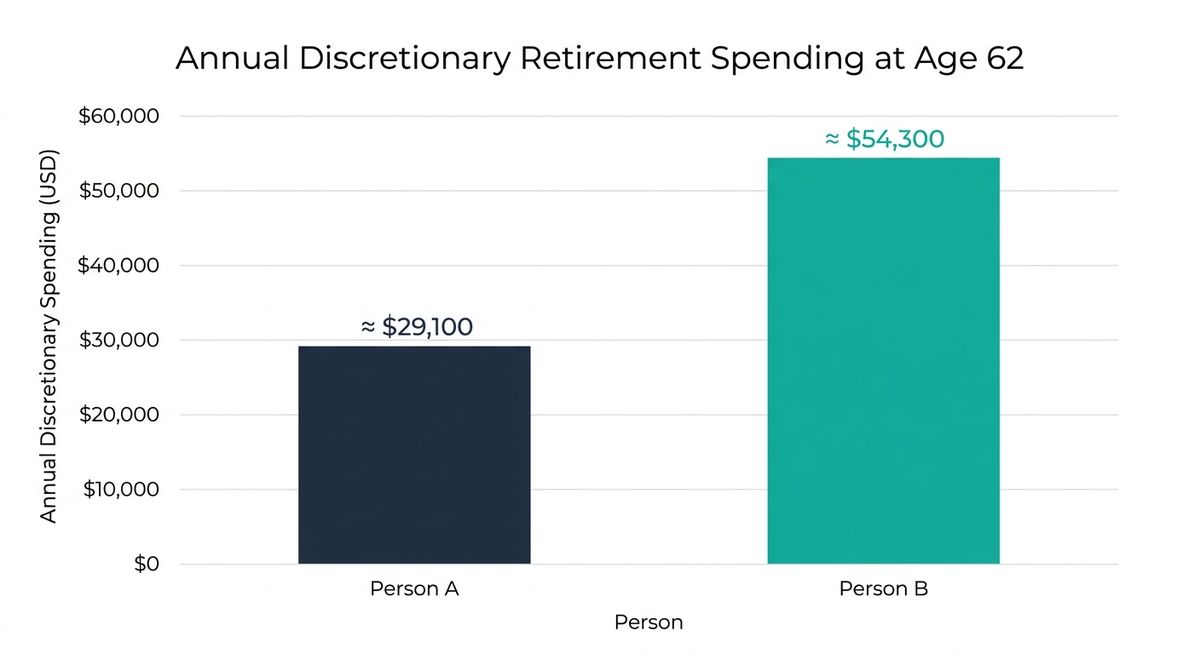
Person B spends about 1.9 times what Person A spends, while holding $650,000 less on paper and drawing on none of their invested assets.
One honest wrinkle, and it cuts against Person A twice. Morningstar's 3.9% figure is calibrated to a portfolio holding 30% to 50% equities. Person A can't have it both ways: the equity-heavy allocation that gets $1.4 million to $2.0 million is not the allocation that supports a 3.9% withdrawal, and the balanced allocation that supports 3.9% probably doesn't reach $2.0 million. Every version of that trade lands Person A lower, not higher.
You can run these numbers for your own situation at ReadyAimRetire.com to see where your own plan actually lands.
The ACA Subsidy Cliff Is the Whole Ballgame
The enhanced premium tax credits expired December 31, 2025, and the ACA subsidy cliff (the 400% FPL threshold) came back for plan year 2026 (CRS R48290). This is not a gentle phase-out. It's a wall.
Michael Kitces ran the math: for a couple, earning one more dollar above the $84,600 threshold costs roughly $12,000 in lost credits, an effective marginal tax rate of approximately 1.2 million percent on that dollar.
KFF's version: a 60-year-old at $65,000 of income watches premiums go from 8.5% of income to 24%, an increase of $10,389 a year. As Kitces puts it, "the MAGI budget generally becomes the guiding constraint rather than the individual's federal income tax bracket" (Kitces).
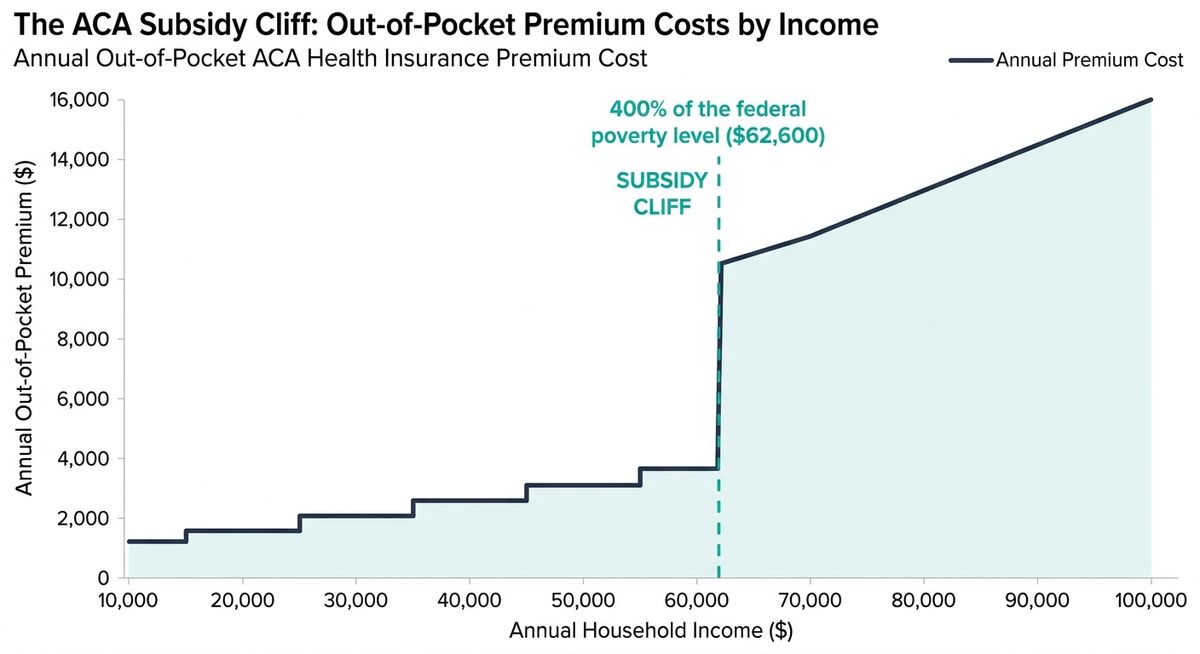
Person A has no lever. One hundred percent of the liquid wealth sits in one account type, and every dollar that comes out is MAGI. There's no Roth to pull from tax-free, no taxable brokerage where only the realized gain counts. Dropping from Silver to Bronze saves maybe $4,500, at the cost of a much higher deductible. That's the entire menu. Person B's Roth withdrawals generate zero MAGI, which is exactly why that $400,000 can sit there compounding while the pension covers life.
Status check: date-stamp this if you're reading it later
As of August 2026, the enhanced credits are still expired. HR 1834 passed the House 230-196 on January 8, 2026 via discharge petition. The Senate hasn't acted, and S 3385 failed to reach 60 votes. Nothing has become law and nothing has been restored retroactively (ASTHO). Verify before you act on any of it.
One more thing nearly every article out there gets wrong: Fidelity's widely quoted $185,500 lifetime healthcare estimate for a 65-year-old retiring in 2026 explicitly assumes Medicare enrollment. It doesn't include the 62-to-65 health insurance bridge at all (Fidelity via CNBC). For a 62-year-old over the cliff, add $16,800 to $23,800 a year on top of that for three years, roughly double it for a couple.
The Mortgage Exit Trap
"Never pay off a 2.85% mortgage" is good advice, right up until it isn't. Holding cheap debt while you've got earned income is straightforward arbitrage. But look at what happens if Person A decides at 62 that the payment is making them uncomfortable. The only money available to knock out that roughly $305,000 balance is pre-tax. Pulling it in one year means withdrawing about $418,000 to $436,000 gross to net $305,000, because a distribution that size stacks straight into the 32% and 35% brackets, and that one withdrawal wipes out any ACA subsidy for the year on top of it.
The 2.85% mortgage carries something like a 40% unwind surcharge
Nobody in the standard "3% interest versus 8% returns" debate ever mentions this, because they're all reasoning in accumulation terms, where the payoff money comes out of a paycheck. The fix isn't to abandon the arbitrage. It's to amortize the balance down with earned income between 55 and 62, and never go after it from the 401(k) at 62.
Person B's Real Problems, and There Are Three
None of this makes Person B bulletproof. The name of the fortress is the problem.
1. The inflation slow-burn
A non-COLA $42,000 pension at 3% inflation is worth $31,253 in today's dollars at 72, $23,255 at 82, and $21,281 at 85, a 49% loss. Over 30 years the cumulative purchasing power lost runs to roughly $437,000. Meanwhile Social Security, the one fully indexed asset in either scenario, rose 2.8% for 2026 (SSA).
2. The rental is optimistically stated
$22,000 net on a $300,000 property is a 7.3% net yield, against a 2026 benchmark of 5% to 6% for stabilized single-family rentals. Operating expense ratios run 50% to 70% of gross rent, and repair and maintenance costs are up 28% since 2021. Haircut it to $16,000 and Person B's discretionary spending drops to about $49,000, still 1.7 times Person A's, because the pension is doing the heavy lifting. That resilience is itself the finding.
3. The fortress has one door
If Person B is married and elected a single-life annuity, that $42,000 dies with them. Federal law defaults married participants to a qualified joint and survivor annuity of at least 50% and requires written spousal consent to waive it, so go find out what actually got signed. Person A's 401(k) passes to a spouse in full. And Person B has a tax bomb of their own: depreciation recapture up to 25% under Section 1250, plus capital gains, whenever that rental sells.
The Insight That Inverts Everything
Here's the part that's going to feel wrong and is right.
Person B, the conservative one, should hold the more aggressive portfolio. Person A, the aggressive one, needs the bond tent.
Risk capacity is a function of floor coverage, not temperament. Person B's core living costs are contractually secured for life. That $400,000 Roth has exactly one job: outrun inflation on a pension that's going to lose half its value. It should be invested for growth, because a 40% drawdown in it changes nothing about whether the lights stay on.
Person A's portfolio is the floor. It's also the roof and the walls. Roughly 70% of retirement plan failures show a portfolio that had already lost value by the end of year five, and Wade Pfau's work attributes about 77% of the final outcome to the first ten years' average return. A 20% drop at 62, with a mortgage payment due every month and a health premium that doesn't care what the market did, forces Person A to sell depreciated shares to cover fixed obligations: sequence-of-returns risk in its purest form.
Guaranteed income doesn't just feel safer, it measurably spends better
Blanchett and Finke found that retirees holding a higher share of wealth as guaranteed income spend roughly twice as much per year as retirees with equivalent wealth sitting in a portfolio (SSRN). Every dollar converted to guaranteed income produces about 2x the equivalent spending, because portfolio wealth gets hoarded out of longevity fear.
The Resolution: Person A Can Buy the Floor
The good news is this isn't a verdict. It's a seven-year to-do list, and the market is cooperating right now.
TIPS real yields on July 17, 2026 were 2.01% at 5 years, 2.31% at 10, and 2.87% at 30, the first time real yields have topped 2% in more than a decade (TheStreet). Morningstar's own research puts a guaranteed 30-year TIPS ladder at a 4.8% inflation-adjusted withdrawal rate, versus 3.9% for the best risky-portfolio safe withdrawal rate strategy they studied.
Two credible numbers, one open question
Bill Bengen, working from historical rather than forward-looking returns, lands at 4.7% for a stock-and-bond portfolio. That disagreement is methodological and unresolved: Morningstar forecasts from today's elevated valuations, Bengen backtests. Just know both numbers exist and the answer depends on which one you believe.
Read that comparison slowly anyway: the risk-free floor currently pays more than Morningstar's best risky portfolio. Person A can buy Person B's pension, today, at a historically good price.
Every retirement plan is different, and the right mix of Roth conversions, TIPS ladders, and Social Security timing depends entirely on your own account balances and goals. ReadyAimRetire lets you test how strategies like these play out with your specific numbers.
What Each of Them Does Monday
Person A, ages 55 to 62
- Stop contributing to pre-tax. Send everything to Roth 401(k), Roth IRA, and HSA. The account-type monoculture is the single biggest structural problem here, and seven years of contributions is the cheapest fix on the table.
- Build a taxable brokerage account. It's the only MAGI control valve that exists for ages 62 to 65, because only realized gains count toward MAGI, not the return of principal.
- Amortize the mortgage down with earned income. Never pay it off from the 401(k).
- Buy a floor. A TIPS ladder covering 62 to 70 at today's real yields takes sequence risk off the table in the danger window and funds a Social Security bridge.
- Plan Roth conversions for 65 to 75, not 62 to 65. Conversions and ACA subsidies are mutually exclusive before Medicare. Born in 1971, the RMD age is 75, not 73 (Congress.gov IF12750), a ten-year conversion runway, IRMAA-constrained but real.
Person B, ages 55 to 62
- Invest the $400,000 Roth for growth. It's the inflation hedge, not the safety net.
- Delay Social Security to 70. The $64,000 of baseline cash flow bridges the gap without touching the Roth, and the benefit rises roughly 77% for life, fully indexed, converting the missing COLA into the greatest strength. (ACA MAGI counts 100% of Social Security benefits even though only up to 85% is taxable, so claiming early would push toward the cliff too.)
- Open a HELOC while still employed, since underwriting needs income. At 62, look at a standby HECM line, which Pfau and Kitces found extends portfolio longevity by up to 30% and, unlike a HELOC, can't be frozen by the lender.
- Fund a real CapEx reserve and re-underwrite that $22,000 against 7% vacancy and 28% higher maintenance costs.
- Confirm the pension survivor election in writing, and check for any ad-hoc COLA provision.
- Model the depreciation recapture before assuming that rental is a $300,000 asset.
The Real Answer
Person B is winning today. Person A is winning in 2045.
But that framing is less useful than what the numbers actually show us: wealth is not the figure on the balance sheet. It's the structure of how that wealth is held. Person A has $1.85 million with one tax treatment, one asset class, one income source, and a fixed monthly obligation. That's not a portfolio. That's a single point of failure with a big number attached to it.
Person B stumbled into floor-and-upside by accident. Person A has seven years and a 2.87% real yield to go build it on purpose.
Go pull up your own statement and ask a different question than the one you usually ask. Not "how much do I have," but "how many separate things have to go right for this to work?" If the answer is one, you've got a $1.85 million illusion too.