

The Ultimate Guide to U.S. Investment Accounts: Pros, Cons, and How to Prioritize Them


Ninety-eight percent of Vanguard 401(k) plans now offer a Roth option. Only 18% of participants actually use one. Sit with that for a second — that gap isn't a Roth problem, it's an account-architecture problem, and it quietly costs regular people six figures over a career.
- An investment account isn't an investment — it's a tax wrapper. The same S&P 500 fund produces three different after-tax outcomes depending on whether it sits in a taxable account, a Roth, or an HSA.
- Every wrapper trades along three axes: upfront tax relief, tax-free growth, and unrestricted liquidity. No single account maxes all three — a set of accounts does.
- The 2026 waterfall: match → HSA → IRA → 401(k) max → mega backdoor Roth → 529 → taxable brokerage — but real life calls for breaking that order often.
- TCJA rates did not sunset. OBBBA made the 10/12/22/24/32/35/37% brackets permanent, so the Roth-vs-Traditional decision now rests on your own bracket, not a Congressional deadline.
Action: audit your pre-tax, Roth, and taxable balances this week — most people are wildly lopsided and don't know it.
Here's the thing almost nobody explains properly, and it took me embarrassingly long to figure out myself: an investment account is not an investment. A 401(k) isn't a thing that grows. It's a wrapper. A tax basket you drop investments into. The exact same S&P 500 index fund can sit in a taxable brokerage account, a Roth IRA, or an HSA, and spit out three wildly different after-tax results over 25 years. The fund didn't change. The wrapper did.
Every wrapper is trading along three axes:
- Upfront tax relief (deduct now, pay later)
- Tax-free growth (pay now, never again)
- Unrestricted liquidity (pay as you go, touch it whenever you want)
You can't max all three in one account. Nobody can. But you can build a set of accounts that covers all three, and that right there is the whole game.
The Master Comparison Matrix (2026)
| Account | Tax Treatment | 2026 Limit | Liquidity & Penalty Rules | Best Used For |
|---|---|---|---|---|
| Taxable Brokerage | After-tax in; annual tax drag; gains at LTCG rates | Unlimited | Fully liquid, no penalty, no age gate | Pre-59½ bridge money, 0% LTCG harvesting, step-up at death |
| Traditional 401(k)/403(b) | Pre-tax in; ordinary income out | $24,500 (+$8,000 at 50+, +$11,250 at 60–63) | 10% penalty before 59½; Rule of 55 applies; RMDs at 73/75 | Grabbing the match, high current brackets |
| Roth 401(k) | After-tax in; tax-free out | $24,500, same catch-ups, no income phaseout | Non-qualified withdrawals come out pro-rata; no RMDs since 2024 | High earners who want serious Roth capacity |
| Traditional IRA | Pre-tax if deductible; ordinary income out | $7,500 (+$1,100 at 50+) | 10% penalty before 59½; 72(t) available; RMDs | Rollover consolidation, savers with no work plan |
| Roth IRA | After-tax in; tax-free out | $7,500 (+$1,100), MAGI phaseout $153k–$168k single / $242k–$252k MFJ | Contributions out anytime, tax and penalty free; no RMDs | Tax diversification, backup emergency reserve, heirs |
| HSA | Deductible in, tax-free growth, tax-free out for medical | $4,400 self / $8,750 family (+$1,000 at 55+) | 20% penalty + tax before 65 for non-medical; penalty disappears at 65; no RMDs | The best retirement account almost nobody maxes |
| 529 Plan | After-tax in (state deduction possible), tax-free for education | No federal cap; $19,000/donor/beneficiary gift exclusion, 5x superfunding | Income tax + 10% penalty on earnings if non-qualified | Education, plus a $35,000 lifetime Roth escape valve |
Correction
Before we go any further, because your entire Traditional-vs-Roth decision leans on it: the TCJA tax rates did not sunset. OBBBA, signed July 4, 2025, made the 10/12/22/24/32/35/37% structure permanent. So if you're reading a guide that tells you to hurry up and convert before rates snap back in 2026, that guide is stale. The case for Roth conversions is still very much alive. It just rests on your bracket now, not on Congress's calendar.
A. Taxable Brokerage: The Underrated Retiree Weapon
How it works: you fund it with after-tax dollars. Dividends and realized gains get taxed every year (that's the "tax drag"). Sell something you've held longer than a year and you pay long-term capital gains rates instead of ordinary income rates.
That distinction is enormous, and hardly anybody actually uses it. In 2026, a married couple pays 0% federal tax on long-term gains and qualified dividends up to $98,900 of taxable income. Single filers get $49,450. And because that's taxable income, you stack the standard deduction on top of it: $32,200 for a couple under 65, or $35,500 if both spouses are 65 or older.
At the kitchen table
A retired couple, both 66, pull $40,000 out of a Traditional IRA. The $35,500 standard deduction plus the senior bonus deduction eats almost all of it. Then they sell appreciated index funds and realize close to $98,900 of long-term gains at 0% federal tax, buying the exact same position right back at a higher cost basis. That gain is gone. Permanently. For free.
I explained this to my friend Chuck over dinner a couple of years back, and she genuinely thought I was making it up. She wasn't rude about it, she just didn't believe the government would leave that door open. It's open. If you want to see how the 0% bracket plays out against your own account balances and Social Security timing, you can run these numbers for your own situation at ReadyAimRetire.com.
Pros
- The 0% LTCG bracket. The single most under-used lever available to retirees, and it's not close
- Step-up in basis at death wipes out embedded gains for your heirs. No tax-deferred account does this. Heirs of a Traditional IRA inherit the full tax bill and a 10-year clock to drain it
- Tax-loss harvesting: losses offset gains dollar for dollar, plus $3,000/year against ordinary income, carried forward forever
- Donate appreciated shares to charity: skip the gain entirely, deduct fair market value
- No RMDs, no penalties, no age gates, no income limits, no caps. It just sits there being useful
Cons
- The annual tax drag compounds against you, year after year
- NIIT tacks on 3.8% above $200,000 MAGI single / $250,000 MFJ, and those thresholds haven't been indexed since 2013, so bracket creep drags more people in every single year
- Realized gains push up your MAGI, which can trip IRMAA and phase out the senior deduction
- State taxes stack right on top
Ideal for: anyone retiring before 59½, anyone whose taxable income lands in that 0% LTCG band, and anyone who'd rather leave their kids assets than a tax bill.
B. Traditional 401(k) / 403(b): The Match Is the Whole Point
How it works: your deferrals come out pre-tax, grow tax-deferred, and every dollar you eventually withdraw is ordinary income. RMDs kick in at 73, or 75 if you were born in 1960 or later.
Pros
- The highest contribution ceiling anywhere: $24,500, or $32,500 at 50+, or $35,750 if you're between 60 and 63
- The employer match. An instant 25% to 100% return. Most common formula out there: 50% up to 6% of pay
- ERISA creditor protection, the strongest you can get
- No income limit to participate
- Rule of 55: leave your job in or after the year you turn 55 and you can take penalty-free withdrawals from that employer's plan
Cons
- You get a menu of roughly 16 funds, not the open market
- Layered fees. A $5 million plan averages 1.08% all-in versus 0.76% at a $50 million plan
- RMDs force taxable income on you whether you need the money or not
- 10% penalty before 59½ unless an exception applies
The mistake that costs the most: roughly 25% of workers don't capture the full match, walking away from an average of $1,336 per year. Invest that at 7% across a 30-year career and you've left something like $130,000 on the table. Among workers earning under $40,000, the miss rate is 42%. Among folks over $100,000, it's 10%. So this isn't a "people are careless" story. It's mostly a "money is tight and the paperwork is confusing" story.
The second mistake: rolling that 401(k) into an IRA at 56 because you want better funds. My man David did exactly this, with the best of intentions, and torched his Rule of 55 access in the process. That move bought him a 10% penalty until 59½.
New for 2026
If your prior-year FICA wages from that employer topped $150,000, your age-50+ catch-up has to be Roth. So picture a 56-year-old who earned $180,000 in 2025 and had budgeted a $32,500 pre-tax deferral. She now gets only $24,500 pre-tax. At 24%, that's $1,920 of tax she didn't plan for. Three details most articles fumble: the indexed number is $150,000, not the statutory $145,000; the test is W-2 Box 3 (Social Security wages), not Box 5; and it's measured per employer, so if you switched jobs mid-2025 you might be under the threshold at both. Self-employed partners with no FICA wages are off the hook entirely.
Getting at the money before 59½. Four routes worth knowing, and every one of them needs lead time:
- Rule of 55, described above, and destroyed by an IRA rollover
- 72(t) SEPP: substantially equal periodic payments at any age, using one of three IRS methods, and they have to run the longer of five years or until you hit 59½
- SECURE 2.0 carve-outs: $1,000/year personal emergency, $10,000 domestic abuse, $22,000 federally declared disaster
- Disability, death, medical expenses above 7.5% of AGI, IRS levy, and $5,000 for a qualified birth or adoption
403(b) note: if you work for a qualifying organization and you've got 15+ years of service, you may be able to tuck away an extra $3,000/year ($15,000 lifetime) under the 15-year rule. Almost nobody mentions this one. My cousin taught high school for 22 years and had never heard of it.
Ideal for: anyone with an employer match. Full stop, no caveats, go do it. Past the match, this is the right home for high earners in the 32%+ brackets and for anyone whose retirement income is realistically going to be a lot lower than today's.
C. Roth 401(k): Huge Capacity, No Income Test
How it works: same $24,500 limit, funded with after-tax dollars, comes out tax-free in retirement.
Pros
- No income phaseout. This is the only big-capacity Roth vehicle a high earner can walk right into without any gymnastics
- No RMDs since 2024. SECURE 2.0 killed them for Roth accounts inside employer plans, and plenty of guides out there still have this wrong
- Your employer match can be made as Roth if the plan allows it, though it's taxable to you in the year you receive it
Cons
- You're giving up the deduction during what might be your peak earning years
- The 5-year clock is plan-specific and it does not travel with you. Roll a Roth 401(k) into a Roth IRA and it takes on the IRA's clock. That's wonderful if you opened a Roth IRA back in 2012. Rough if you open one fresh at 60
- It's not as liquid as a Roth IRA. A non-qualified withdrawal from a Roth 401(k) comes out pro-rata, part basis and part taxable earnings. You can't pick out just your contributions the way you can in a Roth IRA
Ideal for: anyone in the 22% to 24% band who wants tax diversification, anyone whose pre-tax balance is already big enough to become an RMD headache, and any high earner who's maxed the backdoor Roth and still wants more tax-free room.
D. Traditional IRA: The Consolidator with a Catch
How it works: $7,500 in, or $8,600 at 50+, and it's deductible only if you're not covered by a workplace plan, or if your income sits under the phaseouts: $81,000 to $91,000 single, $129,000 to $149,000 MFJ when the contributing spouse is the covered one. If your spouse is covered but you're not, your own phaseout runs $242,000 to $252,000.
Pros
- The entire investment universe, instead of a 16-fund menu
- The natural landing spot for those old 401(k)s you've got scattered across three former employers
- Spousal IRA lets a non-earning spouse contribute against household earned income
Cons
- Small limit, and the deduction vanishes fast
- RMDs, plus weaker creditor protection than ERISA plans, and that protection varies by state
- No Rule of 55
- Any pre-tax IRA balance poisons your backdoor Roth through the pro-rata rule. I run the numbers on this in Section E and they're ugly
Conversion mechanics worth knowing: there hasn't been an income limit on conversions since 2010, but conversions are permanently irreversible. TCJA killed recharacterization of conversions. You can still recharacterize an annual contribution, just not a conversion. And each conversion carries its own 5-year clock for the under-59½ penalty.
Ideal for: consolidating orphaned 401(k)s, savers with no workplace plan who can still take the deduction, and non-earning spouses. For most covered high earners, this is a rest stop on the road to a backdoor Roth, not the destination.
E. Roth IRA: Tax-Free Growth and a Hidden Emergency Fund
How it works: after-tax in, tax-free out, no RMDs for the original owner, and your heirs get ten more years of tax-free growth.
The ordering rule almost no guide bothers to explain: distributions come out in a fixed sequence. (1) Contributions, then (2) conversions oldest first, then (3) earnings. Because your contributions come out anytime, tax free and penalty free, a Roth IRA doubles as a legitimate backup emergency fund. That same ordering is what makes the Roth conversion ladder work for early retirees. There's also a separate $10,000 lifetime exception that lets you tap earnings for a first home.
Open a Roth IRA with $100 today just to get the five-year clock ticking. It's the cheapest thing on this list.
The two 5-year rules, which just about every article mashes together:
- Earnings rule: five tax years from January 1 of the year of your first ever Roth IRA contribution. One clock, per person, forever. If you've never opened one, open a Roth IRA with $100 today just to get that clock ticking. It's the cheapest thing on this list
- Conversion rule: each conversion gets its own 5-year clock for the 10% penalty. Becomes irrelevant once you're 59½
Backdoor Roth (basically mandatory above $168,000 single / $252,000 MFJ): make a nondeductible Traditional IRA contribution, then convert it. Neither leg has an income limit. But the pro-rata rule treats all your Traditional, SEP, and SIMPLE IRAs as one big pool, measured on December 31 of the conversion year. Not on the day you convert. December 31.
The pro-rata wreck, in actual numbers
Say you've got a $200,000 rollover IRA and you do a $7,500 backdoor Roth. Your after-tax share is 7,500 ÷ 207,500, about 3.6%. Which means roughly $7,229 of that "tax-free" conversion is taxable. The fix: reverse-roll the $200,000 into your current 401(k) before December 31. Workplace 401(k)s and solo 401(k)s don't count toward the pro-rata pool. That's the escape hatch. And the same December 31 timing can bite you from the other direction: a perfectly routine 401(k)-to-IRA rollover in November can retroactively ruin a backdoor conversion you did cleanly back in January.
File Form 8606 for every nondeductible contribution. Every single one. Skipping this form is far and away the most common error I hear about from readers, and the punishment is paying tax twice on the same dollars. Nobody deserves that.
Mega backdoor Roth: your plan has to allow both after-tax contributions and in-plan conversion. Only about 60% of plans permit in-plan Roth conversions, so the real-world availability is a lot narrower than the internet suggests. 2026 headroom: the $72,000 total-additions ceiling minus your $24,500 deferral minus employer contributions, which works out to roughly $47,500 at the top end.
Ideal for: basically everyone who qualifies, and through the backdoor, everyone who doesn't. Per dollar, it's the most valuable account going for young savers, for anyone who wants retirement income that IRMAA can't see, and for anyone leaving money to their kids.
F. The HSA: A Triple Tax Advantage That 90% of Owners Waste
How it works: deductible going in, tax-free growth in the middle, tax-free coming out for qualified medical expenses. Contribute through payroll and you also skip the 7.65% FICA tax, which is a fourth advantage you won't find in any other account. Quick caveat: that FICA piece requires your employer's cafeteria plan. If you contribute directly and deduct it on your return, you get the income tax break but not the FICA break.
The stealth retirement thesis: at 65, the 20% penalty on non-medical withdrawals just disappears. Your HSA quietly becomes a Traditional IRA that also happens to have a permanent tax-free medical escape hatch bolted onto it. And medical costs in retirement are not a rounding error. Fidelity's 2026 estimate is $185,500 for a single 65-year-old and $371,000 per couple, up 7.5% in a single year, and that's before long-term care. Medicare Part B, Part D, and Advantage premiums all qualify. Medigap doesn't. Long-term care insurance premiums qualify up to age-based limits.
The shoebox strategy: IRS Notice 2004-50 sets no deadline for reimbursement. None. So you pay for a $4,000 procedure out of pocket at 40, you keep the receipt, and you leave the money invested. At 8% for 25 years that $4,000 turns into about $27,400, all of which you can pull out tax-free against a receipt from decades earlier. Three conditions: the expense happened after you opened the HSA, you never got reimbursed for it from somewhere else, and you never claimed it as an itemized deduction. My buddy Marcus keeps his receipts scanned in a folder called "future me." Not a bad system.
Cons, which is where most guides suddenly go quiet
- You need HDHP eligibility (2026: minimum deductible $1,700/$3,400, max out-of-pocket $8,500/$17,000). If you use a lot of healthcare, you may lose more to the deductible than you gain in tax
- California and New Jersey don't conform. No state deduction, and internal earnings, including realized gains inside the account, get taxed annually at the state level. That meaningfully weakens the pitch for roughly 14% of the country
- Medicare's 6-month lookback. Enrolling in Part A, or claiming Social Security at 65 (which triggers Part A automatically), is retroactive up to six months. That voids your HSA eligibility for those months and creates excess contributions subject to a 6% excise tax. So stop contributing about six months before you enroll
- A non-spouse beneficiary is a tax disaster. The account stops being an HSA at death and the entire balance is ordinary income to your heir in one single year. A $400,000 HSA passed to an adult child could land them in the 35% bracket. That same $400,000 in a taxable account would have passed with a full step-up in basis. A spouse is different: they inherit it as their own HSA. This is the strongest argument I know against dying with a giant unspent HSA
- Only about 10% of HSAs are actually invested (4.2 million out of 41.7 million). The rest are sitting in cash, which is exactly why the famous triple advantage so rarely shows up in real life. The fix is mechanical, not philosophical: keep your annual deductible in cash, invest everything above it
Ideal for: any HDHP-eligible saver healthy enough to absorb the deductible out of pocket, outside California and New Jersey. It's the only account that can be tax-free on all three legs, and honestly it should usually get funded before you go past the 401(k) match.
Ready to run your own numbers?
See how your retirement plan stacks up with ReadyAimRetire's free retirement calculator.
G. 529 Plans: Now With an Exit Ramp
How it works: after-tax federal contributions, tax-free growth, tax-free withdrawals for qualified education. There's no federal deduction here. The benefit lives at the state level, and 36+ states plus D.C. offer one. Nine "tax parity" states (AZ, AR, KS, ME, MN, MO, MT, OH, PA) give you the break for contributing to any state's plan. Everybody else has to use their home-state plan to get it. Indiana's 20% credit, worth up to $1,500 on $7,500 contributed, is the most generous per dollar in the country. If you live there and you're not using it, that's free money going out the window.
Contributions run on gift-tax rules instead of a federal cap: $19,000 per donor per beneficiary in 2026, with 5-year superfunding of up to $95,000 available through a Form 709 election. State aggregate balance caps usually land somewhere between $235,000 and $600,000.
New for 2026 (OBBBA): the K-12 withdrawal cap doubles from $10,000 to $20,000 per year, qualified K-12 expenses now cover curriculum materials, textbooks, standardized test fees, and outside tutoring, and there's a new credentialing category for WIOA-authorized, military, and government-approved programs.
"But what if my kid doesn't go to college?" Four valves:
- Change the beneficiary to any qualified family member, including yourself or a grandchild. Unlimited and tax-free
- Roll up to $35,000 lifetime into the beneficiary's Roth IRA. The account has to be 15+ years old, contributions from the last 5 years don't count, it's capped by the annual Roth limit ($7,500 in 2026), and the beneficiary needs earned income at least equal to the rollover
- Scholarship exception: withdraw up to the scholarship amount penalty-free, though earnings are still taxable
- Spend it on the newly expanded K-12 and credentialing categories
The wrinkle nobody has resolved
Does changing the beneficiary restart that 15-year clock for a Roth rollover? The 529 industry formally asked the IRS back in September 2023 and, as of mid-2026, has heard nothing back. Some plan administrators are playing it conservative and assuming it does. Practical takeaway: if you're counting on the Roth valve, don't go switching beneficiaries in year 14. Switch early or don't switch at all.
Here's a real-shaped example: a 529 opened in 2008 has $28,000 sitting in it after graduation. The 24-year-old beneficiary earns $60,000, comfortably more than the annual rollover. At $7,500 a year, the whole thing drains into their Roth IRA in under four years, never getting anywhere near the $35,000 lifetime ceiling. That kid starts adult life with a funded Roth. Not a bad handoff.
Cons: non-qualified withdrawals cost you income tax plus a 10% penalty on earnings, you can only change investments twice per calendar year, your state deduction can get recaptured, and the assets do count against financial aid, though at a friendly parental rate of about 5.64%.
Ideal for: parents and grandparents with a clear education goal and a state deduction worth grabbing, and higher-net-worth families using superfunding as an estate-planning move. Fund it after your own retirement accounts. There are loans for college. There are no loans for retirement.
Sidebar: the account you probably haven't heard of yet
Trump Accounts opened for contributions on July 4, 2026. They're custodial, traditional-IRA-style accounts for minors with a $5,000/year cap, up to $2,500 of which can come from an employer, plus a one-time $1,000 federal pilot contribution for U.S.-citizen kids born between January 1, 2025 and December 31, 2028.
Framework 1: Traditional vs. Roth
Compare your marginal rate today against your expected marginal rate when you withdraw. Then adjust for five things almost every online calculator ignores.
| Your current bracket | Default choice |
|---|---|
| 10–12% | Roth. You will rarely see rates this low again |
| 22–24% | Split. The goal here is tax diversification, not optimization |
| 32%+ | Traditional, and Roth shows up anyway through the mandatory catch-up and the backdoor |
| Large pre-tax balance already | Roth. You've got a future RMD problem, not a current tax problem |
| Married, meaningful age or health gap | Roth. See below |
Choose Traditional when...
- You're in your peak earning years at 32%+
- Your projected retirement income is realistically much lower
- You need the deduction to also qualify for other income-based breaks
Choose Roth when...
- You're in the 10–12% bracket and won't see rates this low again
- Your pre-tax balance is already large enough to create an RMD problem
- You're married with a meaningful age or health gap between spouses
The five adjustments:
1. The RMD bracket bomb. A big pre-tax balance forces income out at 73 or 75 whether you want it or not, and it often shoves you back up a bracket in retirement. That's a strange feeling: you retired, your income went down, and your tax rate went up.
2. The widow(er)'s penalty. The surviving spouse files single, with roughly half the brackets and half the standard deduction, on 70% to 80% of the household income. This is frequently the single strongest Roth argument for married pre-retirees, and it barely ever gets mentioned. It's not a fun thing to plan around. It's still the right thing to plan around.
3. IRMAA cliffs. 2026 surcharges start at $109,000 MAGI single / $218,000 MFJ, based on your 2024 return. Every tier is a cliff, not a gentle ramp. A couple whose 2024 MAGI was $217,500 and who did a $1,000 Roth conversion that December crossed $218,000, and now both spouses pay the surcharge every month of 2026. Part B runs $202.90 to $689.90 a month in 2026. Roth withdrawals don't count toward MAGI. Traditional withdrawals do.
4. The 2026–2028 senior deduction window. Filers 65+ can claim up to $6,000 each ($12,000 MFJ) on top of the standard deduction and the existing age-65 addition. It phases out above $75,000 MAGI single / $150,000 MFJ and is gone entirely at $175,000 / $250,000. Now here's what it actually costs you, because I've seen this one wildly overstated: it's a smooth phaseout, not a cliff, worth about $60 of lost deduction per $1,000 of MAGI for a single filer and about $120 per $1,000 for a couple where both spouses are 65+. In the 22% bracket, that turns conversion dollars above the threshold into an effective 23.3% rate for a single filer, or 24.6% for that couple. Real, but small. Size your conversions to stay under the threshold when it's easy, and don't let a two-point surcharge talk you out of a conversion that's otherwise correct.
5. The tax torpedo, which is the one that actually hurts. In the income band where each extra dollar makes 85 cents of Social Security benefits taxable, a retiree who's nominally in the 22% bracket can face an effective marginal rate of 40.7%. That is far more punishing than the senior deduction phaseout, and it's the best argument going for converting aggressively during the gap years between leaving work and claiming benefits, when your AGI is at its lifetime low. Those gap years are the most valuable planning window most people never use.
You retired, your income went down, and your tax rate went up. That's the RMD bracket bomb — and it's entirely avoidable with enough lead time.
One more, for the 32%+ crowd: you deduct at your marginal rate, but you withdraw through the brackets from the bottom up. That asymmetry is a genuine argument for Traditional if you're at 32%+ today with modest projected retirement income.
Framework 2: The Waterfall
Step 0. Emergency fund of 3 to 6 months, and kill any debt above 7% to 8%. Non-negotiable.
Step 1. 401(k) to the full match. Instant 25% to 100% return, and a quarter of workers leave it sitting there.
Step 2. Max the HSA if you're HDHP-eligible. Contribute through payroll so you catch the FICA savings too.
Step 3. Max the IRA. Roth if you qualify, backdoor Roth if you don't.
Step 4. Max the 401(k) to $24,500 plus catch-ups.
Step 5. Mega backdoor Roth, if your plan allows after-tax contributions and in-plan conversion.
Step 6. 529, sized at minimum to capture your state deduction.
Step 7. Taxable brokerage.
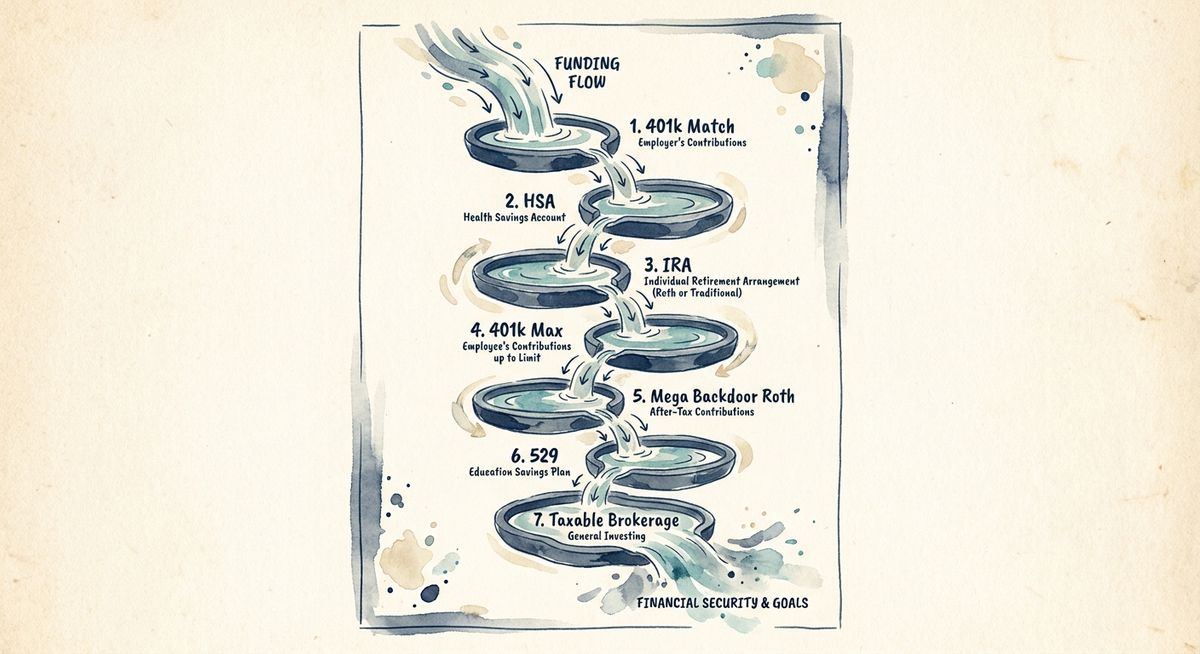
Now go ahead and break the order, on purpose, when your life calls for it:
- Bad 401(k) (all-in fees over 1%, no index options): take the match, then jump straight to the HSA and IRA.
- Retiring before 59½: over-weight taxable and Roth basis so you can fund the bridge years. "Taxable is always last" is flatly wrong for early retirees. Liquidity has a value that no tax spreadsheet knows how to price.
- California or New Jersey resident: the HSA slides below the IRA.
- Heavy medical utilizer: an HDHP may just be the wrong insurance for you, regardless of what the tax math says.
- Already sitting on a very large pre-tax balance: prioritize Roth and taxable to build the diversification you're missing.
Every retirement plan is different, and the waterfall above is a starting point, not a verdict. ReadyAimRetire lets you test how these strategies play out with your specific numbers before you change a single contribution election.
Your Next Three Moves
- Audit your tax buckets this week. Add up your balances in three columns: pre-tax, Roth, and taxable. A lot of pre-retirees run this and find something like 85/5/10. That's not a portfolio. That's a bet that future tax rates will be kind to you. Working rule of thumb: if any column sits under 15%, congratulations, you just found your funding priority for the next five years.
- Verify your match and your catch-up. Log into your plan and confirm two things. One, that your deferral rate is capturing 100% of the employer match. Two, if you're 50+ and your 2025 W-2 Box 3 wages from that employer topped $150,000, that your catch-up is coded as Roth. And if your plan has no Roth feature at all, you can't make catch-up contributions this year, period. That's a conversation to have with HR now, not in November.
- Price your bridge. Count the years between your target retirement date and 59½, multiply by your annual spending, and check whether your taxable account plus your Roth contribution basis actually covers it. If it doesn't, you need a Rule of 55 plan, a 72(t), or a conversion ladder. All three take years of lead time. None of them can be arranged the week you hand in your notice.
Look, none of this is glamorous. It's wrappers and clocks and thresholds. But the wrapper you pick today decides how much of your money is genuinely yours in 2045, and that's a difference measured in years of your life, not just dollars.
Pick deliberately. Thanks for reading if you've made it this far.
Peace!