

The Wealth Plateau: Why Working Past 57 Might Be the Worst Deal You Ever Make

Let me offer you a deal.
Option A: I pull out my wallet and hand you $10,000. Guaranteed. It's yours before you finish reading this sentence.
Option B: I flip you into a game with a 25% chance at $50,000 and a 75% chance at absolutely nothing. One shot. No second round, no "best two out of three."
Almost everyone takes the ten grand. And almost everyone who does is technically leaving money on the table, because Option B has an expected value of $12,500. That's 0.25 times $50,000. On paper the gamble is 25% better. In actual human life, hardly anybody wants it.
Daniel Kahneman and Amos Tversky wrote this exact instinct down in their 1979 Econometrica paper on prospect theory. Their version used different numbers: 3,000 Israeli pounds guaranteed versus an 80% shot at 4,000. Out of 95 people, 80% took the sure thing even though the gamble was worth more. Their phrasing for what was happening: we "underweight outcomes that are merely probable in comparison with outcomes that are obtained with certainty."
Here's what I want you to sit with. That instinct isn't a bug. It's the reason millions of Americans built actual wealth instead of losing it at a blackjack table. It's also the reason a lot of those same people are going to hand over the last healthy decade of their lives to a job they stopped needing years ago.
Definition: One More Year Syndrome
Behavioral economists' name for the pull to keep working long after the number in your account already says you could stop. It's the same certainty-effect wiring that built your wealth in the first place, still running, years after it stopped being useful.
- The same certainty-effect wiring that helped you build wealth is what keeps you working past the point you actually need to.
- EBRI data shows the median retiree stops at 62, not the 65-to-70 most workers plan for, and nearly half leave earlier than planned.
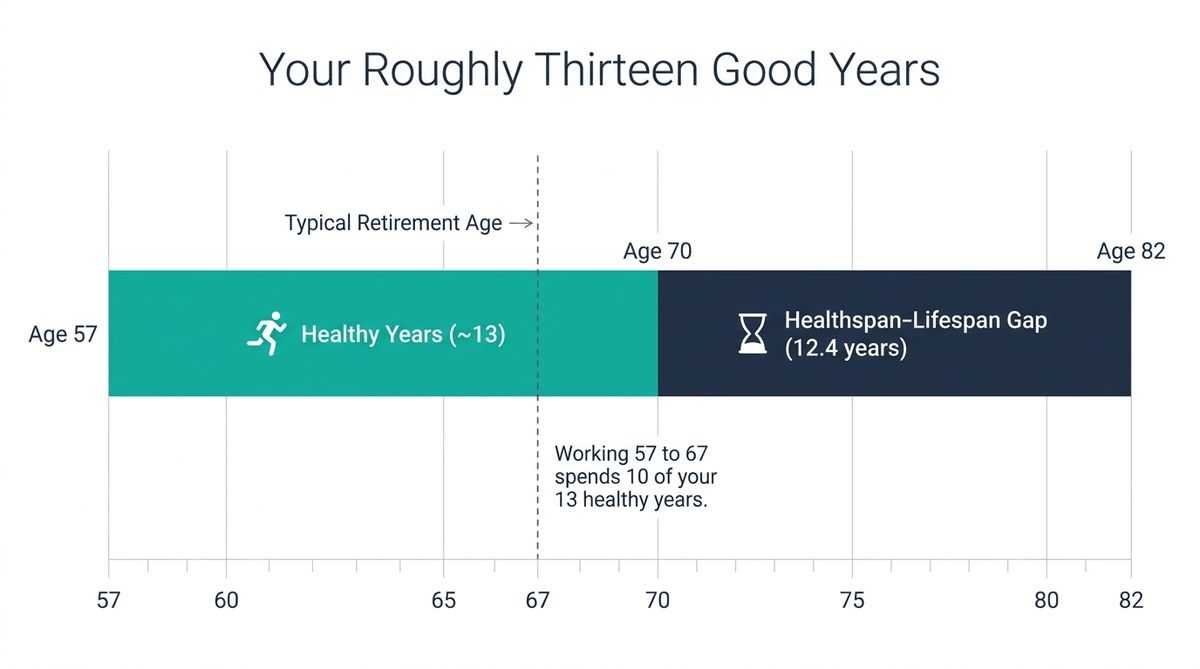
- The U.S. healthspan-lifespan gap is 12.4 years, the largest in the world. At 57, you have roughly thirteen genuinely healthy years left. Working to 67 spends ten of them.
- The Rule of 55 lets you pull penalty-free from your current employer's 401(k) starting the year you turn 55, no need to wait for 59½, if you know the fine print.
- The 2026 ACA subsidy cliff is real and can cost tens of thousands of dollars, but it's a MAGI-management problem you solve after you stop working, not a reason to keep working.
Action: Run your own numbers this week, in the exact format at the end of this article.
The Certainty Effect Comes With an Expiration Date
Two things push you toward the guarantee, and only one of them is a quirk of behavioral finance.
The first one is psychological. Sitting right next to the certainty effect is loss aversion, which is the idea that losing your baseline hurts more than gaining the same amount feels good. The famous number from Tversky and Kahneman's 1992 work was about 2.25, so losses hurt roughly twice as much. I'll be honest with you though, that number has been getting squeezed. Recent meta-analyses put it more in the 1.8 to 2.1 range, and at least one reassessment has it down near 1.3. Researchers have also found that at small stakes, loss aversion barely shows up at all. The direction of the effect is solid. The neat little "losses hurt twice as much" line you hear at every conference? Less solid.
The second force isn't a quirk at all. It's just math, and it depends entirely on your balance sheet. If you're sitting on a 24% APR credit card balance with no emergency fund, that $10,000 isn't a windfall. It's a structural repair on your life. Rolling the dice on a 75% chance of nothing would be genuinely reckless, and anyone who tells you otherwise has never had that kind of balance.
Now let's climb the ladder. Same ratio the whole way up.
- $100 guaranteed versus a 25% shot at $500
- $1,000 versus a 25% shot at $5,000
- $100,000 versus a 25% shot at $500,000
- $1,500,000 versus a 25% shot at $7,500,000
At the bottom, everybody gambles. Losing a hundred bucks doesn't change your Tuesday. But somewhere up that ladder the whole thing flips, hard. Once the guaranteed number covers the life you actually want (mortgage gone, health coverage handled, cash flow you can count on), taking a 75% chance at zero to chase money you will never spend isn't bold. It just doesn't make sense.
In a thought experiment, spotting that line takes about four seconds. In a real career, it's nearly invisible. You spend thirty years of wealth accumulation climbing toward a number, and then one day in your mid-50s your statement finally clears it, and you don't stop. You just move the target. One more bonus cycle. One more vesting date. A slightly fatter cushion, because who knows.
And the data on how that story ends is not ambiguous even a little bit. In EBRI's 2026 Retirement Confidence Survey, the median worker expects to retire at 65, and 39% expect to work until 70 or never. The median retiree actually stopped at 62. Nearly half of retirees left earlier than they'd planned. In a separate EBRI study of 3,600 retirees between 62 and 75, 58% retired ahead of schedule, with 38% pointing to health problems and 23% pointing to employment disruption. The Urban Institute found that more than half of full-time workers in their early 50s eventually leave their jobs involuntarily.
"One more year" isn't really a plan. It's a bet that you'll be the one who gets to pick the exit date.
The Straight Line That Isn't
Our brains love straight lines. Double the input, double the reward. And early in a career, that's basically true.
At 24, going from nothing to $4,000 a month of take-home is life-altering, because every single dollar lands on rent, groceries, the electric bill, the urgent care visit. This is Maslow's hierarchy doing exactly what it says on the tin, straight out of his 1943 paper A Theory of Human Motivation: physiological needs first, then safety, then belonging, then esteem, then self-actualization. Down in those bottom two tiers, money is close to a perfect machine. Dollars convert into security at roughly one to one. Economists have a term for what happens as you climb: diminishing marginal utility, the idea that each additional dollar buys a little less well-being than the one before it. It's working in your favor at the bottom of the ladder. Further up, it flips against you.
Two caveats, because the pop-culture version of both of these ideas is wrong and I'd rather you hear it from me.
Maslow's tiers are real, but the strict order isn't. Tay and Diener looked at 60,865 people across 123 countries in the Gallup World Poll and found people reporting strong social bonds and real self-actualization while their basic needs went unmet. Different tiers also drive different things: basic needs predict how you evaluate your life, while social and esteem needs predict how you actually feel on a random Wednesday.
And the famous $75,000 happiness ceiling? Gone. Kahneman and Deaton found it in 2010. Matthew Killingsworth ran the numbers in 2021 and found no plateau at all. Instead of sniping at each other through footnotes for a decade, they did something I genuinely love: an adversarial collaboration, with Barbara Mellers refereeing, published in PNAS in March 2023. The verdict was that on average, happiness keeps climbing with income. No general plateau. The plateau is real, but only for the least happy 20% or so of people, whose well-being rises sharply to around $100,000 and then goes flat.
Now read that again, because it doesn't weaken the case for walking away at 57. It makes it a whole lot more personal.
If you're broadly content and more money keeps adding to that, great, genuinely. But if you're the person who wakes up Monday with a low hum of dread about the day in front of you, congratulations, you're in the exact group where the curve already flattened. More money is the one thing the evidence says will not fix it.
That's the trap. Three decades of conditioning taught your nervous system that more capital equals more safety. So when that top-of-the-pyramid discomfort shows up, your brain writes the only prescription it's ever written: earn more. Then hedonic adaptation handles cleanup, resetting your baseline within weeks of every single upgrade. Brickman's 1978 study of lottery winners found them no happier than the control group, and getting less pleasure out of ordinary daily stuff.
The Central Paradox
Money is exceptionally good at solving bottom-of-the-pyramid problems and pretty much useless at solving top-of-the-pyramid problems. Chasing more of it to fix the top spends the only asset that works up there: your time.
Health Is the Exchange Rate
Money has no value on its own. You can't eat a brokerage statement. I've tried explaining this to people over dinner and it lands better than you'd think. Money is worth exactly what your body can convert it into, and that conversion rate does not decline gently.
Here's the number that should stop every 57-year-old in their tracks. The United States has a healthspan-lifespan gap of 12.4 years. Largest in the world. That's Mayo Clinic research published in JAMA Network Open in December 2024. The gap grew from 10.9 years in 2000 to 12.4 by 2019, and it runs 29% above the global average. For women it's 13.7 years. Americans aren't really living longer. We're spending longer being sick at the end.
Now put a denominator underneath that. Period life expectancy for an American at 57 is roughly 82. Take out the 12.4-year gap and the healthy portion wraps up somewhere around 70. Call it thirteen good years. Fair caveat: that's a population average, and an affluent, well-insured professional who lifts weights three times a week should beat it. But even then, the shape doesn't change much.
Working from 57 to 67 spends ten of your roughly thirteen.
The decline inside those years is quieter but it's just as real. VO₂ max drops about 10% per decade after 25. Muscle mass falls 1% to 2% a year after 50, and strength goes faster: around 1.5% annually from 50 to 60, then roughly 3% a year after that. By 65 to 74, 64% of adults are managing two or more chronic conditions. Add it up across that decade at the desk: aerobic capacity down about 10%, muscle mass down 10% to 20%, strength down roughly a quarter. You're not trading time for money. You're trading the exchange rate itself.
Think about what $15,000 buys at each end of that.
My buddy Marco did the Camino at 58 and still talks about it like it happened last month. That's not nostalgia, it's what researchers call a memory dividend: money spent on experience while you're healthy keeps paying out in recollection for years, long after the receipt is gone.
Age 57: Still Fit Enough to Go
- Physical state Working knees, real stamina
- What $15,000 buys Three weeks on the Camino, a Rockies road trip, real hands-on work
- What it leaves behind A memory dividend
Age 82: Managing the Decline
- Physical state Chronic pain, limited mobility
- What $15,000 buys A nicer hotel room, a car service nearby
- What it leaves behind The same balance, a smaller life
David Blanchett's research on the retirement spending smile shows retirees already know this in their bones. Real spending falls roughly 1% to 2% a year through the go-go and slow-go years, so retirees typically need about 20% less than a straight-line model predicts. And per the Health and Retirement Study, life satisfaction in retirement peaks between 65 and 71.
The same logic takes apart the inheritance argument, which is where a lot of "one more year" thinking likes to hide. The median American who receives an inheritance gets it at 58. Only about 30% of households ever receive one at all, and the median amount among people who actually get something is around $69,000. So work to 67, live to 87, and your kid gets your money at 58. That's the statistical base case, right on the nose. At 28, that money is a down payment or a business or a graduate degree. At 58, it's a slightly bigger IRA that they're also going to fail to spend.
Warren Buffett is the cleanest version of this I know. He stepped down as Berkshire Hathaway's CEO on January 1, 2026, at 95, handed operations to Greg Abel after six decades, stayed on as chairman, sitting on a fortune near $150 billion. Now ask what fraction of that he'd trade for one year of 25-year-old health. Non-renewable resources don't get more valuable in a straight line as they run out. They go exponential.
The American Sweet Spot: 55 to 59½
You've probably seen "57" pop up in retirement writing. That's a British thing. The UK's pension access age climbs from 55 to 57 on April 6, 2028, under the Finance Act 2022. Over here it isn't a date, it's a window, and it runs from 55 to 59½. If you're mapping out the logistics of this window, 6 Things To Do If You Want To Retire In Your 50s is a good practical companion to what follows here.
The biological case. At 55 to 57 you're still fit enough to get fit. Take back 45 hours a week at 56 and you've got real runway to build strength, fix your sleep, and knock down chronic inflammation before the steep part of the curve. Start that same project at 67 and you're rebuilding from a hole.
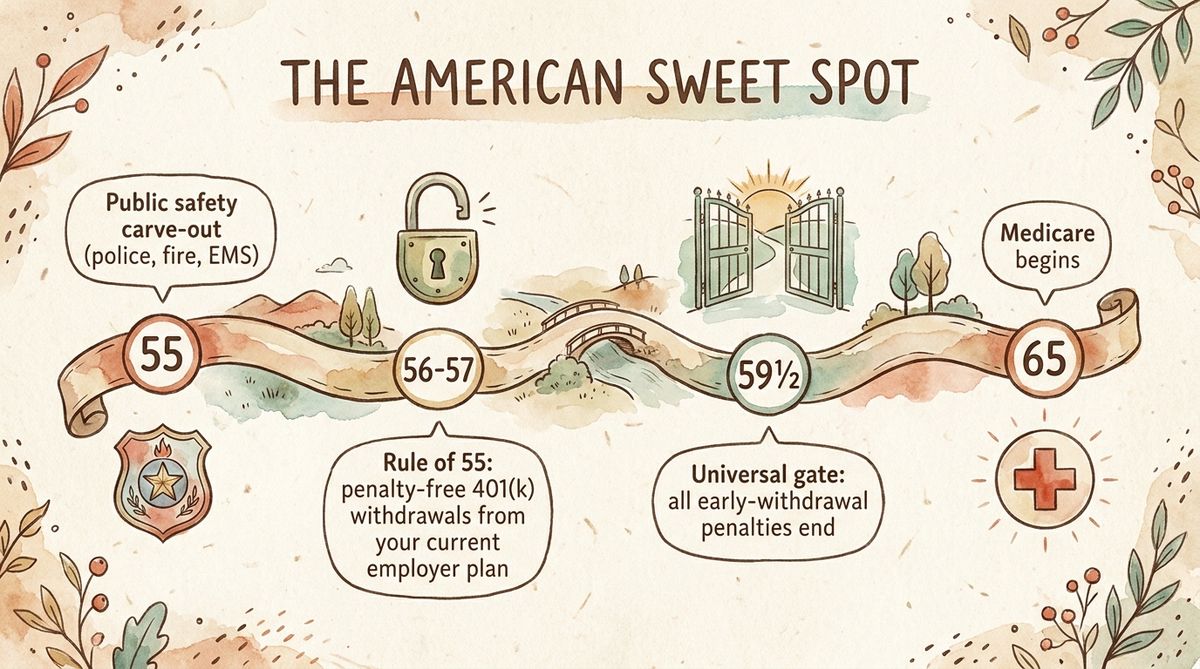
The Rule of 55. Most people are convinced 59½ is a wall you cannot get through on 401(k) withdrawals. It isn't. If you separate from your employer during or after the calendar year you turn 55 (quit, laid off, fired, doesn't matter), you can take penalty-free distributions from that employer's 401(k), 403(b), or TSP. There are three pieces of fine print that decide whether this actually works for you, and almost every article on the internet skips right past them:
- Rolling to an IRA kills the exception. Permanently. Picture a 56-year-old whose advisor helpfully "consolidates" her 401(k) into an IRA. She just turned a $100,000 withdrawal into a $110,000 problem. Leave it in the plan, spend down what you need until 59½, then roll.
- Your plan document has to allow partial distributions after separation. Plenty of plans force a full lump sum, which turns a smart strategy into one catastrophic tax year. Call your plan administrator and get the answer in writing before you resign. Not after.
- Only your current employer's plan qualifies. Which sets up the move nobody talks about: roll your old 401(k)s into your current employer's plan while you still work there, so the Rule of 55 blankets all of it.
The public safety carve-out. Police officer, firefighter, EMS, corrections officer, or (thanks to SECURE 2.0 §329) private-sector firefighter? Your threshold is age 50 or 25 years of service, whichever hits first. Five full years ahead of everybody else.
Age 59½. The universal gate. IRAs, old employer plans, penalties all gone. One thing the usual framing gets wrong: Roth earnings also need the account to have been open five years, and every Roth conversion carries its own separate five-year clock.
And if you need a bridge, 72(t)/SEPP is more usable than its grumpy reputation suggests. Notice 2022-6 set a 5% interest rate floor, which meaningfully bumped up the income these schedules can throw off.
The Bill That Just Came Due
Here's the part every "retire at 57" article written before 2026 got to skip. This one doesn't.
The enhanced ACA premium tax credits expired on December 31, 2025. The 400% federal poverty level subsidy cliff is back. For 2026 the thresholds are $62,600 for a single filer, $84,600 for a couple, and $128,600 for a family of four. One dollar of MAGI over that line and every dollar of subsidy disappears. Not tapers. Disappears.
The numbers are rough, and they're worse than the averages let on. KFF puts the average increase in marketplace premium payments at roughly 114%, about $1,016 a year. But averages hide cliffs. Take a 63-year-old couple with $85,000 of income, four hundred dollars over the line. In Idaho, a relatively cheap market, their lowest-cost Gold plan goes from $8,544 a year in 2025 to $28,248 in 2026. In West Virginia, the most expensive market in the country, that same couple goes from $3,600 to $54,744. That's two-thirds of their gross income, and no, that's not a typo. Michael Kitces documents the marginal version: a 60-year-old couple crossing $84,600 can watch their cost jump by more than $1,100 a month, an effective hit of roughly $12,000 triggered by one additional dollar of income.
So a $1,000 Roth conversion at a MAGI of $84,599 can cost you $12,000. That's a marginal rate north of 1,000%.
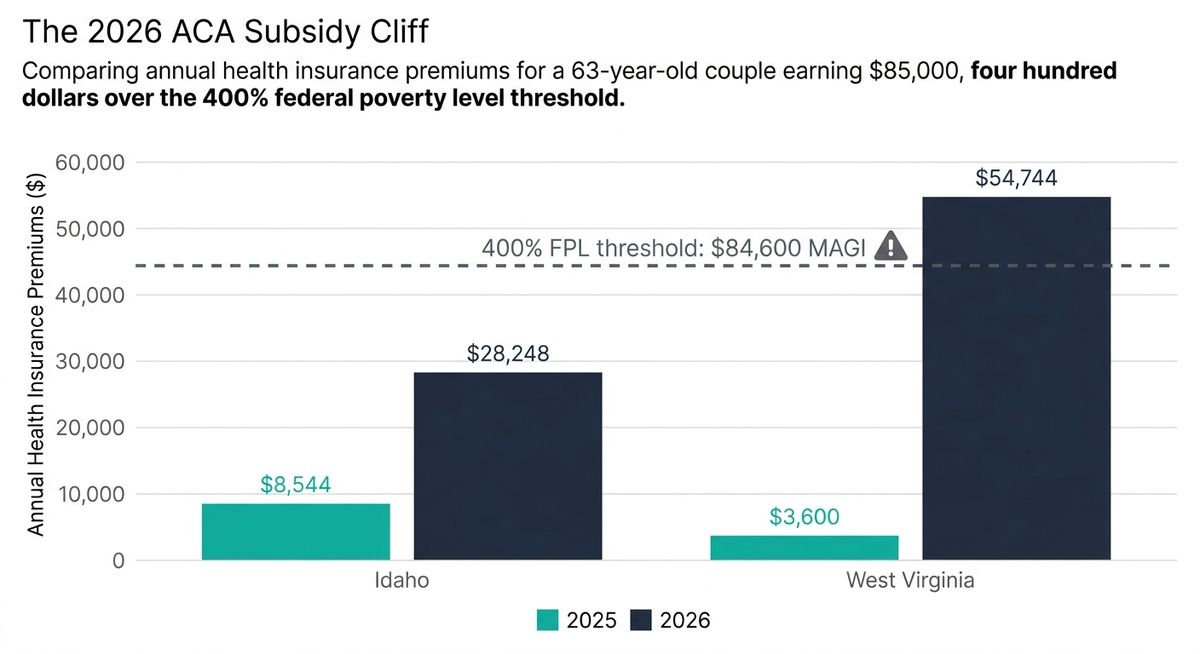
This is the strongest near-term financial argument against retiring at 57 that exists right now, and pretending otherwise would insult you. But look closely at what kind of problem it actually is. It's a five-figure annual problem you solve by managing your MAGI, not by working another decade. Harvesting capital gains under the cliff. Sequencing Roth conversions into the years before you claim subsidies. Spending from taxable basis and cash instead of pre-tax accounts. Using an HSA-qualified plan. Every one of those levers is available to somebody who already stopped working.
One more year at the desk buys you one more year of employer coverage. Learning to control your taxable income buys you ten.
There's a second bill further down the road, and it deserves a real answer instead of a wave of the hand. Roughly 56% of adults who make it to 65 will need some form of long-term care, averaging about 3.1 years. Genworth's 2026 figures put a private nursing home room near $10,965 a month, about $131,000 a year, with a semi-private room around $115,000. That's a genuine tail risk, and "go spend your healthy years" is not a license to pretend it isn't there.
But notice the timing. That spending sits in the no-go years, after 82, which is exactly where Blanchett's data already shows discretionary spending falling off. The honest plan is to earmark a dedicated late-life reserve, or a paid-off home you're genuinely willing to convert, or a hybrid policy. Then stop using an unquantified fear of the tail to justify working straight through your only healthy decade. Name the number. Fund it. Spend the rest.
The psychological case for leaving at 57 got stronger this year. The execution just got more technical.
Auditing "Enough"
For those already sitting on financial independence, walking away from a career at 57 does not mean parking on a porch for thirty years. For high-drive people, unstructured idleness is genuinely risky, and I'm not going to pretend the evidence says otherwise.
The strongest study cutting against everything I've argued here is Zulkarnain and Rutledge's 2018 working paper for Boston College's Center for Retirement Research. Using Dutch administrative data and an instrumental-variable design, they found that delayed retirement cut five-year mortality for men aged 62 to 65 by 2.4 percentage points. That's a 32% reduction against non-workers, worth roughly three extra months of life expectancy at 60. To their credit, the authors flag the obvious problem themselves: people who keep working are probably healthier to start with. And a Swedish longitudinal study found no mortality effect at all from working past 66.
This is retirement psychology at its most practical: the variable that keeps mattering isn't work versus no work. It's voluntary versus involuntary, and structured versus unstructured. Retiring into purpose looks nothing like retiring into a void. AARP's February 2026 data shows 7% of retirees going back to work within six months, with 48% citing money and roughly one in seven citing boredom or a need to stay active. That second group didn't plan.
So the question was never whether you work. It's what you're working for.
Working out of fear or status: staying in a high-cortisol role because you're attached to the title, because you're a little afraid to look closely at the spreadsheet, or because you're chasing a net worth number that sits on the flat part of the curve. This is one more year syndrome in its purest form.
Working for self-actualization: consulting ten hours a week, teaching, running a nonprofit, building things with your hands, launching something small where the money is beside the point.
Before you decide, put a price tag on the year you're considering. A 57-year-old with $1.5 million works one more year, saves $40,000, earns 5% real, and ends that year roughly $115,000 ahead. About 7% on the balance. Sounds like a lot. At a 3.9% withdrawal rate, that converts to about $4,500 a year of additional lifetime income.
Call it $375 a month.
That's what the year buys. The price is one of your roughly thirteen healthy years. Run your own version of that math, but run it in that exact format. Not "how much more will I have," which always sounds impressive. Instead: "what does the extra buy me per month, and what slice of my remaining good years does it cost."
Do This Part This Week
Enough theory. Go do the audit.
🎯 The Audit
- Calculate what you actually spend. Twelve months of real outflow, not the number in your head. Then subtract what vanishes when you stop working: the commute, the wardrobe, the convenience premium you pay because you're wiped out by 7pm.
- Price your health insurance bridge honestly. Run the KFF subsidy calculator at your projected MAGI. Find your cliff threshold ($62,600 single, $84,600 couple) and treat it as a hard wall on every withdrawal decision until Medicare kicks in at 65.
- Call your 401(k) administrator. Two questions. Does the plan allow partial distributions after separation, and can you roll old employer plans in before you leave? If that first answer is no, the Rule of 55 is off the table for you and you need a different bridge.
- Test at 3.9%. Morningstar's 2026 safe withdrawal rate for a 30-year horizon at 90% success is 3.9%, up from 3.7%, for portfolios holding 30% to 50% equities, which is part of why the old 4% rule is now considered officially dead. Flexible spending strategies push it as high as 5.7%. On $1.5 million, 3.9% is $58,500 before Social Security. Notice something there: that sits comfortably under the couple's cliff, and the portion you draw from taxable basis doesn't even count as MAGI.
- Model Social Security on its own. Claiming at 62 locks in a permanent 30% reduction against a full retirement age of 67. Waiting until 70 adds 24%. Break-even against FRA lands around 78; against 70, around 82 or 83. For the full age-by-age breakdown of claiming at 62, 67, or 70, it's worth running your own numbers before you decide. Retiring at 57 and claiming at 70 are compatible choices, not competing ones.
- Name your long-term care number and fund it as its own line, so it stops floating around as a free excuse.
- Write down the number that means enough. Then write down what you'd do with a Tuesday if you never had to explain it to anybody.
If that audit tells you your foundation is secure, then every extra year of accumulating is a 75% chance of nothing wearing a very convincing prudence costume. It's the same instinct explored in why most retirees die with too much money: the surplus safety that never gets spent because it never gets questioned. You're risking healthy years you cannot get back to buy surplus safety on a base that's already solid.
You already knew the answer to the opening gamble. Take the guarantee. The only question left is whether you can see that the guarantee, in your case, isn't the money. It's the time.
Thanks for reading if you made it this far. Go call your plan administrator.
Peace!