

How to Retire by 40: The Aggressive FIRE Movement Math That Actually Works in 2026


So here's a question that might mess with your whole Monday: what if you don't actually have to work until 65? The FIRE movement has proven that retiring by 40 isn't some pipe dream—it's arithmetic. But the 2026 version requires updating your math for today's reality.
- Your FIRE number: Annual expenses × 29 (using 3.5% withdrawal rate for 40+ year retirements)
- Savings rate drives everything: 65% savings rate = 10.5 years to FI, 25% = 32 years
- Healthcare reality check: Add $10K-$15K per person annually for post-2025 ACA costs
- Bridge strategy required: Roth conversion ladder or 72(t) SEPP for pre-59½ access
- Geo-arbitrage multiplier: Strategic location moves can cut FIRE timeline by 30%+
Most of us spend 40-plus years trading our best hours for a paycheck, all because of a retirement age that was set back in 1935. The financial independence retire early (FIRE) movement has turned "retire by 40" from a pipe dream into actual arithmetic. And in 2026, the arithmetic still checks out. But things have shifted in ways that a lot of the advice out there hasn't caught up with yet.
Healthcare costs have gone through the roof. Housing has jumped over 40% since 2020. And that famous 4% rule? It needs a pretty big asterisk next to it.
Here's the real math, updated for right now. No fluff. No fairy tales.
The Only Number That Actually Matters: Your FIRE Number
Forget your salary. Forget your job title. The single number that determines when you achieve financial independence is your annual spending.
Understanding Your FIRE Number
Your FIRE number is the total amount you need invested to cover your annual expenses forever. It's calculated using the safe withdrawal rate—the percentage you can pull from your portfolio each year without going broke.
Think about it this way. If you know what you spend each year, you can calculate exactly how big your nest egg needs to be to cover those expenses forever. This is your "FIRE number," and it's based on something called the safe withdrawal rate, which is just the percentage you can pull from your portfolio every year without going broke.
The classic version: multiply your annual expenses by 25. That assumes a 4% withdrawal rate, which comes from Bill Bengen's landmark 1994 research showing that a retiree could withdraw 4% annually from a balanced portfolio and survive any 30-year period in U.S. market history.
Spend $40,000 a year? You need $1 million. Spend $60,000? You need $1.5 million.
Pretty straightforward. But here's where most FIRE content gets it wrong.
The 4% rule was built for 30-year retirements. If you're planning to retire at 40, you're looking at a 45- to 55-year retirement. That's a completely different animal.
Karsten Jeske, the former quantitative researcher behind Early Retirement Now, has run one of the most thorough analyses on safe withdrawal rates for extended retirements. His recommendation: 3.25% to 3.5% for anyone planning a 40- to 60-year retirement.
At 3.5%, the math shifts a bit. That $40,000 annual budget doesn't require $1 million. It requires roughly $1,143,000. Not a huge difference on paper, but that's an extra $143,000 you need to save up before you hand in your badge.
2026 Withdrawal Rate Update
Bengen himself updated his number in 2025, telling CNBC that 4.7% is viable with small-cap value exposure. But he's talking about traditional 30-year retirements. For early retirees playing the longer game, dial it down to 3.25-3.5%.
The Savings Rate: Your One Real Lever to Financial Freedom
Alright, here's the table that should permanently change how you think about money. I'm serious. Read it twice.
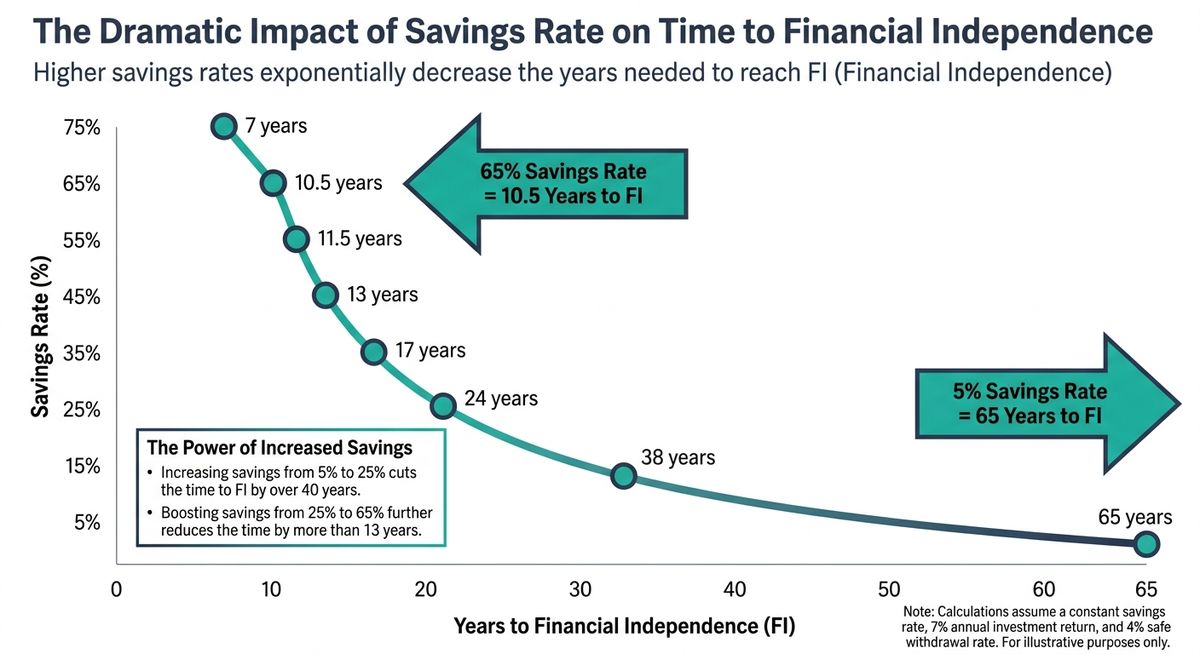
| Savings Rate | Years Until Financial Independence |
|---|---|
| 5% | ~65 years |
| 10% | ~51 years |
| 25% | ~32 years |
| 50% | ~17 years |
| 65% | ~10.5 years |
| 75% | ~7 years |
These numbers assume roughly 5% real (inflation-adjusted) investment returns and starting from zero net worth. Go ahead and read that table one more time. A household earning $100,000 and saving 10% ($10,000 per year, living on $90,000) needs over 50 years to reach financial independence. That same household saving 65% ($65,000 per year, living on $35,000) gets there in about a decade. Same income. A 40-year difference.
The exact amount you'll need depends heavily on your target retirement age, but the principle remains the same.
Let that sink in for a second.
Your savings rate is pulling double duty here. Every dollar saved is simultaneously a dollar invested AND proof that you can live on less, which shrinks the nest egg you need in the first place. Living on $35,000 per year means your FIRE number (at 3.5%) is roughly $1 million. Living on $90,000 means you need $2.57 million.
The strategy isn't "earn more" (though that obviously helps). It's "widen the gap between what you earn and what you spend." And the single biggest threat to that gap has a name.
Lifestyle Creep: The Silent FIRE Killer
You get a $15,000 raise. You upgrade your apartment. You lease a nicer car. You start eating out four nights a week instead of two. Six months later, you've absorbed the entire raise into your baseline spending and your savings rate hasn't budged.
I've watched friends do this over and over. This is lifestyle creep, and it's the reason high earners often retire at the same age as everyone else. Each bump in spending doesn't just cost you that money today. It raises your annual expenses permanently, which inflates your FIRE number, which extends your working years.
The Lifestyle Creep Trap
- Initial annual spending $85K
- After raises absorbed $115K spending
- FIRE number jumps from $2.4M to $3.3M
- Impact +15 years to FI
The FIRE Approach
- Spending stays constant $85K
- All raises go to investments 100%
- FIRE number stays at $2.4M
- Impact Reach FI years earlier
The antidote is aggressive and intentional: when your income increases, your lifestyle doesn't. Bank 80% to 100% of every raise. Let compound interest do the heavy lifting. At roughly 8% nominal average returns in a total stock market index fund, your money doubles approximately every 9 years. A $50,000 investment at age 25 becomes $200,000 by age 43 without adding another cent.
Speaking of index funds, keep it simple. Low-fee total stock market index funds remain the best vehicle for wealth building toward early retirement. And fees matter enormously over decades. A 1% annual fee versus a 0.03% fee on a $500,000 portfolio costs you nearly $5,000 per year. Over 30 years of compounding, that fee difference can consume hundreds of thousands of dollars. That's real money that just evaporates.
Geo-Arbitrage: The FIRE Accelerator Nobody Talks About Enough
If savings rate is the engine, geo-arbitrage is the turbocharger.
The concept is pretty straightforward: earn in a high-income area, spend (or retire) in a low-cost area. One San Francisco couple documented saving $6,610 per month ($79,320 per year) by relocating to Oakland, compressing their FIRE timeline by roughly nine years. And the more dramatic version? Retiring internationally can cut a $1.5 million U.S. retirement target in half in countries like Thailand, Portugal, or Indonesia.
The Geo-Arbitrage Multiplier
Even domestic moves from high-cost coastal cities to mid-tier towns routinely slash expenses by 30% or more. A household spending $80,000 in Boston might spend $50,000 in Boise for a comparable lifestyle, trimming the required nest egg by nearly $860,000.
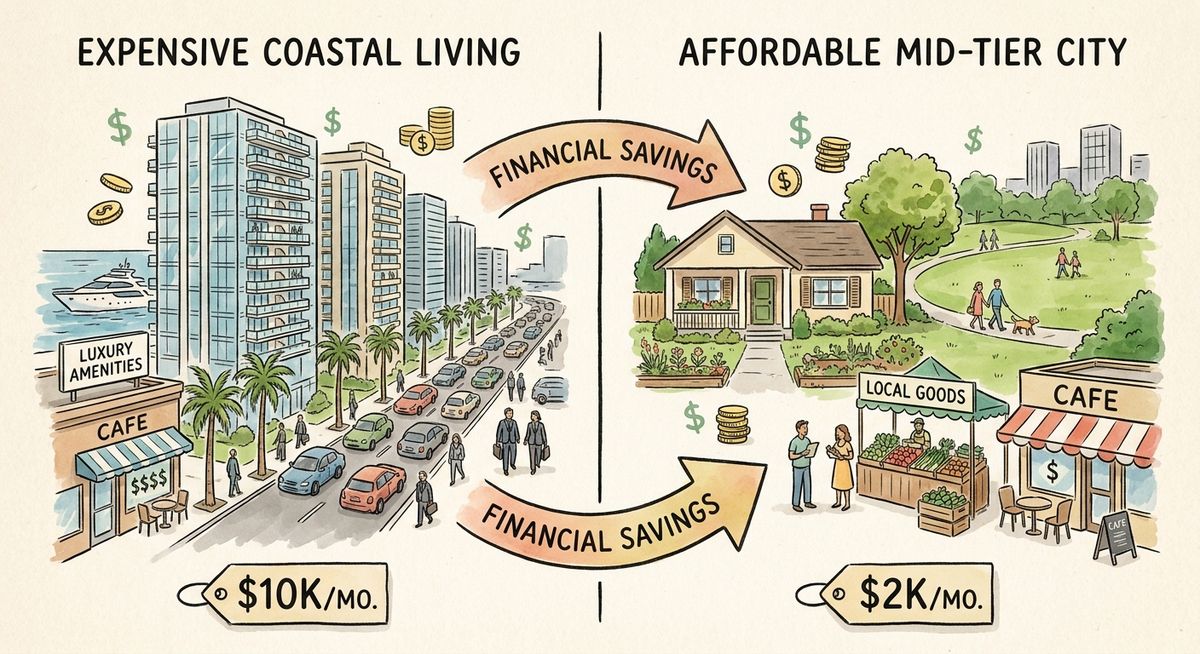
I've seen this play out firsthand living and working remotely from different countries over the years. The cost differences are very real.
But geo-arbitrage has risks that the cheerful FIRE blogs tend to gloss over. Currency fluctuations can erode international cost advantages. Local inflation in popular expat destinations often outpaces U.S. inflation as those areas gentrify. And the social cost of moving away from your community is real, especially if you're retiring into a place where you have no roots. I've met people who saved a fortune by moving abroad but felt genuinely lonely six months in. That matters.
Use geo-arbitrage as a tool, not a religion. And run the numbers with a conservative buffer.
The Gap Years Problem: Accessing Your Money Before 59½
Here's the trap that catches people off guard. You retire at 40 with $1.2 million in your 401(k). Sounds great, right? Except you can't touch it without a 10% penalty until you're 59½. That's nearly 20 years of living expenses locked behind a wall.
Early retirees need a bridge strategy. Two primary options exist:
The Roth Conversion Ladder
Each year, you convert a portion of your Traditional 401(k) or IRA into a Roth IRA. After a five-year seasoning period, the converted principal (not the earnings) can be withdrawn completely tax-free and penalty-free at any age. The catch: you need five years of living expenses from other sources while the ladder matures.
Roth Conversion Example
A 40-year-old retiree with $1.2 million in a 401(k) and $200,000 in a taxable brokerage account lives on the taxable account for five years while converting roughly $48,000 annually from the 401(k) to a Roth. At age 45, those first converted dollars become accessible penalty-free.
This Roth conversion strategy is elegant and powerful when executed correctly.
72(t) SEPP Distributions
Substantially Equal Periodic Payments allow penalty-free withdrawals from retirement accounts before 59½, but the payments must continue for five years or until age 59½, whichever is longer. Modify the payments early and you trigger retroactive penalties on every prior distribution. Less flexible than the Roth ladder, but useful for people who need immediate access.
One critical detail worth knowing: Roth IRA contributions (the money you put in directly, not conversions or earnings) can be withdrawn at any age, any time, with zero tax or penalty. If you've been contributing to a Roth for 15 years, that contribution base is your most flexible early-retirement asset.
The 2026 Healthcare Crisis for Early Retirees
Okay, pay attention here. This is the section that could save your retirement plan or expose a serious hole in it.
The enhanced Affordable Care Act premium subsidies expired at the end of 2025. For early retirees who depend on marketplace health insurance (that's everyone between leaving employer coverage and reaching Medicare at 65), costs have roughly doubled.
Healthcare Cost Reality Check
An early retiree who budgeted $500 per month for ACA coverage in 2025 may now face $1,200+ per month for the same plan. A 64-year-old could see annual premiums jump from $5,300 to over $16,000. That extra $11,000 per year means you need an additional $314,000 in your nest egg at a 3.5% withdrawal rate.
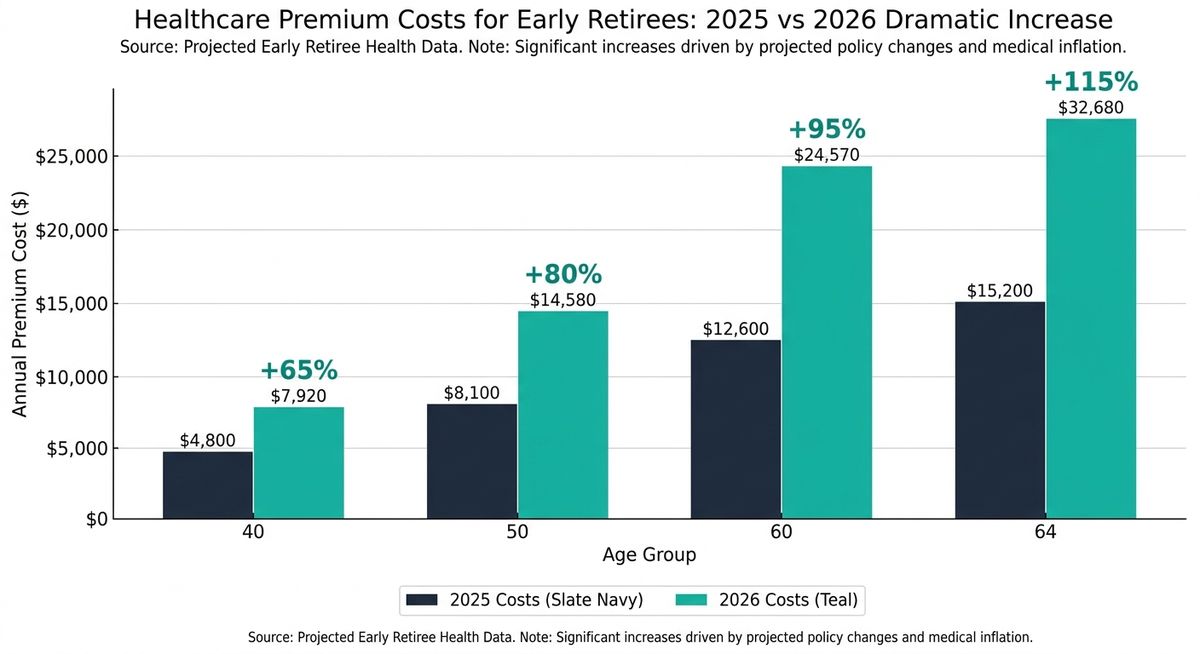
Income management becomes critical here. Roth distributions don't count toward your Modified Adjusted Gross Income, while Traditional IRA and 401(k) withdrawals do. Keeping your MAGI between roughly $22,000 and $64,000 (138% to 400% of the 2026 Federal Poverty Level for a single person) can mean the difference between full-price premiums and subsidized coverage.
One creative solution is transitioning to part-time work that maintains health benefits, which can bridge the gap between full employment and Medicare eligibility.
If you're running FIRE calculations in 2026, add $10,000 to $15,000 per person per year for healthcare unless you have a concrete plan to manage your MAGI below the subsidy threshold. Most online FIRE calculators haven't updated for this yet.
The Rules of Execution for FIRE Success
The math is clear. Execution is where plans fall apart. Four principles separate people who actually retire early from people who just talk about it at dinner parties:
Define your number, then stress-test it
Use a 3.25% to 3.5% withdrawal rate for retirements longer than 30 years. Build in a healthcare buffer. Account for sequence-of-returns risk (bad markets in your first 5 years are far more damaging than bad markets later). A portfolio of 60% to 80% stocks and 20% to 40% bonds helps manage that early-year volatility.
Align with your partner before you optimize your spreadsheet
FIRE content is overwhelmingly written for singles or couples where both partners are equally committed. In reality, one partner wanting to retire at 38 while the other wants a career until 55 creates friction that no index fund can solve. I've seen this strain relationships that were otherwise rock solid. Have the conversation early. Have it often. Build a plan that works for both of you, including the real costs of children, which most FIRE calculators conveniently ignore.
Kill bad debt and bad fees simultaneously
High-interest debt is a guaranteed negative return. A 22% credit card balance negates your 8% market returns and then some. Eliminate consumer debt first, then channel that cash flow into low-fee index funds. Every 0.5% in unnecessary investment fees costs you years. Literally years.
Build flexibility into the plan
The most resilient early retirees aren't the ones with the most rigid spreadsheets. They're the ones willing to do part-time work during bear markets (sometimes called "Barista FIRE"), adjust spending when their portfolio dips, or delay full retirement by a year or two if conditions shift. Flexible withdrawal strategies, where you spend a bit less in down years and a bit more in up years, can safely increase your starting withdrawal rate while protecting your portfolio's longevity.
🎯 Start Building Your FIRE Plan Today, Not Someday
The difference between retiring at 40 and retiring at 65 isn't talent, luck, or a tech salary (though that helps). It's a savings rate decision you make this month, protected from lifestyle creep next month, compounded over every month after that.
- Calculate your FIRE number: Track your annual spending for 3 months, multiply by 29 (using a 3.5% withdrawal rate). That's your target.
- Audit your savings rate: If it's below 50%, identify the gap. Housing, transportation, and food are the three biggest levers.
- Open a brokerage account: Total stock market index fund with automatic contributions. Start with whatever you can afford.
- Model your path: Use ReadyAimRetire's calculator to see exactly when your plan will get you to financial freedom.
The math doesn't care about your age, your background, or your excuses. It only cares about the gap between what you earn and what you spend. Widen it.
Start Your FIRE Plan →Thanks for reading if you've made it this far. Peace!