

Medicare 101: Making Sense of Your Coverage and Getting Through Open Enrollment (AEP) Without the Stress


Every October, Medicare open enrollment feels like Groundhog Day. The mailbox fills up with glossy flyers. TV ads start talking about "extra benefits" like there's a fire sale. Your phone lights up with numbers you've never seen before. And somewhere in the back of your mind, a little voice asks: Am I supposed to be doing something?
- AEP 2026 (for your 2027 coverage) runs October 15 through December 7, 2026. Changes take effect January 1, 2027.
- For many people, the right move after an hour of honest review is to keep what they have.
- If you got a letter saying your plan is ending, doing nothing isn't safe.
- Moving from Original Medicare to Medicare Advantage is easy. Moving back can be hard, because in most states Medigap insurers can ask health questions.
- Four steps get you through: read your ANOC, review your drugs, confirm your doctors, and avoid high-pressure sales traps.
Bottom line: spend an hour on the checklist before December 7, and only change plans if your review gives you a reason.
If that's you, you've got a lot of company. A WellCare spokesman once summed up how plenty of retirees feel about this choice: it's "overwhelming, scary, and has consequences, so we put it off." And people really do put it off. KFF found that nearly 7 in 10 people on Medicare (69%) didn't compare their options during open enrollment.
Here's the good news. For a lot of folks, the Medicare Annual Enrollment Period (AEP) comes down to about an hour of honest review, and the right answer at the end of that hour is to keep what they have. For others, 2027 brings some real changes. Hundreds of thousands of people are getting letters saying their plan is ending, and the sales rules got looser on October 1. My goal with this guide is simple: help you figure out which group you're in.
Mark Your Calendar
AEP 2026 (for your 2027 coverage) runs October 15 through December 7, 2026. Changes take effect January 1, 2027.
Find your situation (think Choose Your Own Adventure, minus the dragons):
- New to Medicare? Start with "Medicare Basics."
- Got a letter saying your plan is ending? Jump to "Do I Need to Act?"
- Just want the to-do list? Skip to "Your Medicare Enrollment Checklist."
- Helping a parent? Head to "Helping a Parent?" near the end.
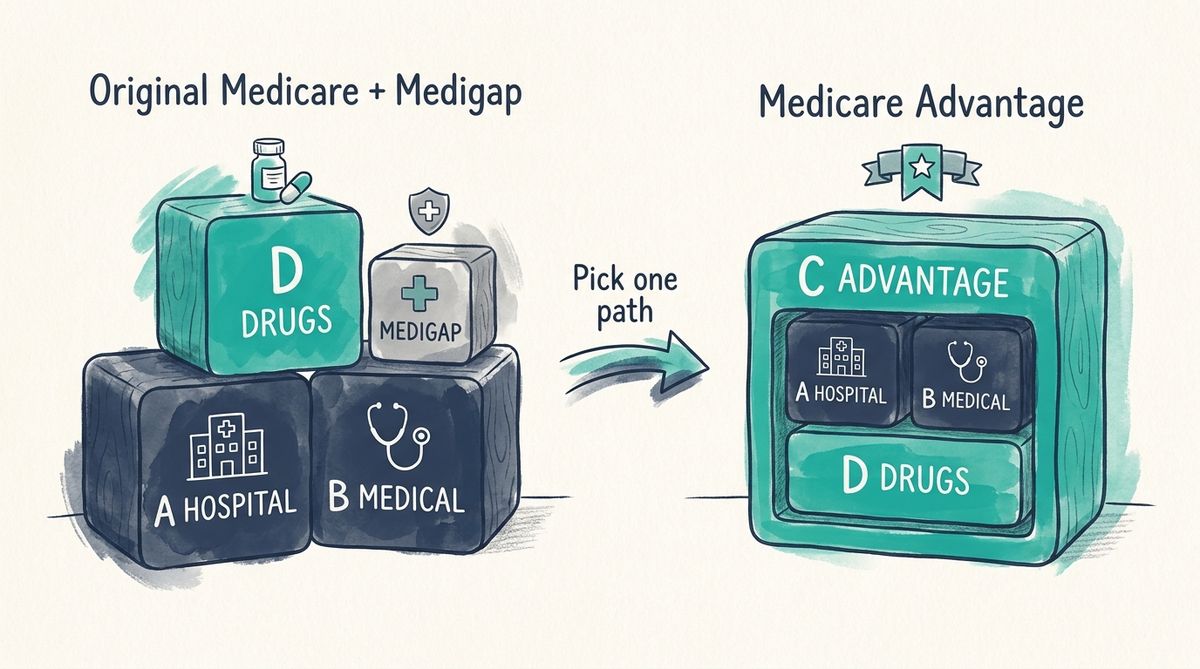
Medicare Basics: Parts A, B, C, and D as Four Building Blocks
Medicare is federal health insurance for people 65 and older, plus some younger people with disabilities or kidney failure. It comes in four "parts," and the easiest way I've found to think about them is as building blocks. You stack them differently depending on which path you pick.
| Part | What it covers | Key costs (2026) |
|---|---|---|
| Medicare Part A (hospital) | Inpatient hospital stays, skilled nursing care after a hospital stay, hospice | $0 premium for most people. $1,736 deductible per benefit period |
| Medicare Part B (medical) | Doctor visits, outpatient care, lab work, scans, preventive care | $202.90/month premium and $283 yearly deductible, then usually 20% of costs |
| Medicare Part C (Medicare Advantage) | Private plans that bundle Parts A and B, and usually D | Varies by plan. You still pay your Part B premium |
| Medicare Part D (drugs) | Outpatient prescription drugs | Varies by plan. Standalone plans will average about $36/month in 2027 |
CMS announces the 2027 Part A and Part B amounts in mid-November, so a few of these numbers will move.
I've worked remotely from a lot of different countries, and I've learned that every health system has its own alphabet soup. Medicare's is a big bowl. Here are five terms in plain English:
Five Terms in Plain English
- Premium: what you pay every month just to have coverage. Kind of like a gym membership. You pay it whether you go or not.
- Deductible: what you pay before coverage kicks in. For example, you cover the first $283 of Part B costs each year.
- Coinsurance: your share of a bill, as a percentage. If a scan costs $1,000, Part B's 20% coinsurance means you pay $200.
- Copay: a flat fee, like $20 for an office visit.
- Out-of-pocket maximum: the most you'll pay for covered care in a year. Once you hit it, the plan picks up the full cost of covered care for the rest of the year.
Then there's Medigap (also called Medicare Supplement insurance). It isn't one of the four parts, which confuses a lot of people. It's private insurance that pays some or all of that 20% and the other gaps Original Medicare (Parts A and B) leaves behind. For once, the name actually tells you what it does. If you want to see how the premium math can swing in either direction, we walk through it in the Medicare Supplement insurance decision framework.
Original Medicare vs. Medicare Advantage: Two Pathways
Most people end up on one of two roads:
Pathway 1: Original Medicare + Medigap + Part D
You pay more each month, and in return you get broad access and bills you can predict. Medigap Plan G, the most popular choice for new enrollees, averages roughly $180 to $220 a month at 65, though prices bounce around a lot by state and insurer.
Pathway 2: Medicare Advantage
A private insurer manages your care, often for a low or $0 premium on top of Part B, and many plans throw in extras like dental or vision. The trade-off: you usually stick to a local network, pay copays as you go, and may need the plan's OK before some care.
Neither road is the "right" one. They're built for different people with different priorities. Here's how they stack up:
| Original Medicare + Medigap + Part D | Medicare Advantage | |
|---|---|---|
| Monthly cost | Higher | Lower, often $0 beyond Part B |
| Doctor choice | Any provider nationwide that accepts Medicare | Plan network, usually local |
| Costs when you get care | Low and predictable | Copays and coinsurance as you go |
| Yearly out-of-pocket cap | None in Original Medicare alone; Medigap covers most gaps | Yes, up to $9,850 in-network in 2027 (many plans set lower caps) |
| Prior authorization | Required for a short list of services | Common for many services |
| Switching later | Easy to move to Medicare Advantage | In most states, buying Medigap later can mean answering health questions |
Every retirement plan is different, and which column fits you depends on how a higher monthly premium or a bigger bill at the doctor's office sits inside your overall budget. ReadyAimRetire lets you test how these strategies work with your specific numbers.
Prior authorization is a mouthful, but the idea is simple: the plan has to approve a service first, or it may not pay for it. KFF found that Medicare Advantage plans fully or partly denied 7.7% of these requests in 2024. Here's the part that jumped out at me. Only about 1 in 9 denials got appealed, but about 81% of appeals were fully or partly overturned. So if you get a "no," don't treat it as the final word. An appeal is often worth filing.
Original Medicare has some prior authorization too. It's long required approval for a handful of items, like power wheelchairs and some outpatient procedures. And a six-year pilot called WISeR, which kicked off in January 2026, adds 17 types of services in Arizona, New Jersey, Ohio, Oklahoma, Texas, and Washington. That list includes knee arthroscopy, spinal injections, and nerve stimulator implants. The good news: your doctor handles these requests.
The Key Insight: Medicare Can Be a One-Way Street
If you only read one section, read this one
It's also the part the ads leave out. Moving from Original Medicare to Medicare Advantage is easy. Moving back can be hard. It's not quite the Hotel California, but it's closer than most people realize.
Here's why. When you first have Part B at 65 or older, you get a one-time, six-month Medigap Open Enrollment Period. During that window, insurers have to sell you a policy, and they can't charge you more because of your health. Once it closes, insurers in most states can look at your medical history and charge you more or just say no.
Let me introduce you to Denise. She's made up, but I bet you know someone like her. Denise is healthy at 65 and picks a $0-premium Medicare Advantage plan. Because she joined when she first became eligible, a federal "trial right" lets her switch to Medigap within 12 months without answering health questions. She's happy with her plan, so she stays. Totally reasonable.
Then in year three, she's diagnosed with cancer. Now she wants the freedom to see specialists anywhere in the country. Unless she lives in Connecticut, Massachusetts, Maine, or New York, a Medigap insurer can usually review her health and charge her more or turn her down.
"Almost like a de facto lock-in for some people."
That's how a health economist quoted by Boston College's Center for Retirement Research described it. And KFF estimates that 90% of Medicare Advantage enrollees 65 and older have no guaranteed right to buy Medigap once their trial period ends.
Now, I'm not saying one path is better. Medicare Advantage saves a lot of people real money, and its yearly cap limits the damage from a rough health year. Original Medicare without Medigap has no cap at all. Twenty percent of a $50,000 course of outpatient cancer treatment is $10,000, and that comes out of your pocket. The real lesson is this: your first choice is easier to keep than to undo, so make it with your eyes open.
Medicare Open Enrollment 2026 (AEP): Rules and Key Dates
The Annual Enrollment Period (most people just call it Medicare open enrollment) runs October 15 through December 7, 2026. During AEP, you can:
- Switch from Original Medicare to Medicare Advantage, or the other way around.
- Switch from one Medicare Advantage plan to another.
- Join, switch, or drop a Part D drug plan.
You can change your mind as many times as you want. The last change you make by December 7 is the one that counts.
What AEP Doesn't Cover: Medigap
This one trips people up all the time. AEP is not a Medigap enrollment window. You can apply for Medigap any time of year, but after your first six-month window, most states let insurers review your health. So if you're thinking about leaving Medicare Advantage, the order matters:
- Get approved for Medigap first. Ask for a January 1 start date so it lines up with your new coverage.
- Then make the switch during AEP. If your Medicare Advantage plan includes drug coverage, joining a standalone Part D plan ends it automatically. You can also switch through Medicare.gov or 1-800-MEDICARE.
It's like lining up your next apartment before you hand back the keys to the old one.
Your state may give you more options:
- Connecticut, Massachusetts, Maine, and New York give broader rights to buy Medigap without health questions.
- Fifteen states have "birthday rules" (CA, DE, ID, IL, IN, KY, LA, MD, NV, OK, OR, UT, VA, WV, WY), and Missouri has a similar "anniversary rule." These mostly help you switch from one Medigap policy to another, not move from Medicare Advantage into Medigap. The details vary, so check with your State Health Insurance Assistance Program (SHIP).
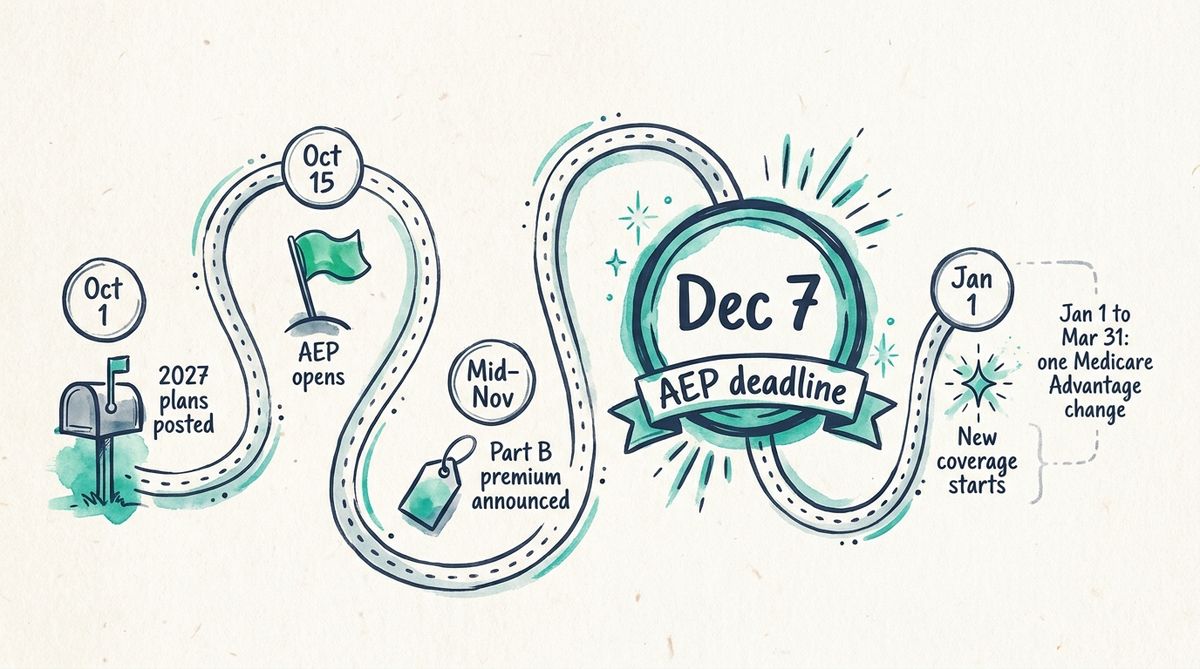
Your AEP 2026 Calendar
Grab a pen. Or, you know, your phone.
| Date | What happens |
|---|---|
| By Sept 30, 2026 | Your plan's Annual Notice of Change (ANOC) should have arrived |
| Oct 1, 2026 | 2027 plans appear on Medicare.gov's Plan Finder. Looser sales rules begin |
| Early October 2026 | Letters reach members whose plans are ending |
| Oct 15 to Dec 7, 2026 | AEP. Make changes as needed; your last one counts |
| Mid-November 2026 | CMS announces the 2027 Part B premium and income-based surcharges |
| Dec 8, 2026 to Feb 28, 2027 | Special window for people whose plan is ending |
| Jan 1, 2027 | New coverage starts |
| Jan 1 to Mar 31, 2027 | Medicare Advantage Open Enrollment Period (Medicare Advantage members only) |
Why You Don't Need to Panic
Ads Are Marketing, Not Emergencies
Those urgent commercials and "final notice" mailers are built to make you feel rushed. That's their whole job. One HumbleDollar forum member compared the flood of Medicare Advantage ads (next to almost none for Medigap) to fast food advertising, and honestly, I haven't been able to unsee it. A sales pitch isn't a deadline. For most people, the only deadline that matters is December 7.
What's Actually Changing in Medicare for 2027
Here's what's real, minus the jingles.
CMS says the average Medicare Advantage premium will drop 16.5%, to about $12 a month. Sounds great, right? There's a catch. Special needs plans pull that average down. Those plans serve people who also have Medicaid, live in nursing homes, or have certain chronic conditions. For regular Medicare Advantage plans with drug coverage, premiums are rising several dollars on average, partly because insurers are offering fewer $0-premium plans.
A few other changes worth knowing:
- Out-of-pocket maximums in Medicare Advantage are up about 10% on average, and drug deductibles inside those plans are up about 30%, according to one Wall Street analysis.
- Some plans are ending. Humana alone is dropping plans that cover about 600,000 members. Centene, UnitedHealthcare, Aetna, and Elevance are each pulling out of dozens to hundreds of counties.
- Standalone drug plans lose a federal subsidy that kept premiums down in 2025 and 2026. The national average is barely moving, but some individual plans may rise more.
- The yearly cap on Part D drug costs rises to $2,400 (up from $2,100). And lower negotiated prices for 15 more drugs, including Ozempic, start January 1.
Still, CMS says about 8 in 10 Medicare Advantage members can keep their current plan at the same or lower premium. For most people, this isn't a five-alarm fire.
Do I Need to Act? A Quick Decision Guide
Find your row and you'll know your next move.
| Your situation | What to do |
|---|---|
| Your plan is renewing, and your ANOC shows nothing that affects your doctors, drugs, or budget | Staying put is fine. Your plan renews automatically |
| You got a letter saying your plan is ending | Act. See Frank's example below |
| Your ANOC shows a drug changing tiers, a doctor leaving, or higher costs | Compare plans before December 7 |
| You have a standalone Part D plan | Run a quick comparison. Premiums may shift more than usual this year |
| You have employer or union retiree coverage | Call your benefits office before changing anything. Switching can permanently end those benefits |
If your plan is ending, doing nothing isn't safe. Let's talk about Frank. He's 69 and hypothetical, but a lot of real people are in his shoes this year. Frank gets a letter saying his Medicare Advantage plan ends December 31. If he tosses it in the junk drawer, he starts 2027 in Original Medicare with no drug coverage and no Medigap. And if he then goes 63 days or more in a row without drug coverage, he risks a Part D late enrollment penalty that generally lasts as long as he has drug coverage. That's a long time to pay for one missed letter.
Frank's options:
- Pick a new Medicare Advantage plan during AEP.
- Go back to Original Medicare, add a standalone Part D plan, and buy Medigap with guaranteed issue, which means no health questions. This right starts 60 days before his coverage ends and lasts 63 days after. He should hang on to that letter as proof.
- Use the special window if he misses December 7. If he picks a plan by December 31, coverage starts January 1. After that, coverage starts the first of the month after he enrolls, so he'd have a gap. The window closes February 28.
Your Safety Net, and Its Limits
If you're in a Medicare Advantage plan on January 1, the Medicare Advantage Open Enrollment Period (January 1 through March 31) allows one more change. You can switch to another Medicare Advantage plan, or go back to Original Medicare and add a standalone drug plan.
It's a real safety net. It's just a narrow one. It can't be used to:
- Switch from one standalone Part D plan to another.
- Move from Original Medicare into Medicare Advantage.
- Guarantee you can buy Medigap.
So if you have Original Medicare, December 7 is your real deadline. Circle it.
Your Medicare Enrollment Checklist
Okay, time to roll up our sleeves. Four steps. You've got this.
1. Read Your Annual Notice of Change (ANOC)
Your plan's ANOC lists what's changing next year. The Evidence of Coverage (EOC) is the full rulebook, and the ANOC is the "here's what's different" version. In the ANOC, check the premium, deductibles, copays, out-of-pocket maximum, and drug list. If you can't find yours, check your plan's website or call the number on your member card.
2. Do a Medicare Formulary Review
A formulary is just your plan's list of covered drugs. The drugs get sorted into tiers, and higher tiers usually cost more. Plans reshuffle those tiers every year, so enter every drug and dose into Medicare.gov's Plan Finder, even if you're keeping your plan. Then compare the total yearly cost, not just the premium. A low premium doesn't help much if your prescriptions cost a bundle.
A few helpful 2027 facts:
- The highest drug deductible a plan can charge goes up to $700 (from $615).
- The optional Medicare Prescription Payment Plan spreads your costs across the year. Someone who'd hit the $2,400 cap could pay about $200 a month instead of getting a big bill in January.
- A temporary program called the GLP-1 Bridge charges a $50 monthly copay for certain weight-loss drugs, like Wegovy and Zepbound, for people who meet its health criteria. Heads up: that $50 doesn't count toward your deductible or the $2,400 cap, and the program ends after 2027.
If your plan dropped a drug you need, switch to a plan that covers it during AEP. After January 1, you can ask your plan for a formulary exception, and you may be able to get a one-time temporary supply (called a "transition fill") while that gets sorted out.
3. Confirm Your Doctors Are In-Network
This one sounds obvious, but it catches people. A doctor who "accepts Medicare" isn't necessarily in your Medicare Advantage plan's network. (With Original Medicare, accepting Medicare is all that matters.) Plan Finder now shows provider directories for 2027 plans, but directories can be wrong. So pick up the phone, call each office, and ask: "Will you be in this plan's network for 2027?"
Getting this right matters, because a mistake can be hard to fix. In most cases, a doctor leaving your plan mid-year doesn't give you a chance to switch. CMS proposed a fix for 2027 but didn't finalize it. One HumbleDollar member described a friend whose surgery got canceled 24 hours ahead of time because the surgeon had left the network. Nobody wants that phone call.
4. Avoid High-Pressure Traps
Medicare bans unsolicited sales calls and door-to-door sales. But here's the fine print: a call isn't "unsolicited" if you gave permission, and filling out a "free Medicare guide" form online can count as permission. That harmless-looking form might be the reason your phone won't stop ringing.
The rules loosened up this year, too. Since October 1, 2026, agents can sell to you on the same call or visit where you agree to talk. The old 48-hour wait is gone. Required disclaimers no longer have to mention free SHIP counseling, and ads can call a plan "best" with less proof.
Most agents are decent people doing their jobs. But with fewer guardrails, it's smart to build in your own pause. Here's a line you can borrow: "Please send me the Summary of Benefits. I'll call you back after I review it."
One more tip: a "Medicare helpline" number in a TV ad usually connects you to a private sales agency. Medicare's own number is 1-800-MEDICARE (1-800-633-4227).
Where to Get Help You Can Trust
- SHIP (shiphelp.org): free, one-on-one counseling with no ties to insurers.
- Independent brokers: free to you, because insurers pay their commissions. Ask which companies they represent and whether they sell both Medigap and Medicare Advantage.
- Medicare.gov or 1-800-MEDICARE: the official sources, straight from the horse's mouth.
Helping a Parent?
If you're the one fielding calls for Mom or Dad, this section's for you.
Meet Mark (hypothetical). He's helping his 80-year-old mother, who filled out a "free guide" card and now gets calls every single day. Under the new rules, an agent could enroll her on any one of those calls. So Mark makes a plan:
- Get the Summary of Benefits by mail.
- Run her drugs and doctors through Plan Finder.
- Book a free SHIP appointment.
- Set a family rule: "No enrolling on the first call."
I love that last one. It's simple, easy to remember, and takes the pressure off everybody.
So that Medicare can talk with Mark about her coverage, his mom can sign an Authorization to Disclose Personal Health Information (form CMS-10106) and submit it through her Medicare.gov account or by mail.
Your Next Steps
Let's zoom out for a second. Medicare is one of the biggest healthcare coverage costs you'll face in retirement. HealthView Services projects that a healthy 65-year-old couple retiring in 2026 will pay about $689,000 in lifetime premiums for Original Medicare, a Medigap plan, and drug coverage. Yep, you read that right. And that's just premiums. You can run these numbers for your own situation at ReadyAimRetire.com to see how healthcare costs fit into the rest of your retirement picture. Still a few years from 65? Some people use part-time work to bridge their health insurance until Medicare starts.
Closer to home, the 2027 Part B premium is projected at $209.50 a month, up from $202.90. Higher earners pay more through IRMAA, an income-based surcharge that starts above $109,000 for single filers and $218,000 for joint filers in 2026. Here's a wrinkle worth knowing: IRMAA uses your tax return from two years earlier. A big income year, like a Roth conversion, can raise your Medicare premiums two years down the road. And if your income dropped because you retired, you can ask Social Security to use newer numbers by filing form SSA-44.
🎯 Your AEP Game Plan
- This week: Find your ANOC and check for a plan-ending letter.
- By mid-November: Run your drugs through Plan Finder and call your doctors.
- Mid-November: Add the official 2027 Part B premium to your retirement budget.
- By December 7: Make a change only if your review gives you a reason.
If you haven't mapped out your retirement budget yet, start by modeling your retirement at ReadyAimRetire. That way, the Medicare premium you add in November lands in a plan you've already tested.
And if nothing has changed and you're happy with your coverage, doing nothing isn't putting it off. It's a decision. A perfectly good one.
Thanks for reading if you've made it this far. Now go find that ANOC. Peace!
Model Your Retirement at ReadyAimRetire
Disclaimer: This article is for educational purposes only and does not constitute official legal, financial, or healthcare advice. Plan availability, rules, and costs vary by state and county. For personalized assistance, consult Medicare.gov, 1-800-MEDICARE, or a licensed insurance professional.