

Building Generational Wealth: How to Invest for Your Children Without Sacrificing Control


Put $5,000 into a broad index fund the day your kid is born and let it earn 7% a year. By the time they turn 65, it's grown to about $406,400. Make that same $5,000 deposit when they're 25 and it only gets to about $74,900. Same money, same fund. The only difference is 25 extra years of long-term compounding, and that's really the whole case for starting early if you want to build generational wealth.
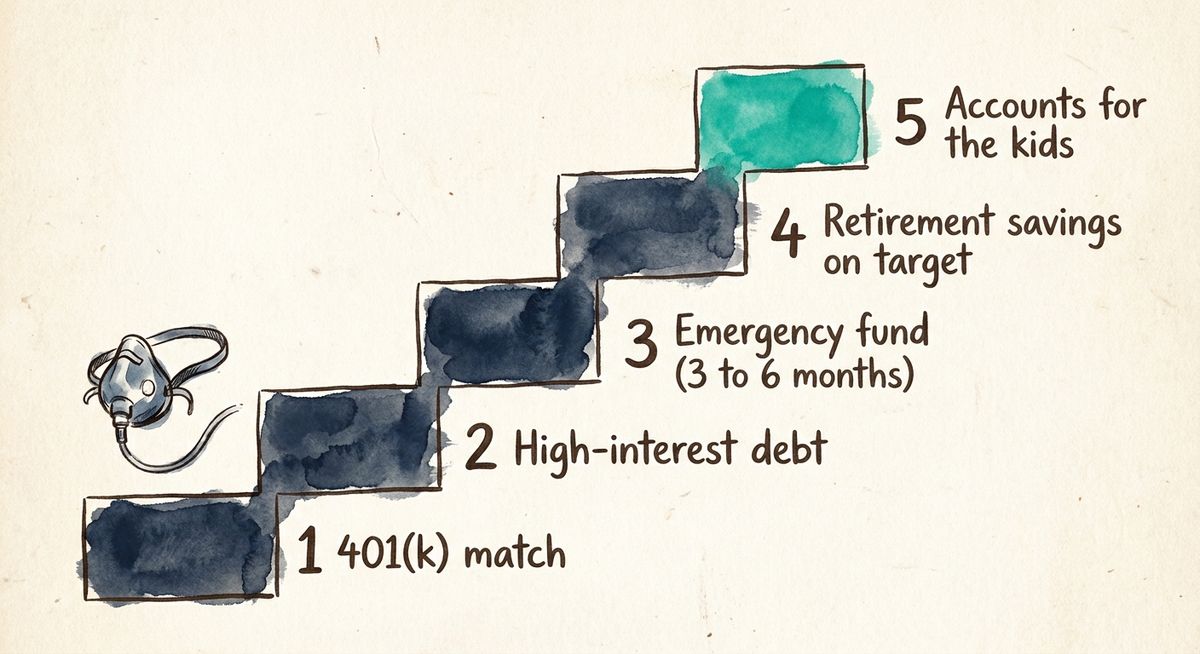
- Fund your own retirement first: 401(k) match, high-interest debt, emergency fund, then retirement savings on target.
- A UTMA/UGMA saves you less than $100 a year in tax, but can cost thousands in financial aid eligibility and permanently hands control to your child.
- For flexible money, an earmarked brokerage account in your own name keeps control, parent-asset treatment for aid and the step-up in basis.
- Use a parent-owned 529, a custodial Roth IRA for teens with earned income, and the $1,000 Trump Account seed for what each was built to do.
- Grandparents can use superfunded 529s, direct tuition and medical payments, and smart handling of appreciated stock.
Bottom line: control usually beats tax savings, and your own retirement comes first.
$5,000 at birth
- Deposit $5,000
- Annual return 7% nominal
- Value at age 65 About $406,400
$5,000 at age 25
- Deposit $5,000
- Annual return 7% nominal
- Value at age 65 About $74,900
Almost everyone agrees on starting early. How to do it is harder, and I've had some version of this conversation over coffee in more countries than I can count. Families tend to slip in one of two ways.
Some pour money into their kid's future and shortchange their own retirement. It feels generous today. Down the road, though, it hands the kid a much bigger bill: a parent who needs support. Others open an account the child legally controls at 18 or 21, and then they get no say in whether that money becomes a down payment on a house or a shiny new jet ski. (I'd love to tell you 18-year-old me would have picked the house. I'd be fibbing.)
Good financial planning for children balances three things: maximum compounding, legal control and tax efficiency. Most advice leads with the tax stuff. I get why. But once you give up control, you can't get it back.
This one's for parents trying to weigh their kid's future against their own retirement, and for grandparents who want to pass money down on purpose instead of by accident. All the numbers use 2026 federal rules. The projections assume a 7% nominal annual return, so treat them as illustrations, not promises.
Pillar 1: The Oxygen Mask Rule
You know the flight attendant speech. Put your own mask on before helping the person next to you. Money works the same way.
The most valuable thing you can give your kids is a parent who will never need their money.
A lot of us are drifting the other direction. In the Federal Reserve's latest household survey (published May 2026), only 35% of non-retirees said their retirement savings were on track. That's barely a third. A 2024 Savings.com survey found that half of parents with adult children are supporting them financially, at an average of $1,474 a month. Parents who were still working spent 2.3 times more on their grown kids than on their own retirement savings.
Let's put a number on that trade. Say my hypothetical friends Maria and Dan shift $500 a month from their retirement into their son's account for 18 years. That moves about $215,400 out of their nest egg. If they'd left it invested for 10 more years until they retire, it would have grown to about $432,800. That's a lot of oxygen. You can run these numbers for your own situation at ReadyAimRetire.com.
There's an old planning line: you can borrow for college; nobody lends money for retirement. The second half is as true as ever, and the first half is getting shakier. New Parent PLUS loans disbursed on or after July 1, 2026, are capped at $20,000 a year and $65,000 per student. And college debt has a way of following parents into retirement. According to the AARP Public Policy Institute, citing New York Fed data, 22.4% of student loan balances held by borrowers 50 and older are at least 90 days delinquent.
So before you fund a child's account, work through these in order:
- Capture the full 401(k) match. That match is part of your pay, so take all of it.
- Pay off high-interest debt.
- Build an emergency fund that covers three to six months of expenses.
- Get your retirement savings on target. For 2026, you can put $24,500 in a 401(k), plus an $8,000 catch-up if you're 50 or older, and $7,500 in an IRA, plus a $1,100 catch-up. For what it's worth, The Money Guy's "Financial Order of Operations" doesn't even get to college savings until Step 8, after the household is already saving 25% of gross income for retirement.
Grandparents face the same test, just on a shorter clock. The planning firm Boldin puts it simply: don't give money away unless you know you can pay for a long life, including long-term care.
Pillar 2: Parental Control vs. Tax Efficiency
Okay, your own retirement is on track. Now the question is which accounts to use for the kids, and this is where a lot of families hand over control without realizing they did it.
UTMA/UGMA Accounts: The Math Nobody Runs
UTMA/UGMA accounts get pitched as the default "tax-advantaged" way to invest for a child. So let's see what that advantage actually looks like in dollars.
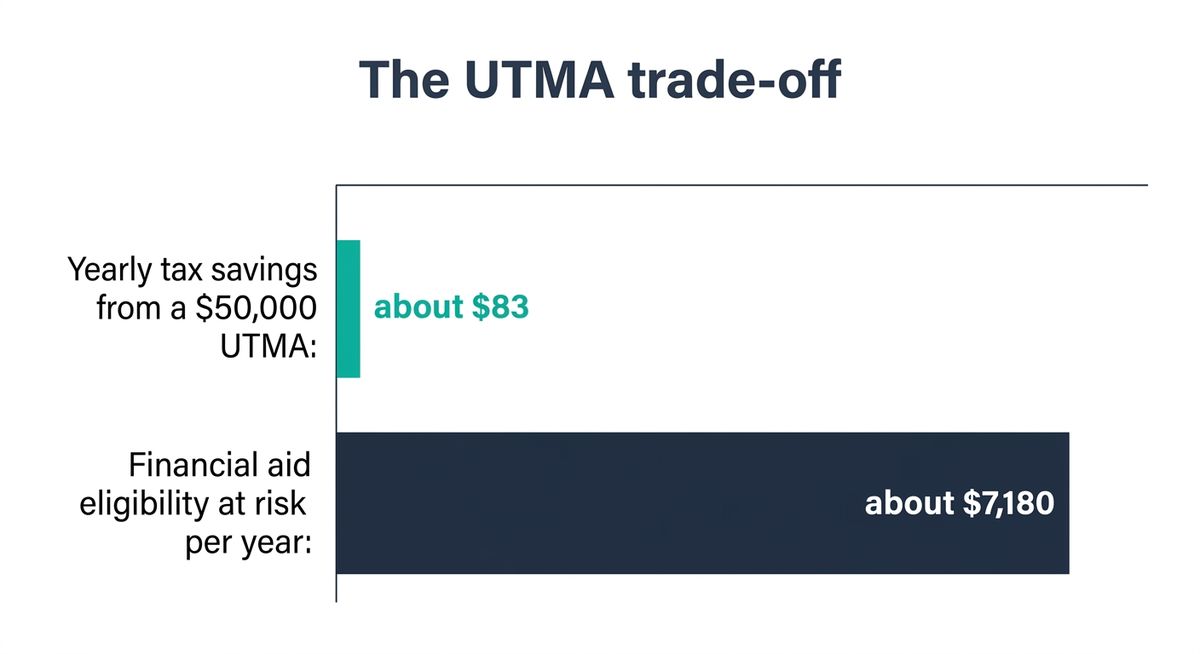
Picture a $50,000 UTMA in a total-market index fund yielding about 1.1%. That pays roughly $550 a year in qualified dividends. Under the 2026 kiddie tax rules, the first $1,350 of a child's unearned income is tax-free, so the UTMA owes nothing. Now put the same money in your own account, taxed at 15%. Those dividends would cost you about $83.
Key Insight
The UTMA saves you less than $100 a year. That's a nice dinner out. Maybe.
The savings peak at the $2,700 kiddie-tax threshold, where the parent's tax rate kicks in. Even there, they top out around $400 to $1,000 a year, depending on your bracket and whether the income is dividends or interest.
Financial aid is where the UTMA starts costing you. The FAFSA counts a UTMA as a student asset at 20%, compared to at most 5.64% for parent assets. On $50,000, that cuts aid eligibility by up to $10,000 instead of $2,820. If you qualify for need-based aid, that's about $7,180 less aid eligibility for every year the account is reported.
Then there's control, which is the big one. Your child legally owns a UTMA from the day you fund it, and the gift is irrevocable. No take-backs. The custodian's authority ends at an age set by state law:
- 18 by default in a handful of states, including California, Kentucky and Michigan
- 21 in most others
- up to 25 in some states, if the donor specifies it
- up to 30 in Wyoming
And if you treat that money like it's yours, your own kid can take you to court. In Mounsey v. Mounsey (N.Y. App. Div. 2007), a son sued his father over UGMA money that was spent after the son turned 18. The father said he'd spent it on the son's education. He still had to defend that spending in court. That's one awkward Thanksgiving.
Add it all up and a UTMA trades less than $100 a year in tax savings for thousands in lost aid eligibility and a permanent loss of control.
Moving the money into a 529 fixes the aid problem, because the FAFSA treats a custodial 529 as a parent asset. It doesn't fix the control problem, though. You have to sell the holdings first, which may trigger capital gains, and the 529 still passes to your kid at the age of majority.
Earmark Instead of Gift
For flexible money, most parents do better with a brokerage account in their own name, earmarked for the child. That's it. Nothing fancy. Index fund investing keeps the yearly tax bill small, and you keep three things a UTMA gives away: full control, parent-asset treatment for financial aid, and a step-up in basis if you die holding appreciated shares.
When your kid is ready, you can move money over in stages using the $19,000 annual gift exclusion ($38,000 for a married couple), tied to milestones you pick. Finished the degree? Landed the first job? Kept a houseplant alive for a full year? Your call.
It's not perfect, and I want to be upfront about the trade-offs. Earnings get taxed at your rate. The account is exposed to your creditors. And "earmarked" is just a label, not a legal structure. So name a transfer-on-death beneficiary or your trust, so the money ends up where you meant it to.
Comparing Your Options
Here's the whole lineup side by side:
| Account | Tax advantage | Legal control | Best use |
|---|---|---|---|
| Parent brokerage (earmarked) | None; step-up in basis at death | Parent, permanently | Flexible launch money; appreciated assets |
| UTMA/UGMA | Small: roughly $80-$1,000/yr; FAFSA student asset (20%) | Child at 18-21 (up to 30 in WY); irrevocable | Small gifts to clearly mature kids |
| Parent-owned 529 | Tax-free for education; Roth rollover option | Owner, permanently | Core education funding |
| Grandparent-owned 529 | Same, plus estate removal; not reported on FAFSA | Grandparent, permanently | Shrinking an estate while paying for education |
| Custodial Roth IRA | Tax-free growth; contributions withdrawable anytime | Child at 18-21 | Teens with real earned income |
| Trump Account | Tax-deferred; $1,000 federal seed | Child at 18 | Claim the seed; low priority beyond it |
| Revocable trust with child subtrusts | None during life; avoids probate | Trustee, per your terms | Backstop if parents die |
| Irrevocable trust | Estate removal; creditor and divorce protection | Trustee, per trust document | Large estates, blended families, special needs |
Estate Planning for Grandparents: Why Gifting Is Their Tool
For grandparents, the math flips. Your retirement needs are mostly known by now, your grandkids have decades of compounding ahead of them, and moving money out of a large estate has real value.
Under the One Big Beautiful Bill Act (OBBBA), the federal estate and gift tax exemption is $15 million per person ($30 million per couple) in 2026. It's indexed for inflation, with no scheduled end date. Very few families will ever owe federal estate tax. But several states tax estates or inheritances at much lower thresholds, so don't skip this part just because you're nowhere near $15 million. (Most of us aren't. I'm sure not.)
Estate planning for grandparents comes down to three tools:
- Superfunding a grandparent-owned 529. A five-year election lets each grandparent put in $95,000 per grandchild at once ($190,000 per couple), reported on Form 709. Put $190,000 in at birth and it grows to about $642,200 by age 18. The money leaves the estate, though a prorated share comes back in if a donor dies within the five years. The grandparents still control the account. Grandparent-owned 529s also no longer show up on the FAFSA. One catch: the CSS Profile, used by roughly 250 colleges and scholarship programs (mostly selective private schools), may still ask about them.
- Paying bills directly under §2503(e). Tuition paid straight to a school and medical bills paid straight to a provider are unlimited gifts. They don't touch the $19,000 annual exclusion.
- Giving cash and holding on to appreciated stock. Gifted shares keep the giver's original cost basis, while inherited shares get stepped up to market value. Let's say Grandma Jean bought shares for $5,000 that are now worth $500,000. If she gives them away, she passes along a $495,000 taxable gain. If her grandkid inherits them instead, that gain is never taxed. Same shares, very different outcome.
Ready to run your own numbers?
See how your retirement plan stacks up with ReadyAimRetire's retirement calculator.
Pillar 3: Tactical Wealth Accelerators
The Authorized User Credit Strategy: Building Your Kid's Credit Early
Payment history makes up 35% of a FICO score, and length of credit history makes up another 15%. So if you add your kid as an authorized user on your oldest card, you can give them years of credit history before they're even allowed to get a card of their own. That head start matters, because under the CARD Act, card applicants under 21 have to show independent income. The CFPB found that 9.6% of consumers started their credit files as authorized users.
Whether this actually builds an authorized user credit score for a minor depends on the issuer:
- Chase says it does not report minors' authorized-user history.
- American Express allows authorized users from age 13 but reports only those 18 and older.
- Capital One reports authorized users of any age.
- Discover and Wells Fargo policies get described inconsistently, so call before adding your child.
Pick a card with a low balance relative to its limit and a spotless payment record. Set autopay for the full balance. Then lock the physical card in a drawer or cut it up. Your 14-year-old does not need to discover online shopping on your card.
Everything here depends on on-time payments. A late payment on your card can show up on your kid's credit file at some bureaus, which is the opposite of the gift you were going for.
The Modern 529 College Savings Plan
A parent-owned 529 college savings plan is the core education account for one big reason: the owner never gives up control. You can change the beneficiary, and you should name a successor owner. OBBBA also raised the limit for K-12 withdrawals to $20,000 a year starting in 2026 and added credential and licensing programs as eligible expenses. So it's not just for four-year degrees anymore.
The SECURE 2.0 Roth rollover takes care of the old fear that unused 529 money gets stuck. Leftover funds can move tax-free into the beneficiary's Roth IRA if all of these are true:
Roth Rollover Requirements
- The 529 has been open more than 15 years.
- The money and its earnings weren't contributed in the last five years.
- Each year's rollover fits within the IRA limit ($7,500 in 2026), minus any other IRA contributions that year.
- The beneficiary has earned income at least equal to the amount rolled over.
- Total lifetime rollovers stay within $35,000.
There's no income limit on these rollovers. And if $35,000 gets rolled over between ages 22 and 26, it grows to about $568,600 by 65.
Three cautions, though:
- Changing the beneficiary: assume it restarts the 15-year clock. The IRS still hasn't issued formal guidance.
- State taxes: treatment varies. California taxes the earnings and adds a 2.5% penalty, and several states may take back state tax deductions you claimed earlier.
- Limited benefit: in one Kitces example, a full $35,000 rollover was worth about $2,279 in tax savings in today's dollars. Nice, but not life-changing. Treat it as a backup plan for leftover money, not a reason to overfund the 529.
The practical move: open a 529 at birth with even a small deposit, so the account qualifies for rollovers by your kid's 15th birthday.
The Custodial Roth IRA for Teens With Earned Income
A custodial Roth IRA requires minor earned income. That means wages or self-employment income. An allowance doesn't count, no matter how hard they worked cleaning their room. The child can contribute up to the lesser of their earnings or $7,500, and a parent or grandparent can give them the money to make the contribution.
This one gets me excited. If your kid contributes $7,500 a year from age 15 through 18, it grows to about $800,700 by age 65 with no further deposits. That's $30,000 in and roughly $800,000 out.
Contributions (but not earnings) can come out tax- and penalty-free at any time, so the account can double as a reserve for a first apartment or a business. After five years, up to $10,000 of earnings can be withdrawn tax- and penalty-free for a first home.
Documented babysitting or lawn-mowing income counts. If you own a business, you can go further and hire your kid. Wages paid to a child under 18 by a sole proprietorship or a partnership owned only by the parents are exempt from Social Security and Medicare tax.
Here's how that plays out. Say you pay your kid $16,100 in documented, market-rate wages. They owe no federal income tax because the standard deduction covers it. You save up to about $3,864 in federal income tax in the 24% bracket, or somewhat less if you take the 20% qualified business income deduction. You also save about $2,275 in self-employment tax, as long as your self-employment income is below the $184,500 Social Security wage base.
One big caveat: the Social Security and Medicare tax exemption does not apply to corporations, including S-corps. And the courts do look at whether the job is real. In Embroidery Express (T.C. Memo 2016-136), the Tax Court allowed modest, regular wages paid to the owners' children. It disallowed large year-end bonuses that had no time records behind them. So keep a job description, timesheets, proof of payment and a W-2, and have a CPA look over the setup.
Yes, the account passes to your kid at 18 to 21. But by then the balance is usually modest, and the taxes and penalties on early withdrawals of earnings tend to discourage spending it.
Trump Accounts: Claim the $1,000
By October 1, 2026, the Treasury had automatically enrolled more than 60 million children in Trump Accounts. But enrollment alone doesn't get your kid the $1,000 federal seed for U.S.-citizen children born from 2025 through 2028. You have to claim the account in the official Trump Accounts app and elect the seed on Form 4547, either in the app or through an IRS online account. The nonprofit Commonwealth estimates that about 20% of eligible children could miss out. That's $1,000 of free money just sitting there, so go claim it.
Beyond the seed, these accounts are a low priority. The child takes control at 18, earnings are taxed as ordinary income under traditional IRA rules, and the Education Department hasn't said how the FAFSA will treat them.
Family Trusts: When the Stakes Justify the Cost
Move from an earmarked account to a formal trust when you need rules that outlive you. Common reasons include a blended family, a child with special needs, a child who tends to overspend, creditor or divorce risk, or an estate approaching $15 million.
Start with your beneficiary forms. It's boring paperwork, and it matters a lot. Never name a minor directly on a life insurance policy or retirement account. If you do, a court appoints someone to manage the money (possibly an ex-spouse), and the child gets it outright at 18 to 21. A revocable trust with child subtrusts solves that, and it can spread out payouts, say one-third each at ages 25, 30 and 35.
Inherited IRAs have their own deadlines. Grandchildren and most other heirs must empty the account within 10 years of the owner's death. A minor child of the owner has until 10 years after turning 21.
Know the costs before you set one up:
- Setup: about $1,000 to $6,000 for a revocable trust, and $2,000 to $15,000 for an irrevocable trust.
- Administration: $300 to $3,000 a year.
- Taxes: trust tax brackets are squeezed tight. Income a trust keeps above $16,000 is taxed at 37%, plus the 3.8% net investment income tax. Single filers don't hit the 37% rate until $640,600. A non-grantor trust that keeps $20,000 of interest income owes about $5,483 in federal tax. A single person with the same taxable income would owe about $2,150.
The usual fixes for the tax hit: use a grantor trust, where you pay the tax, or pay the income out to beneficiaries.
Implementation Checklist by Life Stage
Infancy (birth to 4)
- Make sure your own basics are covered: 401(k) match captured, high-interest debt paid off, emergency fund built.
- Buy term life insurance. Write a will naming a guardian, and name a trust (not the child) as beneficiary.
- If your child was born from 2025 through 2028, claim the Trump Account and elect the $1,000 seed.
- Open a parent-owned 529 with any amount and name a successor owner.
- Grandparents: decide whether to superfund a 529.
School age (5 to 12)
- Add your kid as an authorized user with an issuer that reports minors, and lock the card away.
- Open an earmarked brokerage account in your name, invested in broad index funds, with a transfer-on-death beneficiary.
- Use 529 money for K-12 costs only if you don't need its long-term growth.
Working teen (13 to 18)
- Document your teen's earned income and fund a custodial Roth up to the lesser of earnings or $7,500.
- Keep large assets in parent or grandparent names heading into the years your kid files the FAFSA.
- If you hold a UTMA, act before the termination age. One option is spending it on the child's non-support costs, like camp or a car. Another is asking an estate attorney whether it can be restructured into a 2503(c) trust, which gives the child only a limited window at 21 to withdraw the money.
Young adult launch (18 to 25+)
- Help them open their own credit card once they have income.
- Start 529-to-Roth rollovers once they have earned income, after checking your state's rules.
- Make staged gifts of up to $19,000 a year from your earmarked account, tied to milestones.
- Consider converting the Trump Account to a Roth IRA in a year when their income is low.
Building Generational Wealth: The Order Matters More Than the Account
Families rarely build generational wealth by finding the cleverest account. They build it by funding their own retirement first, keeping ownership of the money until their kids are ready, and using each specialized account for what it was built to do. When it comes down to parental control vs. tax efficiency, control usually wins. The tax savings add up to hundreds of dollars a year. The loss of control is permanent.
🎯 Three things to do this month
- Run your own numbers: Model your retirement before you bump up any contribution for a child. Start at ReadyAimRetire.
- Claim the seed: For any child or grandchild born in 2025 or later, confirm the $1,000 Trump Account seed has actually been elected, not just that the account exists.
- Check your 529 and credit cards: Find out when your 529 was opened (or open one), and ask your card issuer whether it reports authorized users under 18.
Grandparents: before making any big gifts, sit down with an estate attorney and a tax advisor. Figure out which assets to give now and which to hold on to for the step-up in basis.
Thanks for reading if you've made it this far. Now go put your own mask on first.
Peace!