

Frank Spent $478,000 More Than the 4% Rule Allowed. Here's What It Cost Him.


Frank retired on January 1, 2009, with exactly $1,000,000. Then he took out $52,000 and watched the market fall another 25%.
- Frank retired January 1, 2009 and withdrew 5.2% a year using Guyton-Klinger guardrails instead of the standard 4% rule.
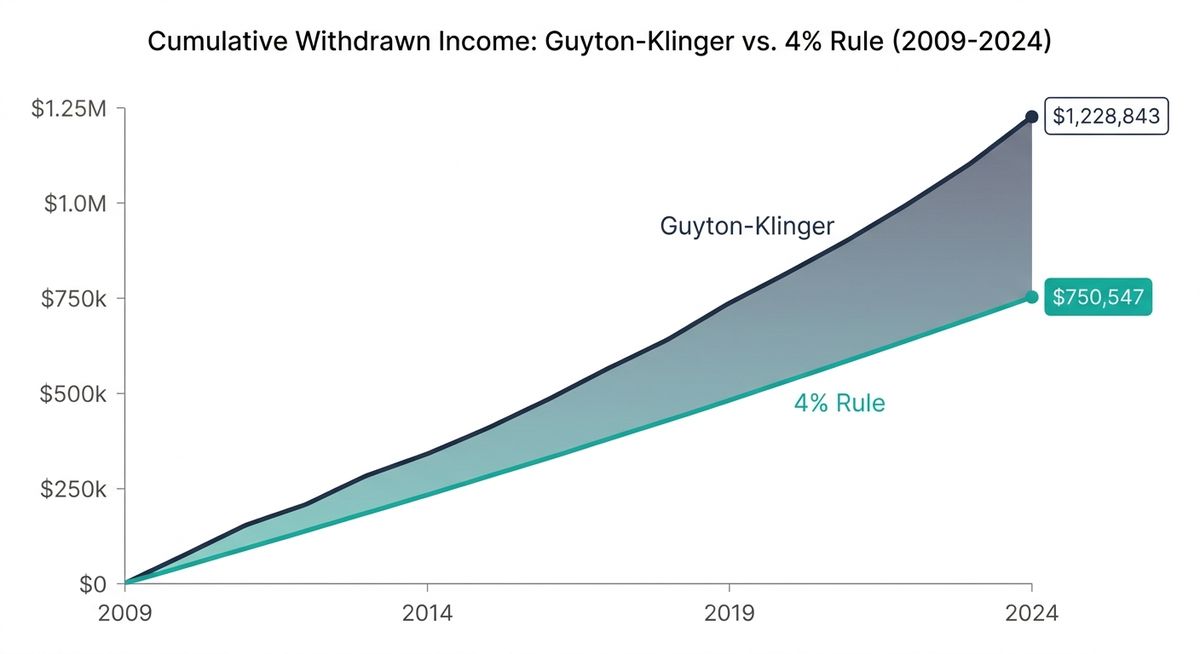
- Over 16 years he pulled $1,228,843 from his portfolio versus $750,547 for a disciplined 4%-rule retiree, 63.7% more, spent while he was young enough to use it.
- The trade-off is real: the 4% retiree ended up with nearly a million dollars more in the account.
- Guardrails also forced one COLA freeze and required real discipline to take the raises, not just absorb the cuts.
This is a case study in a specific historical sequence, not a guarantee.
That's not a typo. And it's not the setup for one of those cautionary tales where the guy loses everything and we all nod solemnly. Frank didn't retire at the bottom of the Great Financial Crisis. He retired on the way down. The S&P 500 closed out 2008 at 903.25 and just kept going, all the way to 676.53 on March 9, 2009. That's ten weeks after Frank cashed his first withdrawal check — ten weeks of sequence of returns risk playing out in real time, a seven-figure portfolio sliding another quarter while he was actively pulling money out of it.
And here's the kicker. Conventional wisdom said Frank should have been taking $40,000 a year. The famous 4% rule. Safe. Time-tested. Everybody's favorite. Instead Frank was pulling 5.2%, an extra twelve grand a year, right into the teeth of the worst market since 1932.
Sixteen years later, Frank had pulled $1,228,843 out of that portfolio
The disciplined 4% retiree? $750,547. That's 63.7% more money, spent while Frank still had the knees to use it.
He wasn't being reckless. He was following a dynamic withdrawal strategy called Guyton-Klinger guardrails.
What the 4% Rule Actually Asks You to Do
The 4% rule is beautifully simple, which is exactly why it spread like it did. Take 4% of your portfolio in year one. Bump it up by inflation every year after that. Then never look at your balance again.
That last part is where things go sideways.
The 4% rule is a static strategy wearing a plan's clothing. It was built to survive the single worst retirement start date in modern American history. Which means that in literally every other scenario, it's overbuilt. You're wearing a parachute on a bus. We've written before about why the 4% rule is increasingly seen as broken for modern retirees — Frank's numbers are the clearest illustration of why.
Watch what happened to Frank's 4%-rule twin:
| Year | Age | Portfolio | Withdrawal | Withdrawal Rate |
|---|---|---|---|---|
| 2009 | 65 | $1,000,000 | $40,000 | 4.00% |
| 2014 | 70 | $1,614,387 | $44,332 | 2.75% |
| 2019 | 75 | $1,968,911 | $47,801 | 2.43% |
| 2024 | 80 | $3,055,947 | $58,426 | 1.91% |
At 80 years old, sitting on $3.05 million, this guy was withdrawing less than two cents on the dollar.
And in real terms? He was living exactly the same life he lived on day one. $40,000 in 2009 money in 2009. $40,000 in 2009 money in 2024. Sixteen years of flat purchasing power, by design, while the pile underneath him tripled.
That's not safety. That's a guy who never gave himself permission to notice the emergency was over.
The Guyton-Klinger Rules in Plain English
Jonathan Guyton and William Klinger published this framework in the Journal of Financial Planning back in March 2006. What they found: with 65% or more in equities and a handful of simple decision rules — a dynamic, responsive alternative to a fixed percentage — retirees could safely start at 5.2% to 5.6%. Not 4%.
Guyton's own analogy is still the best one anybody's come up with:
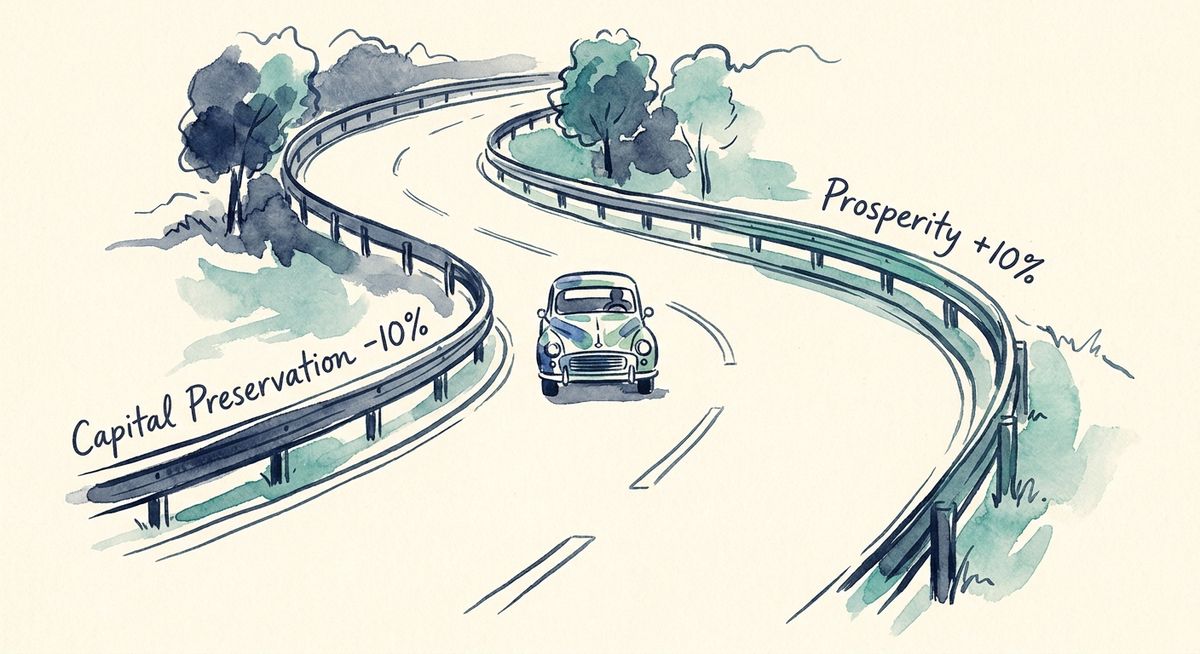
"If you think about driving your car down a road, you hit a guardrail, it does two things. It puts a ding in your car, and it changes your momentum so that instead of the momentum pushing you toward the edge of the road, it now starts to shift you back toward the middle where it's safe."
You don't drive by staring at the guardrail. You drive down the middle and let the rail catch you if you drift. Here's the whole system:
Rule 1. Rebalance every year. Every January 1, reset to your target allocation. Frank's was 70% stocks, 30% bonds. This is the boring rule. It's also the one that makes the other three work.
Rule 2. The COLA freeze. Normally you raise your withdrawal by last year's inflation. But if the portfolio lost money last year AND your current withdrawal rate is above where you started, you skip the raise. Not a cut. Just a pause.
Rule 3. Capital Preservation, the downside rail. If your withdrawal rate climbs more than 20% above your starting rate, you cut spending by 10%. Frank started at 5.2%, so his lower rail sits at 6.24%.
Rule 4. Prosperity, the upside rail. Nobody talks about this one, and it's where all the money is. If your withdrawal rate falls more than 20% below your starting rate, you give yourself a 10% raise on top of inflation. Frank's upper rail: 4.16%.
Every retiree's rails land in different places depending on their starting portfolio, allocation, and spending needs, so Frank's numbers won't map directly onto yours. You can run these numbers for your own situation at ReadyAimRetire.com instead of eyeballing it against his case.
Guyton-Klinger Guardrails in Action: Frank's Sixteen Years
Pay attention to that last column, because the story it tells is not the one most people expect.
| Year | Age | Portfolio | Withdrawal | Rate | Rule Fired |
|---|---|---|---|---|---|
| 2009 | 65 | $1,000,000 | $52,000 | 5.20% | |
| 2010 | 66 | $1,140,453 | $53,404 | 4.68% | |
| 2011 | 67 | $1,222,974 | $54,205 | 4.43% | |
| 2012 | 68 | $1,213,521 | $55,831 | 4.60% | |
| 2013 | 69 | $1,301,974 | $56,780 | 4.36% | |
| 2014 | 70 | $1,519,972 | $63,395 | 4.17% | PROSPERITY +10% |
| 2015 | 71 | $1,622,248 | $70,292 | 4.33% | PROSPERITY +10% |
| 2016 | 72 | $1,569,509 | $70,784 | 4.51% | |
| 2017 | 73 | $1,636,113 | $72,271 | 4.42% | |
| 2018 | 74 | $1,819,421 | $81,167 | 4.46% | PROSPERITY +10% |
| 2019 | 75 | $1,685,011 | $82,709 | 4.91% | COLA kept |
| 2020 | 76 | $1,997,414 | $84,612 | 4.24% | near-miss on raise |
| 2021 | 77 | $2,202,246 | $94,376 | 4.29% | PROSPERITY +10% |
| 2022 | 78 | $2,521,750 | $111,080 | 4.40% | PROSPERITY +10% |
| 2023 | 79 | $2,010,981 | $111,080 | 5.52% | COLA FROZEN |
| 2024 | 80 | $2,281,011 | $114,857 | 5.04% |
Total withdrawn: $1,228,843. Final balance: $2,553,659.
Five Prosperity raises. One COLA freeze. The Capital Preservation cut — the scary one everybody worries about, the one that keeps people from trying this at all — never fired once in sixteen years.
Read that 2023 row slowly, because that's the system doing its job. 2022 was rough. The 70/30 portfolio dropped 16.58% and Frank's withdrawal rate jumped to 5.52%. Inflation that year ran 7.0%. Under the 4% rule he'd have taken the full 7% raise anyway, no questions asked. Under guardrails he froze. He spent 2023 on the same $111,080 he spent in 2022, took the hit on the chin, and by 2024 the portfolio had recovered enough to go back to normal raises.
Frozen for one year. That is the entire cost of the downside protection in this window.
The Comparison: What Frank Actually Bought
| Metric | Guyton-Klinger | 4% Rule | Difference |
|---|---|---|---|
| Total income, 16 years | $1,228,843 | $750,547 | +$478,296 (+63.7%) |
| First 5 years (ages 65-69) | $272,220 | $209,400 | +$62,820 (+30.0%) |
| First 10 years (ages 65-74) | $630,129 | $436,274 | +$193,855 (+44.4%) |
| 2024 withdrawal, nominal | $114,857 | $58,426 | +$56,431 |
| 2024 withdrawal, in 2009 dollars | $78,627 | $40,000 | +$38,627 (+97%) |
| Final balance | $2,553,659 | $3,533,686 | −$980,027 |
That last row is the one your brother-in-law with the calculator is going to find, so let's just put it on the table right now.
Guyton-Klinger
- Total income $1,228,843
- Final balance $2,553,659
- Real purchasing power by age 80 +51%
4% Rule
- Total income $750,547
- Final balance $3,533,686
- Real spending, 16 years Flat $40,000
The 4% retiree ended with almost a million dollars more. Guyton-Klinger is not free money. It has never been free money. Every dollar Frank spent in 2011 was a dollar that didn't compound for another thirteen years. The exchange rate worked out to roughly $2.05 of ending wealth for every $1 of extra income. Front-loading has a price and anybody who tells you otherwise is selling something.
So the honest question isn't which strategy makes more money. It's who gets the money, and when.
Frank's guardrail path gave him a 51% raise in real purchasing power between 65 and 80, from $52,000 to $78,627 in constant 2009 dollars. The 4% path gave him a flat $40,000 for sixteen straight years and handed his kids an extra $980,027.
That $980,027 is a very specific trade: sixteen years of Frank's travel, his grandkids, and his knees, converted into an inheritance. And look, if that's what Frank wanted, the 4% rule delivered it flawlessly. But almost nobody picks that on purpose. They back into it by following a rule built for a worst case that never showed up. If you're weighing how much to spend versus save specifically in those early years, it's worth reading how we think about budgeting through the first five years of retirement — that's exactly the window where Frank's extra income landed.
Every retirement plan is different. ReadyAimRetire lets you test how these strategies work with your specific numbers, so you're weighing your own trade-off rather than borrowing Frank's.
The part most retirement articles skip
David Blanchett studied what retirees actually spend, not what they're told to spend, and found something he calls the "retirement spending smile." Inflation-adjusted spending drops about 1% a year through retirement before ticking back up late for healthcare. A household starting at $100,000 bottoms out around $74,146 by age 84. That's a 26% real decline.
Now hold that up next to the 4% rule and watch something break. The 4% rule keeps your spending flat in real terms for thirty years, which means it systematically underfunds the years you want money most and overfunds the years you want it least. Michael Stein said it in a way I've never forgotten: go-go years, slow-go years, no-go years. Frank's guardrail raises landed at ages 70, 71, 74, 77, and 78. Right in the middle of the go-go window.
The Tax Problem Nobody Models
Here's the part that breaks the 4% rule outright, and I've almost never seen anyone run the numbers on it.
If Frank's million was sitting in a traditional IRA or 401(k), the 4% rule was never actually executable. Frank was born in 1944, which puts him under the old pre-SECURE rules. Required minimum distributions kicked in at age 70½, in 2014. From that day forward the IRS, not Bill Bengen, set the floor on what Frank pulled out. (RMDs trip up more retirees than you'd expect — see our breakdown of the most common RMD mistakes if you're tax-deferred and approaching this age.)
Run the numbers on 2024. The 4% retiree started that year with $3,055,947. At 80, the Uniform Lifetime Table divisor is 20.2, so his RMD was $151,285. His plan called for $58,426.
The IRS forced him to withdraw two and a half times what his own strategy told him to take.
He didn't get to leave that money compounding quietly. He got a fully taxable distribution of $151,285, spent $58,426 of it, paid tax on all of it, and shoveled the rest into a taxable account where the growth gets taxed again every single year.
Now look at Frank. His 2024 guardrail withdrawal was $114,857 against an RMD of $112,921. He was within about two thousand bucks of the required amount. All through his seventies, Frank's guardrail withdrawals track the RMD schedule closely, while the 4% retiree's wander off by a factor of two to three. That's not luck. Both the RMD table and the Prosperity Rule scale your spending to what the portfolio is actually worth right now. The 4% rule is the only one of the three that ignores it completely.
The knock-on effects are real, and they land hardest on the guy who thought he was being careful:
IRMAA. Medicare surcharges are set from your income two years back. For 2026, the first cliff is $109,000 for a single filer, $218,000 for joint. And it's a cliff, not a ramp. One dollar over and you owe the whole tier. A $151,285 forced distribution plus Social Security clears that with room to spare. Frank's $114,857 is in the same neighborhood, so neither guy escapes here. But the 4% retiree got there involuntarily.
The new senior deduction. The One Big Beautiful Bill Act created a $6,000 per-person deduction for filers 65 and up, good for tax years 2025 through 2028. It phases out starting at $75,000 of MAGI for singles and $150,000 for joint, and it's gone entirely at $175,000 and $250,000. A forced six-figure RMD burns right through it.
If you're planning today, the ages have moved. Under SECURE 2.0, RMDs now start at 73, going to 75 for anyone born in 1960 or later. That's a longer runway than Frank got, and it makes this decision sharper, not softer. More years of untouched compounding means a bigger balance sitting there when the forced distributions finally start.
The 4% retiree's $3.5 million isn't a win in the bank. It's a deferred tax bill with a due date, and his heirs inherit that right along with the money.
The Fine Print: What Frank Signed Up For
Here's where most articles wrap up and tell you to go take the extra money. That's exactly why you shouldn't trust them.
Frank's story is a best case. The guy retired into the greatest bull run in modern history. If you want to see what guardrails actually cost through real portfolio drawdowns, run the same two strategies for somebody who retired January 1, 2000, straight into the dot-com bust with the GFC waiting on the other side:
| Metric | Guyton-Klinger | 4% Rule |
|---|---|---|
| Total withdrawn, 2000-2024 | $1,140,276 | $1,339,007 |
| Final balance (age 89) | $1,360,341 | $922,099 |
| Lowest annual withdrawal | $38,288 (2012) | never cut |
| Trough income in 2000 dollars | $28,514 (−45%) | $40,000 (flat) |
| 2024 income in 2000 dollars | $32,396 (still −38%) | $40,000 |
Guardrails fired four Capital Preservation cuts in that run (2002, 2003, 2009, 2010) plus five COLA freezes. That retiree's spending power dropped 45% and had still not recovered 24 years later. Those aren't numbers on a spreadsheet. Those are cancelled trips and postponed purchases and a lot of "maybe next year."
Karsten Jeske over at Early Retirement Now says it plainly, and he's not wrong:
"You replace the small risk of running out of money with the 4% rule with a moderate risk of large spending cuts."
Any honest case for guardrails has to own that. Jeske ran a 1966 retiree through Guyton-Klinger and found withdrawals bottoming out at $16,400 a year, a 59% cut, with the decline dragging on for something like a decade. Wade Pfau and Jeske have both found cases where Guyton-Klinger triggered cuts that, looking back, turned out to be unnecessary.
But now look at the other column. That 2000-cohort 4% retiree never cut a dime. By 2012, at age 77, he was pulling $53,710 out of a $666,849 portfolio. That's an 8.05% withdrawal rate. He didn't make it because he was safe. He made it because 2013 through 2024 handed him a historic bull market and bailed him out.
He had nothing in his system that would have told him he was in trouble. That's the actual difference between these two approaches. Guardrails don't guarantee you more money. They guarantee you respond. The 4% rule's real selling point is that it never asks you to notice anything.
Two more things worth knowing before you go install this:
You have to actually be willing to cut. If your budget is 90% fixed costs — property taxes and insurance and Medicare premiums — then a 10% cut isn't a shorter vacation. It's a crisis. Guardrails need discretionary spending to push against.
It's more work. If the 4% rule is riding a bike, guardrails are flying a 747. You'll need a spreadsheet and a January reminder on your calendar, permanently.
What the Rest of the Field Says About Safe Withdrawal Rates Now
The research has been drifting toward Guyton and Klinger, not away from them:
Morningstar's current State of Retirement Income research puts the base-case safe withdrawal rate for fixed real spending at 3.9% for a 2026 retiree, based on a portfolio with 30% to 50% in stocks. But that same research finds a guardrails approach supports 5.2%. That is the exact rate Frank used. Add in delayed Social Security and some TIPS and they get to 5.7%.
Bill Bengen, the man who invented the 4% rule, raised his own number to 4.7% in his 2025 book A Richer Retirement, using a broader seven-asset-class portfolio. And here's the part that gets buried: 4.7% is his worst-case floor. The average safe rate across all 349 retirement start dates in his study is around 7.1%.
Morningstar's warning, and this one matters: their probability-based guardrails method produced the highest lifetime withdrawals of anything they tested, and a median ending balance of just $230,000 on a $1M start. Guardrails spend down. This is not a legacy strategy and nobody should pretend it is.
The guy who invented the 4% rule doesn't use 4% anymore. Sit with that one for a second.
What To Do in January
Your Guardrails Checklist
- Run both numbers. Take your portfolio, calculate 4% and 5.2%. On $1.2 million, that's $48,000 versus $62,400. Look at the gap for a minute. That gap is the entire decision.
- Split your budget into fixed and flexible. Add up the spending you genuinely cannot cut. If your flexible spending is under 15% to 20% of the total, guardrails are going to hurt when they bite. Think about starting lower, maybe 4.5%, and setting your rails off that.
- Write your rails down in dollars, before you retire. Not percentages. Actual dollar figures. "If my portfolio drops below $X on January 1, I cut my withdrawal to $Y." Decide it while you're calm, because I promise you will not be calm in March 2009.
- Check your rails against your RMD. If your money is in tax-deferred accounts, model out your required distributions at 73 and 80 next to what you're planning to withdraw. If the RMD towers over your plan, your "safe" strategy is fiction and you should be talking to somebody about Roth conversion strategies in your sixties.
- Put a recurring January 1 reminder on your calendar. Rebalance, calculate your current withdrawal rate, check it against both rails, apply CPI or freeze. Twenty minutes. Once a year. That's it.
- Do not skip the Prosperity Rule. This is where most people fall down. Cutting during a downturn feels responsible, so retirees do it. Taking a 10% raise during a bull market feels greedy, so they don't. Frank's entire advantage came from five raises he gave himself permission to take. A guardrail system with only the downside rail installed isn't a strategy. It's anxiety with a spreadsheet.
- Stress-test the bad sequence, not the good one. Before you commit to any of this, model your income as the 2000 retiree instead of the 2009 retiree. If a 45% real spending cut would blow up your life, you need a lower starting rate, or more guaranteed income from Social Security or an annuity, or both.
Frank turned 80 in 2024 with $2.55 million in the bank and sixteen years of a life he actually went out and lived. His disciplined twin has $3.53 million, a photo album with a lot of blank pages, and a tax bill coming due.
Both of them succeeded. Neither one ran out of money. But only one of them made the choice on purpose.
The 4% rule isn't wrong. It's a floor built for a fire that, for most retirees in most decades, never arrives. Guardrails don't ask you to take on more risk. They ask you to pay attention once a year and spend accordingly when the market gives you the room.
Your best years have an expiration date. Nobody puts that on the label.
Thanks for reading if you made it this far. Peace!
Figures in this case study are modeled from published S&P 500 total returns, Bloomberg US Aggregate Bond Index returns, and CPI-U December year-over-year data for 2009 through 2024, assuming January 1 withdrawals and annual rebalancing to 70/30. Guyton and Klinger's original paper caps the annual inflation adjustment at 6%; applying that cap changes Frank's 2022 withdrawal from $111,080 to $110,042 and affects no other figure materially. Tax discussion assumes assets held in tax-deferred accounts and is illustrative only. This is modeling, not a recommendation. Talk to a fiduciary advisor about your own situation.