

The Second Half Playbook: 10 Life Lessons 70-Year-Olds Wish They Knew in Their 50s


Ask most people about retirement planning and you'll get a number. How much do you need, what return can you assume, what year does the money run out? Those are good questions, and since I helped start a company called Ready Aim Retire, I'd better think so. A strong balance sheet solves a lot of problems. But it can't tell you who you are on a Tuesday morning with no meetings. It can't tell you whether your knees will handle a hill town at 74. And it really can't tell you who picks up when you call.
- The real variables in the second half of life are time, health, identity and relationships, and your 50s and 60s are when you can still act on all four.
- Move body-dependent plans forward, protect your hours, buy back time where the budget allows, and lift something heavy.
- Budget for lumpy retirement spending, and start friendships and a sense of purpose before your last day at work.
Action: pick one move before Sunday. Book a strength session, message a friend you've drifted from, or start a 12-month spending log.
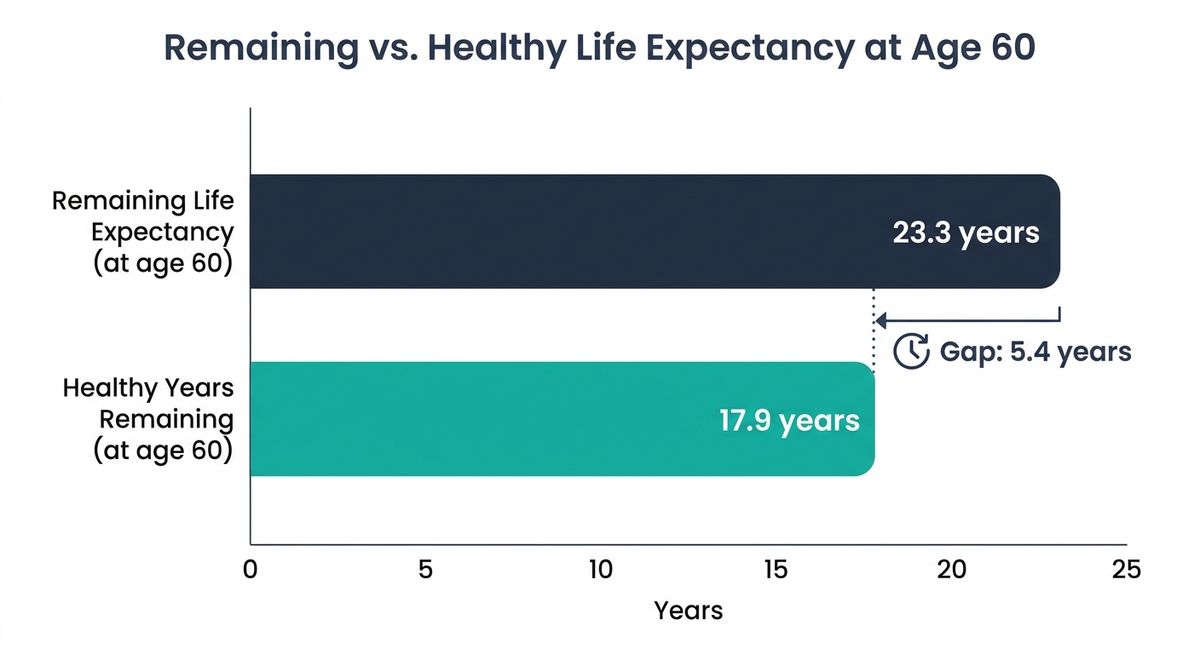
That other stuff is what comes up when people look back. Since 2004, Cornell's Legacy Project has collected life advice from more than 1,000 Americans in their 70s and beyond. "The most important resource is time," says Jeremy, 72, in his list of lessons for the project. "Not money or material things." Jeremy, I like you already. The numbers don't sugarcoat it either. A Census Bureau analysis of 2016 WHO data put life expectancy at 60 at about 23.3 more years, with only 17.9 of them healthy. Go ahead and do that subtraction. In EBRI's 2026 Retirement Confidence Survey, 46% of retirees said they left work earlier than planned, and the median retiree stopped at 62 while the median worker still expects 65. Those figures are averages, not your forecast, so please don't panic. But they point to the real variables in the second half: time, health, identity and relationships. The ten life lessons below pair what older Americans say with what the data shows, for the decade when you can still do something about all four.
1. Spot the Window Before It Narrows
Life rarely hands you time, health and money all at once. Early on, as CFP James Conole puts it on the Ready For Retirement podcast, "you've probably got a lot of time and you've got a lot of health, but you probably don't have a whole lot of money." Think great knees and cheap noodles. Midlife gives you money and health but no spare hours to use them. Later retirement gives you money and time, while your health gets less dependable. The overlap is short. The episode's notes place a rare "sweet spot" in the 50s and 60s, and Conole describes clients who "woke up realizing the last five to 10 years of life had passed them by." Ferris Bueller tried to warn us back in 1986: life moves pretty fast.

The common mistake is assuming that overlap will wait for you. Picture a couple, let's call them Mike and Linda, who postpone a walking trip through the hill towns of Tuscany from 62 to 74. The portfolio has grown. Great. But one knee has rewritten the itinerary. About 28.3% of people over 75 have difficulty walking or climbing stairs. So most don't, which is good news, but the odds have moved. And I've worked from dozens of countries, so trust me on this: the prettiest old towns are rarely the ones with elevators. Borrow Bill Perkins's time buckets from Die With Zero. List the experiences that depend most on your body, give each one a target age, and move the most physical ones forward. (If you want the money side of that argument, here's why most retirees die with too much money.)
2. Sort Your Hours Into Three Accounts
Most time management advice treats your week as one big pool, and that pool drains toward whoever asks loudest. I'd split it up. Career time has a calendar. Relationship obligations have a phone number, and with 63 million Americans now serving as family caregivers, that phone rings a lot. Renewal time has nobody sticking up for it at all. Pew found that 46% of workers with paid time off take less than they're offered, and among managers it's 54%. Those are days off that come with the job, and people are leaving them on the table.
So stop treating recovery as whatever's left over. Researchers describe four recovery experiences: detachment from work, relaxation, mastery and control. A Saturday of errands gives you very little of that. A pottery class you're bad at might deliver three of the four, and I promise I'd be bad at pottery. Color-code one typical week as career, obligation or renewal. If renewal barely shows up, book one block and defend it like a client meeting. That's the start of better work-life balance and a sneak preview of your retirement lifestyle, because it shows you what you do when nobody's asking.
3. Retire the Reflexive Yes
Saying yes built a lot of careers. Jim Carrey even got a whole movie out of it. But few habits age worse through a midlife transition. At 30, the extra committee was an opportunity. At 55, the same reflex hands your scarcest hours to anyone with a calendar invite. Part of the problem is a forecasting error: people expect to have more time in the future but about the same money, so a commitment six months away feels free. It isn't. Future you is going to be just as busy, and a little annoyed with you.
So decline more often, and expect less fallout than you fear. Across five experiments with more than 2,000 participants, Givi and Kirk found that people overestimate the negative reaction a declined invitation causes. Your friend is probably less hurt than you think. Now, those studies covered social invitations, so applying them to the office is a judgment call. The research also carries its own caution: "spending time with others is how relationships develop, so don't decline every invitation." That makes "no" a choice about priorities, not a blanket policy. Before you accept anything, ask whether you'd say yes if it were happening next Tuesday. If not, pass, and save your yes for the people and projects you'd miss.
4. Stop Deferring Hours the Way You Defer Dollars
Decades of saving teach you one powerful lesson: wait. At a 6% return after inflation, $100,000 becomes about $320,700 in 20 years, so yes, patience pays. If you want to see how that kind of compounding plays out with your own balances and timeline, you can run the numbers at ReadyAimRetire.com. The trouble starts when that same reflex spreads to everything else, and the visit to your parents gets pushed past the next big project. Time doesn't pay you anything for waiting. It only runs down, and some hours, like the ones with an aging parent, run out faster than they feel. If you've ever really listened to the words of "Cat's in the Cradle," you already know.
Writer Tim Urban ran this math in "The Tail End" and got a jolt: "when I graduated from high school, I had already used up 93% of my in-person parent time." I had to sit with that one for a minute. Now run your own version: visits per year, times the years you can realistically expect, for each person who matters. Intentional living mostly comes down to that arithmetic, because the answer tends to be small enough to change how you behave. Asked what older people are likely to regret, Sr. Clare, 83, named "unfinished business with others or with what they wanted to do or be," such as "not asking about family history." In Cornell research, 76% of participants asked for their single biggest regret mentioned not fulfilling their ideal self. So add one trip or one standing weekly call this quarter, and ask your questions while someone can still answer them.
"When I graduated from high school, I had already used up 93% of my in-person parent time."
Tim Urban, "The Tail End"
5. Buying Back Time: Do What You Do Best, Pay for the Rest
Funny thing about people who saved diligently for 30 years: they often struggle to pay for anything they could do themselves. Almost half of 850 surveyed millionaires spent nothing outsourcing tasks they disliked. Millionaires! Yet across more than 6,000 adults in four countries, the same research linked time-saving purchases to higher life satisfaction, even after controlling for income.
Say your neighbor Dave is 58 and gives up two weekends every few years to clean and stain a deck, resenting every hour. Angi puts the job at about $850 on average, often $550 to $1,250, and recommends restaining every two to three years. That's roughly $285 to $425 a year. I know that isn't pocket change for everybody, and I feel a little funny even writing this, but if the budget can carry it, that's a clean case for buying back time. List the chores you dread, price the top three and hand off one. Two cautions, though. If you love the work or it's your exercise, it isn't a chore, so carry on. And freed-up hours can vanish into more work. Harvard's Ashley Whillans advises treating them "not as an opportunity to send more emails." Decide in advance where the reclaimed weekend goes.
6. Healthspan vs. Lifespan: Lift Now to Shorten the Slow-Down
The healthspan vs. lifespan question matters more than most retirement planning admits. Plenty of people plan for a 30-year retirement without ever asking how long the slow-down at the end of it will last. Muscle is one place to start. A 2026 meta-analysis of 39 studies and 76,151 community-dwelling older adults linked sarcopenia, the age-related loss of muscle, to about 1.8 times the odds of death and 1.9 times the odds of functional decline. Adjusting for possible publication bias shrank those to 1.33 and 1.55, and the data shows association rather than proof of cause, so let's not get carried away. But the practical stakes are easy to see: 27.6% of adults 65 and older reported a fall in 2020. Terry Chang, 77, made this his top lesson for living, and he didn't dress it up: "If you have to be pushed around in a wheelchair with an oxygen tank, if there's anything in life that you know right now that can prevent that, do it."
Healthspan vs. lifespan
Lifespan is how many years you live. Healthspan is how many of those years you spend in good health. The Census Bureau analysis cited above put life expectancy at 60 at about 23.3 more years, with only 17.9 of them healthy.
Don't wait for retirement, and don't assume light effort will do the job. In a randomized trial of 451 retirement-age adults, participants spent a year lifting heavy weights three times a week, doing moderate circuits with body weight and bands, or neither. At the four-year mark, three years after the training ended, the heavy group had kept its baseline leg strength while the other two had lost ground. Let's keep that in proportion: leg power, the trial's main measure, and grip strength fell in all three groups with no clear difference, and the volunteers were healthier and more active than average. Still, that's encouraging evidence for healthy aging from people who started late. Observational studies disagree on dose, with the biggest mortality benefit showing up at 30 to 60 minutes a week in one review and 90 to 119 in a later Harvard analysis, so one to two hours a week seems plenty. Check with your clinician, book a few sessions with a qualified coach, and learn to lift something that feels truly heavy.
7. Rent the Status Symbol First
After decades of delayed gratification, the reward purchase feels earned: the sports car, the lake house, the boat. And hey, you did earn it. I'm not here to talk you out of anything. But status symbols tend to promise more than they deliver. In University of Michigan research, the more expensive the car, the better students predicted they'd feel driving it. When drivers recalled actual trips, the car's value made no difference. The gap is attention: researcher Norbert Schwarz told Cars.com that you notice a car most "when it's brand new or when it's old and falling apart. In between, it's all routine." Happiness does rise with income for most people, so money itself isn't the villain. The trouble is the object, which can fade into the background or take over. "You don't want your things to own you," says Ed, 76, a retired engineer. Wise words, Ed.
So put a deliberate buffer between wanting and owning. Rent that sports car for 30 days and ask yourself on day 25 whether you still notice it. Rent a lake house for a summer before you buy one. A month's rental isn't cheap, so treat the fee as the cost of a test. If the desire survives, buy with clear eyes and enjoy every minute. If it fades, the money can go toward experiences, which tend to bring less comparison and stronger social ties. Choose them with care, though, because people also adapt to experiences more slowly, good or bad. As one researcher put it, after a horrible vacation people "will feel much worse than if they had bought a horrible kitchen." I don't know why that makes me laugh, but it does.
8. Budget for Lumpy Spending, Not a Smooth Line
A smooth line looks great in a personal finance projection. Real retirement spending rarely follows one. Yes, the averages do decline: David Blanchett's research on 591 retired households shows real spending falling about 0.96% a year from 60 to 90, and even the famous "smile" is a slower decline rather than a late rise. The myth is the neatness. J.P. Morgan reports that six in 10 retirees see a shift of 20% or more in annual spending during their first three years, and more than half of retirees aged 75 to 80 still see those swings. They run in both directions. The active first stretch, which planners call the Go-Go years, can run hot: 2021 J.P. Morgan research found spending "at higher than expected levels in the early years of retirement" and suggested planning to replace more than 90% of working income, not the usual 70% to 80%. In Blanchett's data, households spending far less than their wealth allowed saw real spending climb from 65 to 75, starting at almost 6% a year before slowing. Then late-life care can show up as a very large bill: the national median for a semi-private nursing home room is now $114,975 a year. Not exactly a smooth line.
So replace the curve with your own evidence. Track 12 months of actual spending before you retire, then build a first-three-years budget with room for those swings. Give travel and big projects their own line, and add another for health care, which Fidelity estimates at $185,500 per person over retirement for a 65-year-old retiring in 2026, on Original Medicare plus Part D and before long-term care. And if you might leave work before 65, price your coverage now, because that picture just got more expensive. Enhanced ACA credits have expired, credits stop entirely above 400% of the poverty level (about $63,840 for a single person and $86,560 for a couple on 2027 coverage in most states), and 2027 benchmark silver premiums are up 13% on average.
Ready to run your own numbers?
See how your retirement plan stacks up with the ReadyAimRetire planner.
9. Start Your Friendships Two Years Early
Most people have this one backward. They figure retirement's free time will bring more social connections, but the shared setting that kept their work friendships going is about to disappear. Your office, for all its faults, is kind of your Cheers. Everybody knows your name, and you never had to plan a thing. Federal time-use data shows where the extra hours tend to go. People 65 to 74 report about 1.7 more hours of daily leisure than those 55 to 64, roughly two-thirds of the difference goes to TV, and socializing dips from about 40 minutes to 33. That compares different people rather than one person aging, but it gives you little reason to expect friendship to fix itself.
So treat friendship as a project with a lead time. I know that sounds about as warm as a Gantt chart. But a University of Kansas study estimates that a close friendship takes more than 200 hours, and time spent working together counts for less than hanging out. At two hours a week, that's about two years, which means the work has to start before your last day in the office. That research covers new friendships, and rekindling an old one may go faster, but either way the hours have to come from somewhere. All those years of working remotely taught me how quietly a friendship drifts when nobody's making the effort. So message one person you've drifted from this week and propose something that repeats: a Thursday walk, a monthly dinner. Join one group that has nothing to do with your employer. Robert Waldinger, director of the Harvard Study of Adult Development, says the study's happiest retirees actively worked "to replace workmates with new playmates." That's an observed pattern rather than proof, but his advice on timing is plain: "It isn't too late."
"It isn't too late."
Robert Waldinger, Harvard Study of Adult Development
10. Aging With Purpose: Retire Toward Something
Burnout makes the retirement date look like a finish line. And I get it. Retiring from an unpleasant job can raise happiness even as a sense of purpose falls, so the urge to run isn't foolish. It just isn't a plan. In a study of 35,375 Americans, well-being leveled off at about two hours of daily free time and began to decline after five, though spending that time socially or productively blunted the drop. It wasn't a study of retirees, but its authors say people with excess time, "such as retirement or having left a job," would benefit "from spending their newfound time with purpose." For scale, Americans 65 to 74 report about 6.9 hours of daily leisure in the federal survey the study drew on, though the definitions may not match. The case for aging with purpose goes further: among over-50s, those with the lowest sense of purpose had 2.43 times the mortality hazard of those with the highest, although illness may erode purpose rather than the reverse.
Try the two-Tuesdays test. Describe an ordinary Tuesday in your first year of retirement, then one in your fifth. If your answer amounts to "not at work," you're being pushed rather than pulled. Jeremy, our 72-year-old from Cornell's project, wants a retirement so different from his career that "it is understood as the beginning of something rather than the end." Build that pull now by testing a career transition on a small scale: a consulting project, a class you teach, a board seat. Give it six months and see whether it still holds your interest. That work pays off even if your date changes. Imagine Carla, 61, planning to retire at 66, who gets restructured out. The friendships, the strength and the purpose built by then become the backup plan.
None of this means you should ditch the spreadsheet. I like a good spreadsheet. Keep it as the backbone of your retirement planning, and add the columns it leaves out: which experiences your body can still do, which people you'd call, what a Tuesday will be for. If you'd rather not build the financial side from scratch, start by modeling your retirement at ReadyAimRetire, then layer those columns on top. You can't control when the window narrows, and you may not even control your retirement date, but you do control this week's calendar. So pick one move before Sunday: book the first strength session, message the friend you've drifted from, or start the 12-month spending log. The money will keep compounding while you do it. The hours won't, and the 70-year-old you'll become is the one who will live with how you spent them.
🎯 Pick One Move Before Sunday
- Body: Book your first strength session with a qualified coach.
- People: Message the friend you've drifted from and propose something that repeats.
- Money: Start your 12-month spending log.
Thanks for reading if you've made it this far. Peace!