

25 Timeless Financial Wisdoms and Quotes (Part 2)


Part 1 was about building the pile. Part 2 is about not losing it, figuring out when you've got enough, and deciding what the whole thing is actually for.
- The skills that build wealth (optimism, concentration, swagger) are nearly the opposite of the skills that keep it (paranoia, buffers, patience) — and the handoff usually lands right when you're least inclined to make it.
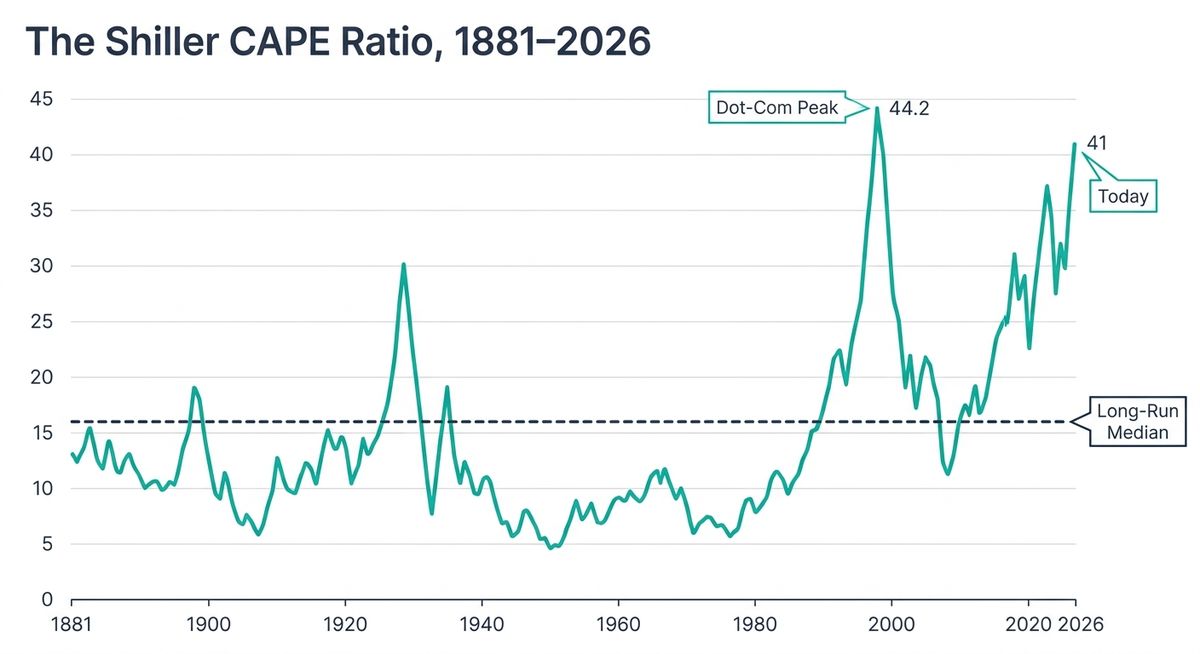
- With the Shiller CAPE near 41 — roughly the 98.8th percentile of market history — plan on lower returns than the last decade delivered, and build a plan that doesn't need heroic ones.
- Margin debt hit a record $1.53 trillion in June 2026. Borrowed money doesn't shrink when your portfolio does, and that asymmetry is what turns a bad year into a ruined retirement.
- Married 65-year-olds withdraw just 2.1% a year on average against a 3.9%–5.7% safe range — most retirees have permission to spend more than they're spending.
- Over 60% of generational wealth transfers fail from silence and broken trust, not bad investments or taxes. The conversation matters more than the estate plan.
Bottom line: build the buffer, calculate your real number, and have the conversation while you're still around to have it.
Part 1 wrapped up on compounding and patience and the quiet math that turns a modest monthly transfer into real retirement savings over thirty years. That math is generous. Set the contributions on autopilot and it mostly does the work while you're off living your life.
The math of losing it all is a different animal.
Here's the part nobody prints in the brochure: the skills that build wealth and the skills that keep it are pretty much opposites. Building rewards optimism, concentration, a little bit of swagger. Keeping rewards paranoia, backup plans, and being willing to look boring for years on end. You get one shot at that handoff, and it usually shows up in your late fifties or early sixties, right when the urge to press down harder on the gas is loudest.
So let's be clear about the two kinds.
Fragile Wealth
- A big number sitting on top of a high burn rate
- Some borrowed money against it
- A lifestyle that looks paid off but isn't
- No cash anywhere
Resilient Wealth
- A smaller number, but low fixed costs
- Zero margin debt
- Two to three years of spending parked somewhere safe
- Total control of your own calendar
When markets are ripping, fragile wealth looks like the genius move. In a 30% drawdown, resilient wealth is the only one still standing. These next 25 pieces of wisdom are about building the second kind.
Part I: Intrinsic Value and Market Gravity
"Price is what you pay. Value is what you get."
Buffett's most quoted line is also the one people get wrong most often. He's not telling you to buy cheap stuff. An expensive asset can be a steal if the cash flows behind it keep growing, and a three-dollar stock can be worth exactly nothing. The question was never "what does this cost?" It's "what is this going to produce, and what am I paying for that production?"
Which brings me to the number that defines investing in 2026. The Shiller CAPE ratio, which stacks the S&P 500's price against ten years of inflation-adjusted earnings, is sitting near 41. The long-run median going back to 1881 is about 16.
The Number Behind the Headline
A CAPE of ~41 puts us in roughly the 98.8th percentile of 1,749 months of market history. Only about twenty months have ever read higher, and every one of them landed in 1999, 2000, or this year. The dot-com peak topped out at 44.2 in December 1999, and the index proceeded to lose close to half its value over the next two and a half years.
As Benjamin Graham put it:
"In the short run, the market is a voting machine, but in the long run, it is a weighing machine."
CAPE is the weighing machine, and right now it's reading heavy.
But read this next bit carefully, because it's the difference between useful thinking and expensive panic: valuation tells you about the next ten years, not the next twelve months. CAPE has been elevated for most of the last decade. My buddy Dave sold out on this exact logic in 2017 and he's still a little sore about what he missed. The honest translation isn't "get out." It's "plan on lower returns than the last ten years handed you, and build something that doesn't need heroic returns to work."
For a 62-year-old, that has real teeth. It means your withdrawal rate assumption matters more than your stock picks. It means a sequence-of-returns cushion isn't a nice-to-have. And it means the best investment available to you might not be in the market at all.
Franklin's line usually shows up on graduation cards:
"An investment in knowledge pays the best interest."
But with a decade of earning life left it's an actual tactic. Upgrading a credential, picking up a consulting skill, getting genuinely fluent in how taxes work: those pay off in ways no asset class can promise. Learning how qualified charitable distributions work is worth more to a 72-year-old with a big IRA than another percentage point of stock exposure, and unlike the stocks, it can't lose. We'll get to the exact numbers in Part IV.
Part II: Asymmetric Risk, Debt, and the Margin of Safety
Charlie Munger's line is the most-repeated joke in finance, and almost nobody repeats the punchline:
"There are only three ways a smart person can go broke: liquor, ladies, and leverage."
On CNBC's Squawk Box back in February 2018, Buffett quoted his partner's line and then took it apart on the spot: "Now the truth is, the first two he just added because they started with L. It's leverage." Then he said the thing that should be taped to every brokerage screen: "There's just no reason to borrow money except you're in a hurry to get rich and you're risking going broke."
The alliteration is the bit. The warning is one word.
And in 2026 it isn't theoretical. FINRA margin debt hit a record $1.53 trillion in June, up 51.5% year over year, then dropped 5.7% in July to roughly $1.4 trillion. One wealth management firm points out that every major equity peak of the modern era came with a record in margin debt followed by a sharp rollover, though that's an analyst's take rather than independent research, so take it as such. The mechanism, though, isn't up for debate.
What Margin Actually Does to a Bad Year
Picture a 63-year-old with a $1.2 million portfolio who borrows $200,000 on margin to juice his returns heading into retirement. His exposure is now $1.4 million. A 25% market decline drops the account to $1.05 million, but the loan doesn't shrink an inch. His own money falls to $850,000 — a 29% loss, not 25% — and margin interest is ticking the whole time.
Push it to the legal max and the failure mode goes from painful to over. Regulation T lets him borrow dollar for dollar, so $1.2 million becomes $2.4 million of exposure. At a typical 30% maintenance requirement, a decline of just under 30% triggers a margin call. He doesn't get to pick when he sells — he gets liquidated at the bottom, and a temporary decline becomes a permanent one. That's the whole difference between a rough year and a ruined retirement.
Nathan W. Morris said it plainly:
"Every time you borrow money, you're robbing your future self."
For folks reading this, the future self already showed up and he's on a fixed income. About 97% of Americans aged 66 to 71 carry some non-mortgage debt, though the median balance is a very manageable $11,349. Average total debt for ages 65 to 74 runs near $135,000 including mortgages, but the median is $45,000, and that gap is almost entirely housing.
Housing is where things have genuinely gotten worse.
| Metric | Then | Now |
|---|---|---|
| Homeowners 65–79 still carrying a mortgage | 24% (1989) | 41% (latest Fed survey) |
| Median mortgage balance (comparable dollars) | $21,000 | $110,000 |
| Average credit card APR (accruing interest) | — | ~22% (Q2 2026) |
| Average Social Security increase, Jan 2026 | — | 2.8% (~$56/mo) |
Credit cards accruing interest averaged about 22% APR in the second quarter of 2026, which is a guaranteed negative return no portfolio can outrun. Social Security went up 2.8% in January 2026, adding roughly $56 a month to the average benefit. The mortgage payment did not send a thank-you note.
Which brings up the question I get more than any other: pay off the mortgage before retiring, or don't? The math answer is that a 3% mortgage is cheap money and a 7% one isn't. The structural answer usually wins anyway. Paying off the mortgage turns a fixed obligation into a flexible one, and that's the single most valuable trade you've got once your income stops being negotiable. If clearing it would drain your liquidity buffer, don't. Otherwise, the peace of mind is real and it's not irrational.
Franklin again, and this one's about control, not arithmetic:
"He who goes a borrowing goes a sorrowing."
Debt gives a third party a vote in your decisions. It turns a flexible expense into a contractual one, which is exactly the wrong direction to be heading when your income goes fixed. Rule: walk into retirement with no revolving debt and a cost structure you could cover on Social Security plus a 3% withdrawal.
Gen. George S. Patton's answer to overthinking it:
"A good plan violently executed now is better than a perfect plan next week."
The answer to all of this is not more studying. Morningstar's Mind the Gap 2026 found the average dollar in US funds and ETFs earned 8.7% a year over the decade ending December 2025, against 9.9% for the funds themselves. That's a 1.2 point behavior gap. (A 2026 Financial Analysts Journal paper picks apart the methodology behind the bigger versions of this claim, so treat 1.2 as the defensible number, not the scary ones.) Target-date fund investors captured over 98% of their funds' returns, mostly because there was nothing in there to fiddle with. This isn't an intelligence problem. It's a fiddling problem.
As Buffett put it:
"Cash combined with courage in a time of crisis is priceless."
Berkshire Proved Both Halves
Cash and Treasury bills peaked at a record $397.4 billion on March 31, 2026 — the first quarter with Greg Abel running the show, capping fourteen straight quarters as a net seller of stocks. Then in Q2 they bought $23.5 billion of equities against $3.7 billion sold, repurchased $4.5 billion of their own shares, and finished the quarter around $365 billion. Streak over.
Read the sequence, not the snapshot. That cash pile was never a prediction of a crash. It was optionality, held until it was worth using, and then used decisively. That's what a buffer is for.
For a retiree, the version of this is mechanical, not philosophical. Morningstar's Christine Benz puts it about as plainly as it can be put: the cash bucket exists so you never have to sell stocks under duress. Schwab suggests roughly one year of living expenses in cash after Social Security and pensions, plus two to four years in high-quality short-term bonds. That two-to-four isn't a number somebody pulled out of the air. From the 1960s through 2023, the average peak-to-peak recovery for a diversified stock index in a bear market ran about three and a half years. The buffer is sized to outlast the average hole.
This matters most in what people call the retirement risk zone: the five years before and five years after your last paycheck, when a bad run of returns does damage that a great decade later can't undo. Morningstar's 2026 base case for a safe withdrawal rate is 3.9%, up from 3.7% last year, assuming a 30-year retirement, a 30% to 50% stock allocation, and a 90% success probability. That's a base case, not your case. You can run these numbers for your own situation at ReadyAimRetire.com instead of borrowing someone else's assumptions about your allocation, your timeline, or your spending.
Housel's framing is the design brief for everything above:
"The trick is arranging your financial life in a way that a bad investment here and a missed financial goal there won't wipe you out."
Build it so no single mistake is fatal. There's an African proverb that says the same thing in six words. Never test the depth of the river with both feet. Don't put everything on one bet, one employer, one property, one venture.
Buffett again, on diversification:
"Diversification is protection against ignorance. It makes very little sense for those who know what they're doing."
That one gets picked up and swung around by people who've badly misjudged which category they're in. Read it as a self-awareness test instead. Almost no individual investor knows more about a company than the institutions on the other side of the trade. If you can't say out loud what you know that the market doesn't, diversify. Same goes for concentration you didn't choose on purpose: employer stock, a single rental property, one adult kid's business. Never risk what you need to get something you merely want.
Part III: The Ultimate Dividend (Autonomy, Time, and Enough)
"Controlling your time is the highest dividend money pays."
Housel stretches the idea out elsewhere: being able to do what you want, when you want, with whom you want, for as long as you want, is the highest dividend that exists in all of finance. It's also the one that never shows up on a brokerage statement.
That invisibility is the whole point of his companion line, "Wealth is what you don't see." Wealth is the cars you didn't buy, the clothes still on the rack, the first-class upgrade you passed on. It stops being wealth the second you turn it into something visible, because then it's just stuff. Which is why the novelist Margaret Bonanno's version lands so well: "Being rich is having money; being wealthy is having time." The surgeon pulling 80 hours a week with a boat payment is high-income and time-poor. That's rich. That's not wealthy.
Chris Rock put it more bluntly:
"Wealth is not about having a lot of money; it's about having a lot of options."
Options are the practical version of the dividend. Walking away from a toxic job. Moving near the grandkids. Taking six months off to care for your spouse without the decision coming down to money. Tennessee Williams supplies the deadline: "You can be young without money, but you can't be old without it." Physical energy and career runway decline on a schedule, which is why front-loading your savings isn't a moral lecture. It's logistics.
And now the finding that should actually change how some of you behave. Research by David Blanchett and Michael Finke, published in Financial Planning Review, found that married 65-year-olds with at least $100,000 saved withdraw just 2.1% a year. Singles pull about 1.9%. Roughly a quarter of retirees actively cut their spending. Meanwhile Allianz Life's 2026 study found 67% of Americans are more worried about running out of money than about dying, a record, up from 57% in 2022.
What They're Withdrawing
A couple with $1.5 million withdrawing 2.1% is spending $31,500 a year — living exactly like a couple with $790,000.
What They Could Withdraw
Morningstar's flexible, guardrails-based approach could support as much as 5.7% — nearly triple the spending, on the same portfolio.
These folks have enough several times over and they can't feel it. Every retirement plan is different, and the gap between 2.1% and 5.7% is exactly the kind of thing worth testing against your own numbers rather than someone else's average. ReadyAimRetire lets you see how those guardrails actually play out against your own portfolio and spending.
Tim O'Reilly's line captures it:
"Money is like gasoline during a road trip. You don't want to run out, but you're not doing the trip just to visit gas stations."
That's the diagnosis right there. They're taking the road trip to admire the fuel gauge.
And the inflation fear driving all of it is overstated too. J.P. Morgan looked at de-identified spending data from more than five million Chase households and found retirees don't ramp spending up with inflation. Total spending trends down 5% to 8% every five years, falling more than 30% between ages 60 and 85 before flattening out in the late eighties. The categories cancel each other: healthcare climbs while transportation, dining out, and clothing all drop.
Plato said it plainly. Seneca sharpened it. Epictetus made it a rule:
"The greatest wealth is to live content with little."
"It's not the man who has too little, but the man who craves more, that is poor."
"Wealth consists not in having great possessions, but in having few wants."
People file these under philosophy. For this crowd they're arithmetic. Every $1,000 of annual spending you cut permanently drops the portfolio you need by roughly $25,000 to $30,000, using Morningstar's 3.3% to 4.0% safe-rate range. No investment return does that reliably. Lowering the bar is the only guaranteed way to clear it.
But run it in both directions, because the Stoics argued against craving, not against living. A retiree hoarding at 2.1% out of fear isn't practicing Seneca's contentment. They're practicing his poverty.
Part IV: Generational Stewardship and Purpose
There's an old saying, and it isn't subtle:
"Shirtsleeves to shirtsleeves in three generations."
The Williams Group studied 3,250 families over 25 years and found roughly 70% of wealthy families lose the money by the second generation and 90% by the third. Some researchers think those figures are overstated, and honestly the trend matters more than the decimals. But almost every article that cites this stat leaves out the part that actually helps you.
| Cause of Wealth Transfer Failure | Share of Failures |
|---|---|
| Breakdown of trust and communication in the family | 60%+ |
| Heirs never prepared | ~25% |
| Investment or tax problems | Under 5% |
Read that again. The lawyers and the accountants account for less than one twentieth of the failures. The estate that falls apart is usually structured beautifully and explained to nobody, and the kids learn the terms at the reading. No trust document fixes that. Only a conversation does, and a good one covers three things: what you own and where it's written down, who's responsible for what and why you picked them, and what you hope the money is for. That third one is the thing families skip, and it's the thing that decides whether the first two survive.
The timing isn't abstract either. Cerulli projects $124 trillion transferring through 2048, $105 trillion of it to heirs, though estimates run anywhere from $36 trillion to $124 trillion depending on how you count. Heirs are already receiving roughly $2.5 trillion a year, projected to pass $3 trillion by 2030. Most of the coverage of the Great Wealth Transfer talks to the people receiving it. If you're reading this, you're on the giving side, and your window is open right now.
John C. Maxwell's rule:
"A budget is telling your money where to go instead of wondering where it went."
Give every dollar a job before the month starts, and give the retirement years their own assignments too. J.P. Morgan found 60% of new retirees see annual expenses swing by more than 20% in the first three years, driven by travel, relocation, and healthcare. That swing is predictable, which means it should be a funded sinking fund instead of a moment of panic.
2026 Contribution and Distribution Numbers
- 401(k) limit: $24,500
- 401(k) catch-up: $8,000 (ages 50–59 and 64+)
- SECURE 2.0 super catch-up: $11,250 (ages 60–63) — see the SECURE 2.0 super catch-up rules
- IRA limit: $7,500, plus $1,100 catch-up
- RMDs begin: age 73
One change catches people off guard: starting in 2026, if your prior-year wages from that employer topped $150,000, your catch-up contributions have to go in on a Roth basis. Same dollars, different tax treatment, and worth running the numbers before December.
Buffett again:
"Someone's sitting in the shade today because someone planted a tree a long time ago."
And then the one that needs a footnote:
"We make a living by what we get. We make a life by what we give."
That attribution — commonly pinned on Winston Churchill — is almost certainly wrong, and in an article about inherited wisdom, the footnote is the lesson. The International Churchill Society files it under quotes falsely attributed to Churchill, noting that a search of more than 2.5 million words by and about the man turns up nothing. Quote researchers trace the earliest version to a 1944 newspaper column, and the habit of reassigning it to Norman MacEwan has no evidence behind it either. The sentiment is solid. The provenance is made up. Things get passed down unexamined all the time, which is exactly the problem with wealth transfer too.
William A. Ward's sequence has a very specific 2026 mechanism attached to its last clause:
"Before you spend, earn. Before you invest, investigate. Before you retire, save. Before you die, give."
The Qualified Charitable Distribution (QCD)
Anyone 70½ or older can send up to $111,000 straight from an IRA to a 501(c)(3) — or $222,000 for a married couple filing jointly. It's excluded from income rather than deducted, so it works even if you don't itemize, and it can satisfy your required minimum distribution. Donor-advised funds and private foundations don't qualify. Deadline is December 31.
The 2026 tax rules made this a lot better. New law puts a 0.5%-of-AGI floor on itemized charitable deductions and caps the value of itemized deductions at 35% for top-bracket taxpayers. Because a QCD never touches your AGI at all, it walks right past both. For a retiree over 70½ with a taxable IRA, the QCD is now the most tax-efficient charitable dollar on the board, by a wider margin than it was last year.
If you're withdrawing at 2.1% and taking RMDs you don't need, this is the cleanest way to turn surplus capital into purpose that exists.
The Synthesis: Build for Survival, Spend for Freedom
Both halves of this series point at the same conclusion. Money is a tool for autonomy and generosity. It is not a scoreboard, and it is definitely not a measure of your worth as a person. The people who get this build financial lives that survive anything, and then they actually go use them.
Four Moves, in Order
- Audit your fragility this month. Write down every dollar of debt, every margin balance, and every position over 10% of your net worth. Kill the leverage first, the 22% APR debt second, the concentration third.
- Build the buffer before you need it. One year of expenses in cash beyond your guaranteed income, plus two to four years in short-term bonds, sized to outlast that three-and-a-half-year average bear market recovery. This exists so you never sell stocks into a decline, and with CAPE near 41 that's not a hypothetical worry.
- Calculate your real number, then give yourself permission. If you're withdrawing at 2.1% against a 3.9% fixed-rate baseline or a 5.7% flexible one, that's not prudence. That's underspending a life. Fund the early-retirement volatility on purpose and plan for the decline that reliably follows.
- Have the conversation. Under 5% of generational wealth failures trace back to investments or taxes. Over 60% trace back to silence. Tell your heirs the plan, the reasoning, and the values behind it while you're still here to answer questions.
Fragile wealth needs the market to cooperate. Resilient wealth doesn't care what the market does, because the market was never the point.
Plant the tree.
Thanks for reading if you've made it this far. Peace!