

The New IRS Rules for Retirees & Pre-Retirees: Every 2027 Tax Bracket, Contribution Limit, and Loophole You Need to Know


Let me tell you about two couples. They're hypothetical, and they make the point nicely. Both are 66. Both collect $50,000 a year in Social Security. And both need another $108,000 to live on in 2027. Under the IRS 2027 retirement rules, their tax bills can look nothing alike.
- The 401(k) deferral limit rises to $25,500, or $34,000 at 50+ and $37,250 at ages 60 to 63. The IRA limit stays at $7,500, plus a $1,100 catch-up.
- If you earned more than $155,000 in FICA wages in 2026 from your plan's employer, your 2027 catch-ups must be Roth.
- A married couple, both 65+, can deduct up to $48,600. The senior deduction starts phasing out above $150,000 of MAGI ($75,000 for single filers).
- For married joint filers, the 0% long-term capital gains rate applies up to $102,100 of taxable income.
- Where your money comes from matters. In our example, one couple owes about $11,723 in federal income tax and the other owes $0.
Action: Update your 401(k) payroll election before your first January paycheck, and plan which accounts your 2027 withdrawals will come from.
Let's call the first pair Linda and Tom. They pull their $108,000 out of a traditional IRA. Their federal income tax comes to about $11,723.
The second pair, Maria and Joe, sell $108,000 of investments they've held for years in a regular taxable brokerage account. Even if every single dollar of that sale is long-term gain, their federal income tax is $0.
Zero. Same age. Same Social Security. Same withdrawal. The only difference is which account the money came out of.
If that gap looks like a typo, I get it. It isn't. I'll walk you through the exact math later, I promise.
This retiree and pre-retiree tax guide is about how that gap happens. I'm going to cover every 2027 IRS number that matters if you're 50 or older, from the new contribution limits to the temporary senior deduction. Then I'll show you how to stack them so more of your money stays yours.
The Big Picture: Why the IRS 2027 Retirement Rules Change the Math
Good news first: the seven federal tax rates haven't budged. They're still 10%, 12%, 22%, 24%, 32%, 35% and 37%. What changed is where each one kicks in. For 2027 the IRS widened the brackets by about 3.2%, bumped up the standard deduction and raised most workplace contribution limits.
Here's the thing, though. Those higher limits only help you if you actually do something about them:
- Your payroll election probably won't update itself. If a percentage or dollar amount maxed you out in 2026, it may fall short in 2027. Say David, a hypothetical 55-year-old, put in the full $32,500 in 2026 using a flat amount from each paycheck. If he leaves that amount alone, he'll finish 2027 $1,500 short of the new $34,000 limit.
- New mandatory Roth rules change how higher earners make catch-up contributions.
- The order you pull money out in matters more than ever. Deductions, brackets and phase-outs now bump into each other in ways that can wipe out your tax bill or quietly push it up.
We'll start with the folks who are still saving, then get to withdrawals.
2027 401(k) Contribution Limits and Catch-Up Rules
| 401(k), 403(b), TSP, governmental 457(b) | 2026 | 2027 |
|---|---|---|
| Employee deferral | $24,500 | $25,500 |
| Age 50+ catch-up | $8,000 | $8,500 (total $34,000) |
| Ages 60-63 "super catch-up" | $11,250 | $11,750 (total $37,250) |
| Combined employee + employer cap (catch-ups go on top) | $72,000 | $75,000 |
Wondering whether your balance is on track? Compare it with these 401(k) savings targets by age. A benchmark is only a starting point, so you may also want to run projections with your own numbers at ReadyAimRetire.com.
The super catch-up contribution for ages 60 to 63
Of all the SECURE 2.0 retirement changes, this might be my favorite. It gives you a four-year window where you can save $3,250 a year more than the regular catch-up allows. Your age is measured on December 31. So if you turn 60 in December 2027, you get the full $11,750 for the year. If you turn 64 at any point in 2027, you drop back to $8,500.
Picture Rosa, a hypothetical saver who turns 60 in March 2027. That's a birthday worth circling on the calendar like it's a party, because she gets the full $11,750 for the year. Which, honestly, kind of is a party.
The window is short. Use it while you're in it.
2027 IRA Contribution Limits: Holding at $7,500
Traditional and Roth IRA limits stay put at $7,500, plus a $1,100 catch-up once you're 50, for $8,600 total. Both numbers are the same as 2026.
Why no bump? IRA limits are tied to something called chained CPI-U, and they can only go up in $500 steps. Inflation over the past year just wasn't enough to get it to $8,000. Maybe next year.
Don't sleep on the spousal IRA, either. If one spouse has little or no earned income, they can still fund their own IRA using the working spouse's earnings. You have to file jointly, and the working spouse has to earn at least as much as you're contributing for both of you. So if one of you has retired and the other is still working, that's another $8,600 you can shelter.
2027 HSA Contribution Limits
- $4,500 for self-only coverage, $9,000 for family coverage
- $1,000 catch-up at 55+. If both spouses qualify, each one has to put their catch-up into their own HSA. (Yes, that means two accounts. I didn't make the rules.)
I'll say it plainly: the HSA is the only account with a triple tax advantage. Contributions are deductible, growth is tax-free, and withdrawals for medical costs are tax-free. Two rules matter as you get close to 65:
- Medicare ends your ability to contribute, and that includes retroactive coverage. If you enroll after 65, Part A coverage gets backdated up to six months. And claiming Social Security automatically enrolls you in Part A. So stop HSA contributions six months before you apply, or you could get hit with a 6% excise tax on the excess. In the year Medicare starts, your limit is prorated by month.
- Your balance keeps working for you. Medical withdrawals stay tax-free for life. That includes Medicare Part B, Part D and Medicare Advantage premiums (but not Medigap). After 65, non-medical withdrawals no longer carry the 20% penalty. They're just taxed as ordinary income.
2027 Solo 401(k) and SEP IRA Limits
If you work for yourself, the overall cap goes up to $75,000 and the compensation cap to $375,000. SIMPLE IRA deferrals rise to $17,500, or $19,100 at small employers that use SECURE 2.0's higher limit. SIMPLE catch-ups hold at $4,000 at 50+ ($3,850 in certain plans) and $5,250 at ages 60 to 63.
Here's a detail that's easy to miss: SEP IRAs don't allow catch-up contributions. A Solo 401(k) does, which lifts its ceiling to $83,500 at 50+ or $86,750 at ages 60 to 63.
Take Marcus, a hypothetical 61-year-old consultant with $200,000 of net self-employment income. With a SEP IRA, he tops out at about $37,174. That's 20% of his net earnings after deducting half of self-employment tax. With a Solo 401(k), he gets that same employer contribution plus the $25,500 deferral and the $11,750 super catch-up, for about $74,400.
Same income. Twice the shelter. And because a sole proprietor like Marcus has no FICA wages, the Roth catch-up rule I'll get to below doesn't apply to him.
The 2027 Saver's Match: Free Federal Money, With Conditions
Starting with 2027 contributions, the Saver's Match replaces the old Saver's Credit, and it's a nice upgrade. If you're eligible, the Treasury matches 50% of the first $2,000 you put in, so up to $1,000 lands right in your retirement account. You have to be 18 or older, not a full-time student, and not claimed as someone else's dependent.
| Filing status (MAGI) | Full 50% match | No match at or above |
|---|---|---|
| Single | $20,500 or less | $35,500 |
| Head of household | $30,750 or less | $53,250 |
| Married filing jointly | $41,000 or less | $71,000 |
Between those two numbers, the match shrinks gradually. For example, a single filer with $28,000 of income gets a 25% match, or $500 on a $2,000 contribution.
Know the strings attached before you count on it
- You claim it on Form 8880-A with your 2027 return. The deposits start showing up in 2028.
- It can't go into a Roth IRA. It can go into a traditional IRA or the pre-tax side of a workplace plan, but providers don't have to accept it. Ask yours.
- Retirement withdrawals can shrink it. Distributions during a "testing period" reduce the contributions that count. For the 2027 match, that period covers 2025, 2026, 2027 and the time up to your filing deadline, including extensions. So if you're working part-time while drawing from an IRA, you may get little or nothing.
- The rules aren't final yet. So far Treasury has only put out a notice of intent (Notice 2026-48), so details could still change.
Critical New Rules and Traps to Watch
Mandatory Roth catch-up contributions for higher earners
If you earned more than $155,000 in FICA wages in 2026 from the employer that sponsors your plan, all of your 2027 catch-up contributions have to go in as Roth. No upfront deduction. 2026 was a good-faith transition year, but the final regulations become mandatory on January 1, 2027.
Whether this applies to you comes down to the details:
- Look at W-2 Box 3 (Social Security wages), not Box 1. Box 3 includes your pre-tax 401(k) deferrals, so it's usually the bigger number.
- The test is per employer, not per household. Your spouse's pay doesn't count.
- Self-employment income without FICA wages doesn't count. But S-corp owners who pay themselves more than $155,000 in W-2 wages are covered.
- New hires get a pass. If you had no 2026 wages from that employer, the rule doesn't apply to you in 2027.
- If your plan has no Roth option, you can't make catch-ups at all. This only applies to employees the rule covers. Ask HR now, not next December.
Income phase-outs and the backdoor Roth IRA for 2027
| 2027 MAGI phase-out range | Single | Married filing jointly |
|---|---|---|
| Traditional IRA deduction (you're covered at work) | $83,000 to $93,000 | $133,000 to $153,000 |
| Traditional IRA deduction (only your spouse is covered) | n/a | $250,000 to $260,000 |
| Direct Roth IRA contribution | $158,000 to $173,000 | $250,000 to $260,000 |
If you earn too much to contribute to a Roth directly, the backdoor Roth IRA still works. You make a non-deductible traditional IRA contribution, report it on Form 8606, then convert it to a Roth. It sounds like a loophole because, well, it kind of is.
The catch: the pro-rata rule
The catch is the pro-rata rule. The IRS treats any conversion as a proportional slice of all your traditional, SEP and SIMPLE IRA money, pre-tax and after-tax lumped together, measured on December 31 of the year you convert.
Say you've got $91,400 sitting in a pre-tax rollover IRA and you add an $8,600 non-deductible contribution. Then 91.4% of whatever you convert is taxable. Ouch. If your 401(k) accepts roll-ins, moving that pre-tax IRA money into it before year-end gets you around the problem.
Deadlines and employer match "true-ups"
401(k) deferrals have to come out of your paychecks by December 31. IRA and HSA contributions for 2027 can be made up to the 2028 filing deadline.
Fun calendar fact: April 15, 2028 falls on a Saturday. Washington, D.C.'s Emancipation Day holiday is observed the following Monday, so the deadline should be Tuesday, April 18, 2028. Double-check it on IRS.gov before you count on those extra days.
Now, if you like to front-load your contributions, keep an eye on your match. Here's how it can go sideways. Say you're 55 and earn $200,000. Your employer matches 100% of the first 4% of pay ($8,000 a year), calculated each paycheck. You put 40% of every biweekly paycheck into the plan so you hit $34,000 fast.
You'll hit the limit on your 12th paycheck and collect only about $3,500 of match. Unless your plan does a year-end true-up, you leave roughly $4,500 of employer money on the table.
The Account Stacking Blueprint: How a Couple Over 50 Can Shelter About $100,000 a Year
Real talk before this section. I know $100,000 a year is more than most households will ever be able to save, and I feel a little weird putting that number in a headline. But if you're in a position to do all of it, or even part of it, here's how the pieces fit together.
Here's what a married couple who are both 55 or older can put away in 2027, before counting a single dollar from an employer:
| Account | 2027 amount |
|---|---|
| Two 401(k)s with $8,500 catch-ups (2 x $34,000) | $68,000 |
| Two backdoor Roth IRAs (2 x $8,600) | $17,200 |
| Family HSA plus two $1,000 catch-ups (each in its own HSA) | $11,000 |
| Total | $96,200 |
Add a typical employer match and the household sails past $100,000. If both spouses are 60 to 63, the super catch-up alone pushes the total to $102,700.
Two caveats:
- The HSA amount requires family coverage under an HSA-eligible high-deductible health plan.
- If either spouse earned more than $155,000 in FICA wages in 2026, that spouse's catch-up has to go in as Roth.
Where to put your next dollar
- Pay off high-interest debt and build an emergency fund. Not glamorous. Still first.
- Contribute to your 401(k) up to the full employer match, and grab the Saver's Match if you're eligible. Free money is free money.
- Max out your HSA if you're on an eligible high-deductible health plan.
- Max out a Roth IRA, or use the backdoor if your income is too high.
- Go back to your 401(k) and fill the rest of the limit. If your plan allows after-tax contributions and in-plan conversions, add a Mega Backdoor Roth on top.
Saving is only half the job. The other half is getting your money back out without overpaying the IRS, and that takes smart retirement tax planning strategies. And honestly? That's where 2027 gets really interesting for retirees.
Ready to run your own numbers?
Create a ReadyAimRetire account to build and save your own retirement plan, and see how it stacks up.
Build Your Plan →2027 Tax Brackets and Deductions for Retirees
| Rate | Married filing jointly (taxable income over) | Single | Head of household |
|---|---|---|---|
| 10% | $0 | $0 | $0 |
| 12% | $25,600 | $12,800 | $18,250 |
| 22% | $104,050 | $52,025 | $69,650 |
| 24% | $218,250 | $109,125 | $109,100 |
| 32% | $416,650 | $208,325 | $208,300 |
| 35% | $529,100 | $264,550 | $264,550 |
| 37% | $793,650 | $661,375 | $661,350 |
The 2027 standard deduction over 65: up to $48,600 per couple
The base standard deduction goes up to $33,200 (married filing jointly), $16,600 (single) and $24,925 (head of household). Once you hit 65, two more deductions stack on top:
| Deduction | Married, both 65+ | Single, 65+ |
|---|---|---|
| Base standard deduction | $33,200 | $16,600 |
| Extra age 65+ deduction | $3,400 ($1,700 each) | $2,100 |
| Senior deduction (2025-2028) | $12,000 ($6,000 each) | $6,000 |
| Total | $48,600 | $24,700 |
To claim the senior deduction, you need a valid Social Security number and you have to be 65 by December 31, 2027. Married couples have to file jointly, and only spouses who are 65 or older count, so it's $6,000 if just one of you qualifies. And you can claim it even if you itemize.
The senior tax deduction trap: a hidden tax increase
This is the part I think catches a lot of people off guard.
The senior deduction shrinks by 6 cents for every dollar of modified AGI above $75,000 (single) or $150,000 (married filing jointly). It's gone completely at $175,000 (single) or $250,000 (married). For couples, each spouse's $6,000 shrinks separately, so together they lose 12 cents per dollar.
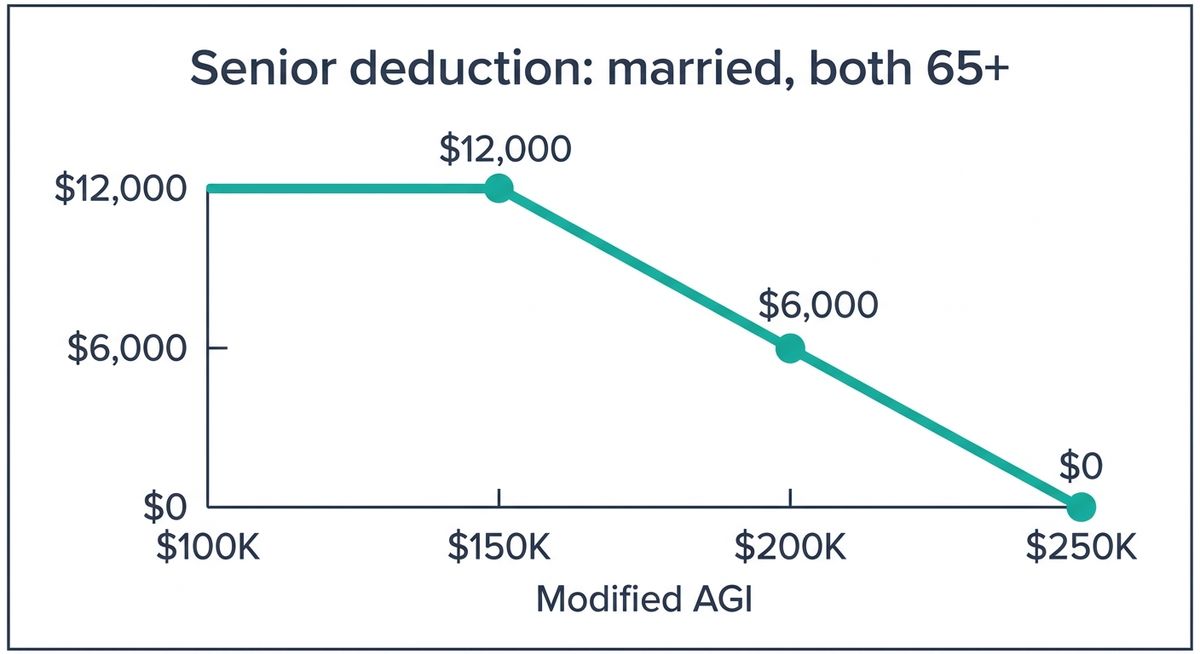
Think of that as a tax rate and it stings. For a couple who are both over 65, each extra dollar of income between $150,000 and $250,000 adds $1.12 of taxable income. If they take the standard deduction, nearly all of that range falls in the 22% bracket, so their real marginal rate is 24.64%.
Single filers lose 6 cents per dollar. Their real rate is 23.32% in the 22% bracket, rising to 25.44% once MAGI passes about $130,500 and the 24% bracket starts. And if part of your Social Security isn't taxable yet, each extra dollar can also make up to 85 cents of benefits taxable, which pushes the real rate even higher.
Here's how that plays out. Picture Frank and Diane, both over 65, with $150,000 of income. 85% of their Social Security is already taxable. They convert $50,000 to a Roth. Because they lose $6,000 of senior deduction, their taxable income goes up by $56,000, and they owe about $12,055 more in federal tax.
That's 24.1% of the conversion, more than the 22% bracket most of it lands in. And watch Medicare. Their $200,000 of MAGI is below the $224,000 joint IRMAA threshold for 2027 premiums, but those premiums are based on 2025 income. Their 2027 income affects 2029 premiums, and those thresholds aren't set yet. A $100,000 conversion or capital gain would also wipe out the full $12,000 deduction.
Two more things to keep in mind:
- The senior deduction doesn't lower your AGI. So it won't reduce the tax on your Social Security, your Medicare IRMAA surcharges or your ACA subsidy calculation.
- It expires after 2028. If your income sits well below the phase-out, the deduction can soak up Roth conversion income cheaply. That makes 2027 and 2028 the last two years to use it for conversions, ideally before required minimum distributions kick in at 73 (or 75 if you were born in 1960 or later). Here's more on when and how to do a Roth conversion.
The zero-tax retirement strategy: the 2027 0% long-term capital gains bracket
| Filing status | 0% rate up to | 15% rate up to | 20% rate above |
|---|---|---|---|
| Married filing jointly | $102,100 | $633,600 | $633,600 |
| Single | $51,050 | $563,200 | $563,200 |
| Head of household | $68,350 | $598,400 | $598,400 |
These thresholds apply to taxable income, meaning after deductions. Add the $33,200 married standard deduction to the $102,100 0% bracket, and a couple under 65 with no other income can realize $135,300 of long-term gains and qualified dividends and pay $0 in federal income tax.
Yep. Zero.
Key Insight: Over 65, the Ceiling Is Higher
If you're both 65 or older, the number's even higher than $135,300. With the full over-65 deductions, a couple's gains stay in the 0% bracket as long as their AGI stays under about $150,625, even after the senior deduction starts to phase out. For a single filer 65+, the ceiling is about $75,700, compared with $67,650 under 65.
How Maria and Joe paid $0
Let's go back to our 66-year-olds from the top.
- Maria and Joe's $108,000 of long-term gains plus $42,500 of taxable Social Security (85% of their benefit, the maximum) gives them an AGI of $150,500.
- That's $500 into the senior deduction phase-out, which trims it by $60. Their deductions total $48,540.
- Taxable income comes to $101,960. Their deductions cover all $42,500 of taxable Social Security, so everything left over is long-term gain. And it sits $140 under the $102,100 top of the 0% bracket.
Linda and Tom, our IRA couple, have the same AGI and the same deductions. But all their income is ordinary income, so the full $101,960 gets taxed at 10% and 12%. Their bill: $11,723.
Maria & Joe: Brokerage
- AGI $150,500
- Total deductions $48,540
- Taxable income $101,960
- Federal income tax $0
Linda & Tom: Traditional IRA
- AGI $150,500
- Total deductions $48,540
- Taxable income $101,960
- Federal income tax ~$11,723
Now, two caveats, because I want to be straight with you. First, Maria and Joe already paid tax on the money they invested. The lesson isn't that taxable accounts beat IRAs. It's that the order you draw from them changes the bill. (Need a refresher on how taxable brokerage, 401(k), IRA, Roth and HSA accounts differ?) Second, IRA money still has to come out eventually through RMDs. The best plans use some years for low-bracket IRA withdrawals or Roth conversions and other years for 0% gains.
The same pattern holds without Social Security. Here's a couple making a $120,000 withdrawal:
| Where the $120,000 comes from | Couple under 65 | Couple both 65+ |
|---|---|---|
| Traditional 401(k) withdrawal | ~$9,904 federal tax | ~$8,056 federal tax |
| Index funds sold from a brokerage account (50% cost basis) | $0 | $0 |
The whole 401(k) withdrawal is taxed as ordinary income. The brokerage sale produces only $60,000 of gain, which fits easily inside the 0% bracket.
Tax-gain harvesting: reset your cost basis for free
This is one of my favorite moves, and the mechanics are simpler than you might expect. In a low-income year, sell investments that have gone up, pay 0% on the gain, and buy them right back. The wash-sale rule only applies to losses, so you don't have to wait 30 days.
Your cost basis goes up, which permanently shrinks the taxable gain when you eventually sell for real. Early retirees in the gap years before Social Security and RMDs start are perfect candidates. (If you're still deciding when to claim Social Security, that choice affects how long your gap years last.) Just remember that the harvested gain still raises your AGI, and that affects ACA subsidies, IRMAA, the senior deduction and state income tax.
The "income stack" rule: why your 0% bracket can disappear
I think of this one like packing a suitcase. Ordinary income goes in first. That includes 401(k) and IRA withdrawals, pensions, Roth conversions, interest and taxable Social Security. Capital gains get packed on top. So when your gains already reach the top of the 0% bracket, each extra dollar of taxable ordinary income pushes a dollar of gains into the 15% rate.
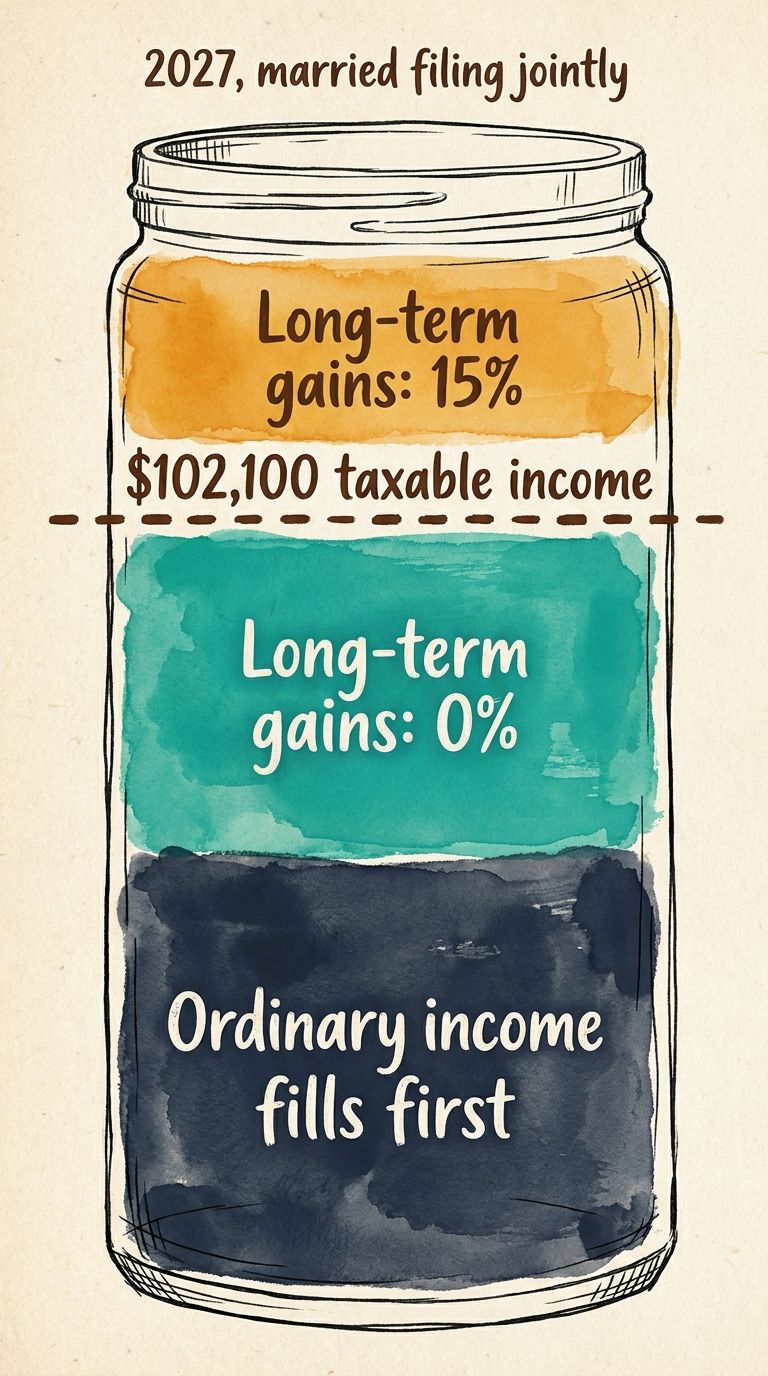
Watch for these other thresholds too:
- State taxes. Many states tax capital gains as ordinary income.
- The ACA subsidy cliff. The enhanced premium credits expired at the end of 2025, so the cliff is back at 400% of the federal poverty level. If you're under 65 and buy marketplace coverage, going one dollar over can cost you thousands in premium credits.
- The 3.8% Net Investment Income Tax applies above $250,000 of modified AGI (married) or $200,000 (single). These thresholds aren't adjusted for inflation.
- Medicare IRMAA surcharges are based on your income from two years earlier. For 2027 premiums, which use your 2025 income, surcharges start above $112,000 of MAGI (single) or $224,000 (joint). Your 2027 income will set your 2029 premiums, and those thresholds aren't set yet.
Qualified charitable distributions: giving straight from your IRA
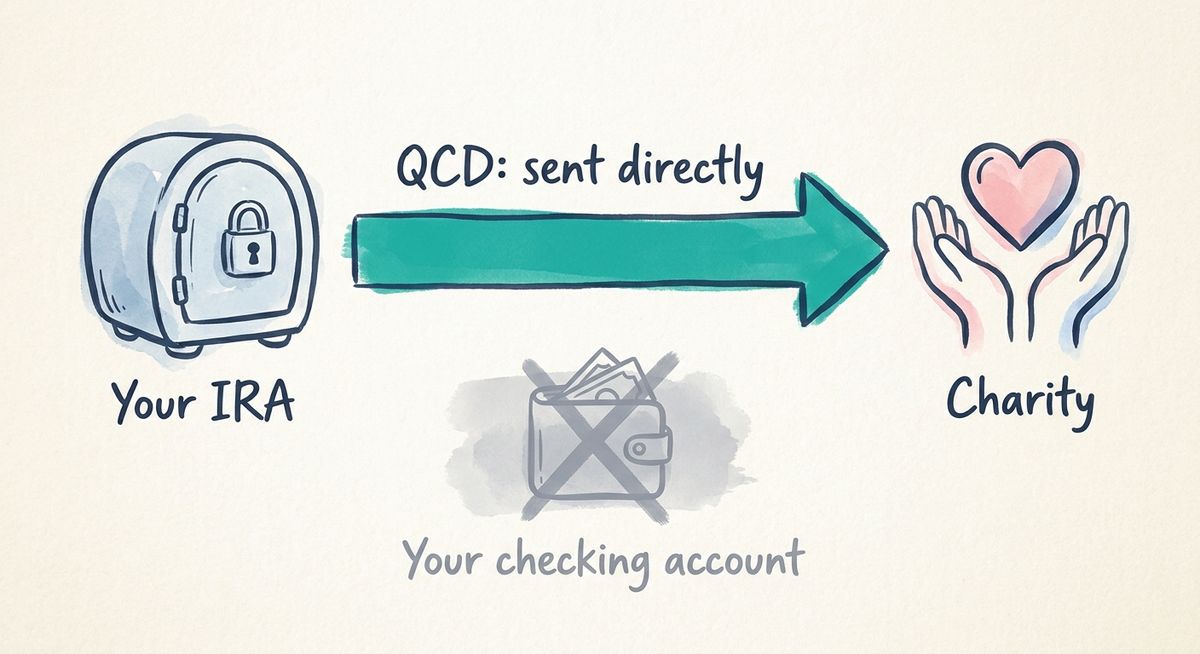
Picture Ray, a hypothetical 74-year-old who writes a personal check to his church every December. If he has his IRA custodian send that gift straight to the church instead, as a qualified charitable distribution, it can count toward his RMD and stay out of his AGI.
How a QCD works
Here's how it works. Once you're 70½, you can send money straight from your IRA to charity as a qualified charitable distribution (QCD), up to $114,000 per person in 2027. That's years before RMDs start. A QCD counts toward your RMD, and unlike a deduction, it never shows up in your AGI.
That makes it one of the few moves that helps with the senior deduction phase-out, the 0% gains bracket, Social Security taxation and IRMAA all at once. A QCD also doesn't depend on itemizing, so you can use it while taking the standard deduction. The money has to go directly from your IRA custodian to the charity, and donor-advised funds don't qualify.
Estate and gifting updates
The annual gift tax exclusion goes up to $20,000 per recipient, or $40,000 for a married couple who split gifts. The lifetime estate and gift exemption is $15.48 million per person, or $30.96 million per couple.
So a couple with three grown kids can move $120,000 a year out of their estate without touching any of that exemption. Make it $240,000 if they also give to each kid's spouse.
Your 5-Minute Year-End and New-Year Action Checklist
Grab a coffee. This won't take long.
🎯 Your Action Steps
- Update your 401(k) payroll percentage before your first January paycheck so you reach $25,500, $34,000 or $37,250. Check it again if you turn 60 or 64 in 2027.
- Check Box 3 of your 2026 W-2, or your final 2026 pay stub. If it's over $155,000, make sure your plan offers a Roth option so you can still make catch-up contributions.
- Ask HR whether your plan does a match true-up before you front-load contributions.
- Finish any 2026 Roth conversions and gain harvesting by December 31. Size them with the senior deduction phase-out, IRMAA and ACA thresholds in mind. Your 2026 income affects 2028 Medicare premiums, and those IRMAA thresholds aren't set yet, so leave some room. For 2026, the 0% gains bracket for couples tops out at $98,900 of taxable income.
- Take any 2026 RMD by December 31. If you're 70½ or older and give to charity, send it as a QCD.
- Plan where your 2027 withdrawals will come from. Decide how much to take from traditional, brokerage and Roth accounts so you fill the 0% gains bracket without going over it.
- Pick a date to stop HSA contributions if you'll start Medicare or Social Security in 2027.
Before you take that RMD, it's worth a look at these common RMD mistakes.
Every retirement plan is different. ReadyAimRetire lets you test how these strategies work with your specific numbers.
Remember Linda and Tom and Maria and Joe? Same Social Security. Same withdrawal. One couple paid $11,723 and the other paid nothing.
The IRS 2027 retirement rules are set. Which couple you end up looking like comes down to the moves you make before that first January paycheck.
Thanks for reading if you've made it this far. I know this was a long one. Peace!
This article is for educational purposes only and is not tax, legal or investment advice. The figures reflect IRS guidance released through November 2026 (Notice 2026-66, Rev. Proc. 2026-35 and Rev. Proc. 2026-24) and may change with future legislation or regulations. Talk to a qualified tax professional about your situation before acting.